

The Remco Jewel Thief: Why This Obscure Figure is a Grail
The Red Ghost of the Remco Aisles
In the crowded landscape of 1980s action figure history, some characters were born to lead franchises, while others were destined to haunt them. Among the pantheon of 5.5-inch legends produced by Remco, none carry the same air of mystery or the staggering market premium as the Jewel Thief.
Originally released under the Conan license and designated simply as “The Enemy,” the Jewel Thief is a striking departure from the bronzed, muscle-bound archetypes of the Hyborian Age. With his vibrant red form and stark, skeletal visage, he was never meant to be the hero of the story—yet, four decades later, he has become the undisputed protagonist of the high-end collector market. This guide explores the biography, the brutal aesthetic, and the extreme scarcity that transformed a $3.26 K-Mart “short-pack” into the ultimate grail of the Remco universe.
The Shadow of the Hyborian Age: A Biography of the Jewel Thief
In the brutal, sun-drenched landscapes of Remco’s Conan line, power is usually measured by the diameter of one’s biceps or the weight of a stone-spiked club. The Jewel Thief exists as the cold, calculating antithesis of this philosophy. While the line is populated by muscle-bound heroes and lumbering monsters, the Jewel Thief—officially designated as “The Enemy”—is a master of the unseen.
Operating from the peripheral shadows of the treasury, the Jewel Thief earned his reputation through precision rather than attrition. While characters like Skullman from the sister Warrior Beasts line announce their presence with a roar of bone and steel, the Jewel Thief is a ghost in the vault. His biography is one of calculated risk; he is a specialist who understood that the true power of the Hyborian gods lay not in their thrones, but in the arcane gems that fueled them.
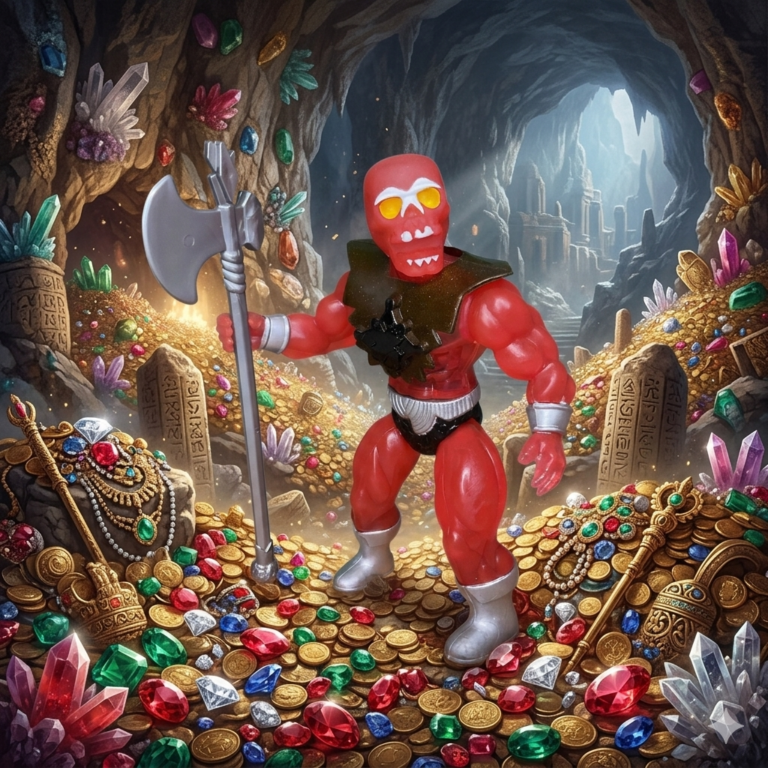
He is the silent variable in the Remco mythos. Despite his lithe, “meat-slab” sculpt, he carries a massive, silver-painted battle axe—a weapon that suggests he doesn’t just slip past guards; he removes them. He is the ultimate predator of the hoard, a character whose primary weapon is his anonymity and whose only goal is the acquisition of the world’s most forbidden treasures.
The Scarcity Principle: Examining the Rarity of the Conan-Era Crossover
To understand the Jewel Thief, one must understand the chaotic production era of 1982–1984. Emerging during a high-stakes transitional period for Remco, the Jewel Thief occupied a precarious manufacturing slot. While Remco was heavily invested in the Conan the Barbarian license, they were simultaneously pivoting to their own in-house Warrior Beasts line to avoid licensing fees. The Jewel Thief exists exactly at the intersection of these two worlds.
As the cardback explicitly states, he was designed to “Play with… Warrior Beasts, Pirates, and other 5.5-inch action figures.” This cross-compatibility was a marketing masterstroke but a production nightmare. Unlike the “anchor” characters like Conan himself, the Jewel Thief saw significantly lower production runs. He was often the “short-packed” figure in shipping cases, meaning for every four Conans that hit the pegs at a retailer like K-Mart, only one Jewel Thief might be available.
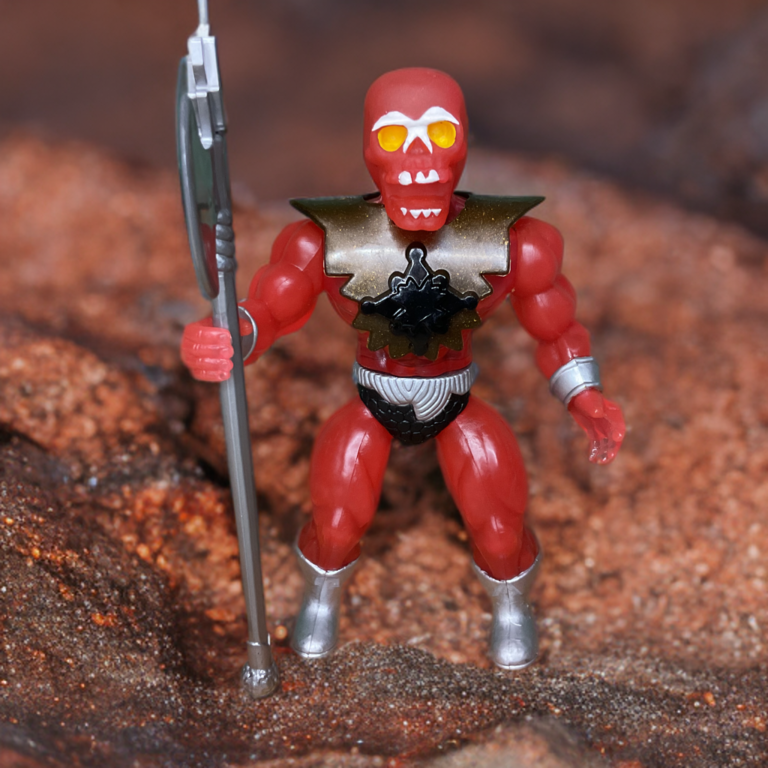
This natural scarcity was compounded by his status as “The Enemy.” In the logic of 1980s play, “Enemy” figures were frequently bought in lower quantities than the heroes, leading to a survivor bias in the modern market. Because he lacked the immediate name recognition of a cinematic character but possessed a far more striking, high-contrast aesthetic than the generic “Beasts,” many were subjected to the rigors of heavy sandbox play. Today, finding a specimen that hasn’t suffered from paint-rub on that vibrant red plastic—or one that still retains its massive, silver-painted battle axe—is one of the most difficult challenges in the 5.5-inch hobby.
Cross-Compatibility
| Feature | Conan Line (Official) | Warrior Beasts | Warlord / Arak | Pirates / Vikings |
| Role | The Enemy | Infiltrator | Chaos Agent | Mercenary |
| Compatibility | Primary | 100% (Peg Fit) | 100% (Peg Fit) | 100% (Peg Fit) |
| Aesthetic Fit | High (Fantasy) | High (Monster) | High (Sword/Sorcery) | Moderate (Raider) |
Aesthetic Distinction: How a Thief Stole the Spotlight from the Barbarians
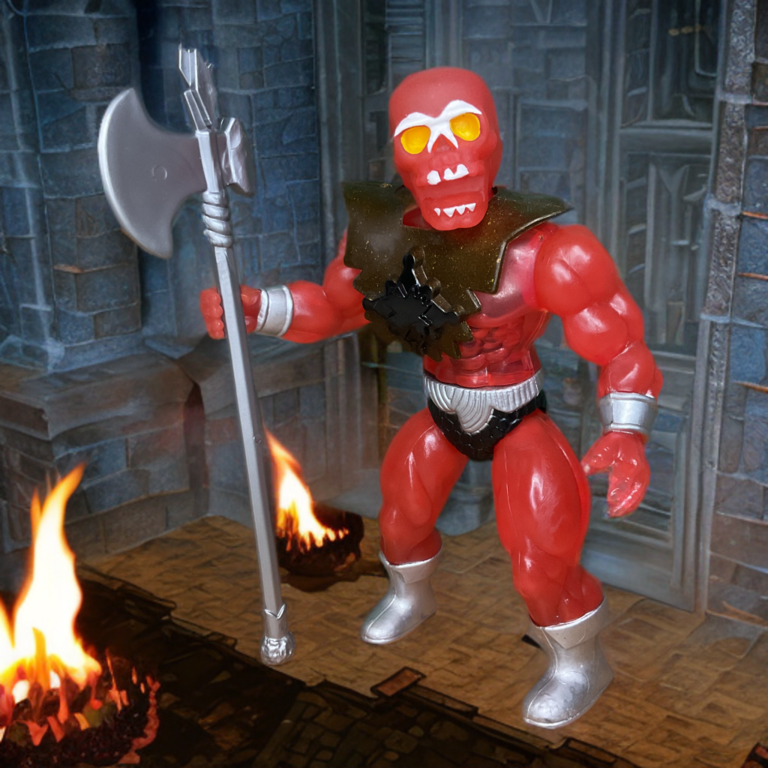
While his peers in the 1982 fantasy aisles were often defined by “furry diapers” and generic bronzed skin tones, the Jewel Thief brought a jarring, high-contrast visual language to the shelf. His design—featuring a vibrant red body and a stark, white-and-yellow skeletal face—marked a radical departure from the standard “naked warrior” trope. He didn’t just look like a thief; he looked like a curse.
The brilliance of the sculpt lies in its visceral impact. In a line dominated by humans like Conan or Arak, the Jewel Thief’s visage is a masterpiece of early 80s horror-fantasy. The deep-set yellow eyes and bared white teeth of the skull mask suggest a creature that has long since traded its humanity for the treasures of the Underworld. Unlike the “existential dread” found on the faces of Remco Hercules, the Jewel Thief radiates a focused, predatory malice.
This aesthetic distinction made him a favorite for kids who needed a high-level “Specialist” in their play scenarios. He wasn’t just another grunt in the army of the Warrior Beasts; he was the elite infiltrator. In a modern high-end display, it is exactly this “Red Skull” aesthetic—paired with the massive, silver-painted battle axe—that makes him pop. He is a masterclass in how a bold color palette and a terrifying head sculpt can turn an “obscure” figure into a visual legend.
Market Analysis: Why This Obscure Remco Figure Commands “Grail” Prices
The ascension of the Jewel Thief to “Grail” status is a masterclass in the mechanics of the vintage toy market. In any high-end collection, price is usually driven by a combination of nostalgia and rarity. However, with the Jewel Thief, there is a third, more powerful factor at play: Completionist Friction.
As serious collectors began to finish their Remco Conan and Warrior Beasts runs, the Jewel Thief emerged as the “Final Boss” of the checklist. He is the bottleneck that prevents a collection from being truly finished.
The “Complete” Factor: The Silver Axe Hurdle
Finding a loose Jewel Thief is difficult; finding one with his original Silver Battle Axe is an astronomical feat. Because the axe was a separate, long-handled accessory made of semi-rigid plastic, it was notoriously prone to being lost in sandbox skirmishes or snapped in half over the decades.
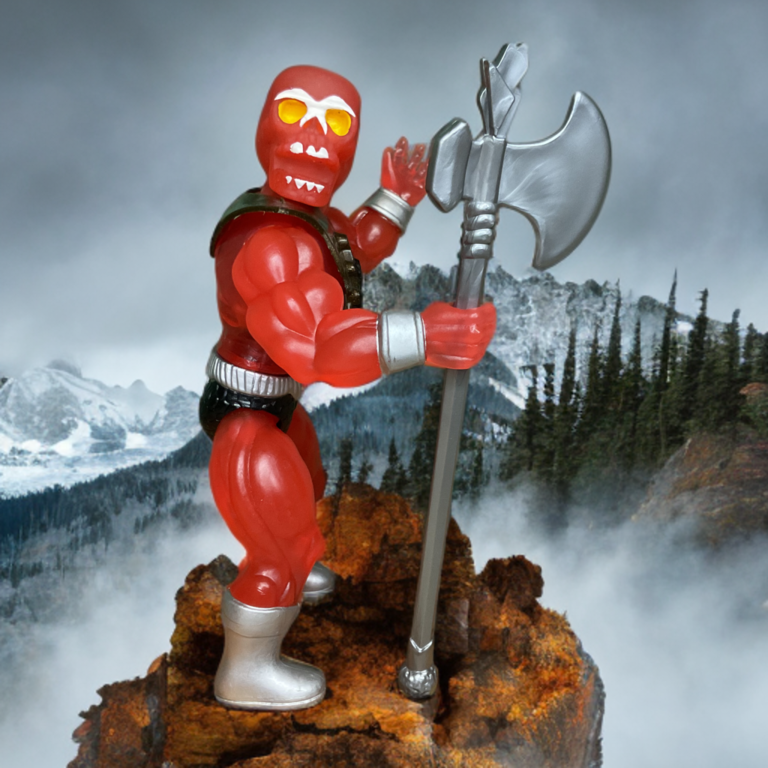
Unlike the integrated armor on other figures, this silver axe is the “make-or-break” element of a Jewel Thief listing. A loose figure might command a respectable price, but a 100% complete specimen with its original weapon represents a tier of collecting that few ever reach.
Peer-Group Validation and the “Enemy” Premium
In the last decade, the Jewel Thief’s value has shifted from “niche interest” to “financial titan.” This is largely due to peer-group validation within the 5.5-inch community. When prominent collectors began highlighting the Jewel Thief as the “Apex Enemy” of the Conan line, the market responded.
He now routinely outperforms licensed A-list characters like Conan or Warlord in open auctions. This price surge is the ultimate proof that obscurity—when paired with a striking, high-contrast “Red Skull” design and low production numbers—creates a legend. He is no longer just a toy; he is a blue-chip asset in the world of 1980s plastic, proving that sometimes, “The Enemy” is much more valuable than the hero.
Condition vs. Value
| Tier | Status | Included Accessories | Market Profile |
| MOC | Mint on Card | Silver Axe (Sealed) | The “Blue Chip” investment. Rare at any price. |
| Complete | Loose / Mint | Original Silver Axe | The “Holy Grail” for loose collectors. Extreme demand. |
| Incomplete | Loose | None | High value for the figure alone; “Weapon Wanted” status. |
| Beater | Play-Worn | None | Significant paint rub on red plastic; often repurposed for customs. |
The Eternal Thief
The story of the Remco Jewel Thief is a testament to the unpredictable nature of toy history. He was a character without a cartoon, a villain without a movie, and a “short-pack” figure tucked away in the shadows of the Conan license. Yet, through a perfect storm of low production numbers, a jarringly superior “Red Skull” design, and the structural integrity of the Remco plastic peg system, he has outlasted nearly all of his contemporaries.
Today, the Jewel Thief stands as the final hurdle for the completionist and the crown jewel for the historian. Whether you are hunting for a carded specimen with its original silver battle axe or simply admiring the bold, high-contrast engineering of the 1980s, the Jewel Thief remains the definitive “Enemy.” He didn’t just steal gems within the mythos of the Underworld; he stole the spotlight from the very heroes he was meant to oppose. In the world of 5.5-inch collecting, some warriors are forgotten, but the shadow of the Jewel Thief only grows longer with time.



 English
  Deutsch
  Français
  Português do Brasil
  日本語
日本語  Español
  English (Australia)