

The Complete History of Orcs: From Ancient Myth to Modern Fantasy Icon
Orcs have become one of the most enduring and adaptable creatures in fantasy lore, evolving from obscure mythological references to multifaceted beings in literature, games, and media. Often depicted as brutish, warlike humanoids, orcs embody themes of corruption, savagery, and redemption across various interpretations. This article provides an exhaustive exploration of their origins, key portrayals—particularly in J.R.R. Tolkien’s works and Dungeons & Dragons (D&D)—notable characters like Azog and Bolg, and their proliferation in other settings. Drawing from folklore, literature, and cultural analyses, we trace the orc’s goblinoid transformation into a staple of speculative fiction, highlighting inconsistencies, evolutions, and societal impacts.
Etymology and Mythological Origins
The word “orc” has deep roots in Indo-European languages, but its modern fantasy connotations stem from Old English and Latin influences. In Old English, “orc” appears in the epic poem Beowulf (circa 8th-11th century) as “orcneas,” translated as a tribe of monstrous beings descended from Cain, alongside elves and giants. This term is glossed in 10th-century texts like the Cleopatra Glossaries as “orc, þyrs, oððe hel-deofol,” meaning goblin, spectre, or hell-devil. Scholars link it to the Latin “Orcus,” the Roman god of the underworld (equivalent to Greek Hades or Pluto), who presided over oaths, punishment, and death. In Roman mythology, Orcus was a hairy, bearded giant who devoured human flesh, evolving into a punisher of broken promises and later a demon in medieval folklore.
Early interpretations portray orcs as demonic or undead entities rather than a distinct race. In Beowulf, orcneas are “evil spirits” or “demon-corpses,” possibly tied to necromancy, contrasting with later humanoid depictions.

Germanic folklore influenced this, with “orc” or “orc-naes” denoting demons or hellish creatures. By the Renaissance, Italian poet Ludovico Ariosto’s Orlando Furioso (1516) featured “orco,” a sea monster akin to the Cyclops, blending with ogre-like figures in fairy tales. William Blake’s 1793 illustrations depicted Orc as a rebellious fallen angel in his prophetic works, symbolizing revolution and energy. These disparate roots—demonic, monstrous, and symbolic—laid the groundwork for the orc’s reinvention in 20th-century fantasy.
Orcs in Folklore and Early Literature
In broader mythology, orcs blur with goblins, ogres, and trolls. Alpine folklore describes “orks” as demons haunting mountains, while Scottish and Irish tales feature sea monsters or giants called “orc” (from Gaelic “orca,” meaning whale). In Basque mythology, orcs are storm-bringing entities, and in some Celtic traditions, they are underworld guardians. Early literature often conflates them with evil spirits: in John Milton’s Paradise Lost (1667), “orc” evokes hellish imagery, and in fairy tales like those of the Brothers Grimm, orc-like beings appear as malevolent trolls or cannibals.

The 19th century saw orcs in Romantic literature as symbols of primal chaos. However, it was J.R.R. Tolkien who crystallized the modern orc as a humanoid race, drawing from these sources while innovating extensively. Tolkien acknowledged borrowing “orc” from Old English for its phonetic fit, distancing it from Latin Orcus while noting similarities to Elvish words like Quenya “orco” (plural “orcor”) and Sindarin “orch.” He preferred “ork” in later writings for authenticity.
J.R.R. Tolkien’s Orcs: The Foundational Interpretation
Tolkien’s orcs, introduced in The Hobbit (1937) as “goblins” and expanded in The Lord of the Rings (1954-1955) and The Silmarillion (1977), are brutish, aggressive humanoids serving evil powers, contrasting with benevolent Elves. They represent industrialized evil, corruption, and the horrors of war, inspired by Tolkien’s World War I experiences.
Origins and Creation Myths
Tolkien provided multiple, inconsistent origins, reflecting his evolving theology. In The Silmarillion, orcs are corrupted Elves captured by Morgoth (the first Dark Lord) in the First Age, twisted through torture and breeding into mockeries of Eru Ilúvatar’s children.

Alternative myths include breeding from slime or stone, corruption of Men (to avoid theological issues with Elves’ immortality), or involvement of fallen Maiar spirits. Tolkien later favored orcs as corrupted Men, noting they reproduce sexually (with orc-women implied but rarely described) and have souls, potentially redeemable though rarely so. Their first appearance was in Y.T. 1330, roaming Beleriand, with numbers swelling under Sauron’s command by Y.T. 1495.
Physical and Behavioral Characteristics
Orcs are smaller than Men, bow-legged, with long arms, fanged mouths, and sallow or black skin; their blood is black. They avoid sunlight (causing weakness), eat meat (including human flesh and possibly cannibalism), and excel in mining and tunneling but create nothing beautiful. Behaviorally, they are cruel, fractious, and cowardly without leadership, delighting in torture but capable of human-like morality (e.g., Gorbag disapproving of abandoning comrades). They ride wolves and wargs, shun water, and are unafraid of fire.

Society and Language
Orc society is tribal and hierarchical, degenerating into quarrels without a Dark Lord’s domination, reducing them to “ant-like” obedience. They use pidgin languages, corrupted Westron, or Black Speech for elites. “Goblin” is synonymous with “orc,” used more in The Hobbit.
History in Middle-earth
• First Age: Orcs fought in battles like Dagor-nuin-Giliath, Dagor Bragollach, and Nirnaeth Arnoediad, sacking Nargothrond and Gondolin. After Morgoth’s defeat, survivors hid in mountains.
• Second Age: Sauron rallied orcs for wars against Elves and Númenóreans, including the War of the Last Alliance, where many perished.
• Third Age: Orcs infested Misty Mountains, clashing with Dwarves (e.g., Battle of Azanulbizar). Sauron’s return swelled their ranks for the War of the Ring, with defeats at Helm’s Deep and Pelennor Fields.
• Fourth Age: Remnants were hunted, though some may have survived in remote areas.
Notable Individuals
• Azog: A massive orc-chieftain of Moria, he beheaded Thrór in T.A. 2790, sparking the War of the Dwarves and Orcs. Known for his pale skin and cunning, Azog was slain by Dáin Ironfoot at Azanulbizar in T.A. 2799. In Peter Jackson’s films, he’s expanded as a nemesis to Thorin Oakenshield.
• Bolg: Azog’s son, he led orcs at the Battle of Five Armies in T.A. 2941, slain by Beorn. Bolg ruled northern orcs from Mount Gundabad, avenging his father.
• Others: Gorbag and Shagrat (Mordor captains debating morality), Uglúk (Uruk-hai leader), Grishnákh (treacherous Mordor orc), and the Great Goblin (Misty Mountains ruler killed by Gandalf).

Variations: Uruk-hai and Half-orcs
Uruk-hai (“orc-folk” in Black Speech) are larger, black-skinned, daylight-tolerant orcs bred by Sauron in the Third Age, later by Saruman via crossbreeding with Men. Half-orcs blend orc and human traits, sunlight-resistant, used by Saruman as spies (e.g., the “squint-eyed southerner” in Bree).
Evolutions in Tolkien’s Writings
Tolkien revised orc origins to align with his Catholic beliefs, rejecting absolute evil without free will. Late letters suggest orcs could seek redemption, though none do in his stories. Inconsistencies include lifespan (immortal like corrupted Elves or mortal like Men) and reproduction.
Orcs in Dungeons & Dragons: From Foes to Playable Heroes
D&D, created by Gary Gygax and Dave Arneson in 1974, borrowed Tolkien’s orcs but adapted them into a role-playing staple, evolving from mindless monsters to complex, playable races.

Evolution Through Editions
• Original D&D (1974): Orcs are chaotic humanoids in the “Monsters & Treasure” booklet, inspired by Tolkien but with pig-like features (snouts, tusks). They live in tribes, hate sunlight, and serve as low-level foes.
• Advanced D&D (1st Ed., 1977-1989): Detailed in the Monster Manual as gray-skinned, bow-legged brutes with sloped foreheads. Alignment: Lawful Evil. Half-orcs introduced as playable in Player’s Handbook (1978).
• 2nd Ed. (1989-2000): Orcs gain boar-like faces, live in subterranean lairs or villages. The Complete Book of Humanoids (1993) makes orcs playable, emphasizing tribal society.
• 3rd/3.5 Ed. (2000-2008): Gray-skinned, hairy orcs with +4 Strength, -2 Intelligence/Charisma/Wisdom penalties. Monster Manual describes them as barbaric raiders worshiping Gruumsh. Playable in core rules.
• 4th Ed. (2008-2014): Orcs are primal, chaotic evil warriors from the Elemental Chaos. Playable in Player’s Handbook 2 (2009), with blood rage mechanics.
• 5th Ed. (2014-present): Orcs are gray- or green-skinned, muscular (up to 8 feet tall), with aggressive traits (+2 Strength, +1 Constitution). Player’s Handbook (2014) makes them playable without alignment restrictions, shifting from inherent evil to cultural influences. Volo’s Guide to Monsters (2016) explores redeemable orcs, addressing bioessentialism critiques. 2024 updates remove negative ability modifiers for inclusivity.
Physical Description and Abilities
Orcs are 6-8 feet tall, 180-280 pounds, with tusks, pointed ears, and gray/green skin. They have darkvision, aggression (bonus actions in combat), and live 50 years. Subraces include mountain orcs (stronger) and gray orcs (more intelligent).
Society, Culture, and Religion
Orcs form nomadic tribes led by chieftains, valuing strength and raids. Culture revolves around war, with shamans and scarification rituals. They worship Gruumsh (one-eyed god of destruction, who created orcs by spilling his blood after losing an eye to Corellon Larethian) and other deities like Luthic (fertility) and Yurtrus (death).

Origin myth: Gruumsh led orcs from caves to conquer, emphasizing survivalism. In settings like Forgotten Realms, orcs inhabit mountains; in Eberron, they’re honorable druids.
Subraces and Notable Characters
Subraces: Orog (elite underground orcs), Tanarukk (demon-tainted). Notable: Obould Many-Arrows (king in Forgotten Realms), Drizzt Do’Urden’s foes. Half-orcs blend human traits, often outcasts but heroic (e.g., in Critical Role campaigns).
Changes reflect shifts from “always evil” foes to nuanced, playable characters, influenced by cultural sensitivities.
Orcs in Other Fantasy Settings: Diversification and Subversion
Tolkien’s template inspired variations, often subverting the “evil minion” trope.
World of Warcraft (Blizzard Entertainment, 2004-present)
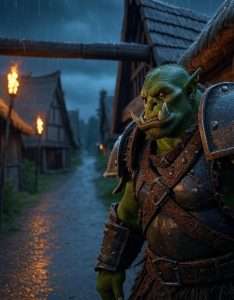
Warcraft orcs are green-skinned (originally brown, corrupted by fel magic), honorable warriors from Draenor. Led by chieftains like Thrall, they value shamanism, clans (e.g., Frostwolf), and redemption after demonic corruption. Unlike Tolkien’s slaves, they’re playable protagonists with rich culture, influenced by Warhammer but emphasizing dignity and tragedy. Notable: Grom Hellscream (redeemed berserker), Garrosh (warmonger).
Warhammer Fantasy and Warhammer 40,000 (Games Workshop, 1983-present)
Warhammer orcs (or “Orcs & Goblins”) are green-skinned, fungus-based brutes obsessed with “Waaagh!” (psychic war energy). Cunning yet comedic, they regenerate and spawn from spores. In 40k, “Orks” are sci-fi parodies: tech-savvy barbarians with red vehicles going “fasta.” Gods: Gork (brutal) and Mork (cunning). They’re independent factions, not servants, emphasizing anarchy.
The Elder Scrolls (Bethesda, 1994-present)
Orsimer (“Pariah Folk”) are green-skinned, tusked elves cursed by Trinimac’s transformation into Malacath after Boethiah’s deception. Skilled blacksmiths and warriors, they live in strongholds, valuing honor and exile for weakness. Playable in games like Skyrim, they’re integrated into society, subverting evil stereotypes with tragic nobility.
Other Games and Literature
• Magic: The Gathering: Orcs are red-aligned warriors, often allied with goblins.
• Discworld (Terry Pratchett): Orcs in Unseen Academicals (2009) are near-extinct weapons, redeemable like Mr. Nutt.
• Grunts! (Mary Gentle, 1992): Satirical orc protagonists as Vietnam War-like grunts.
• Orcs: First Blood (Stan Nicholls, 1999): Orcs as anti-heroes fighting human oppressors.

• Video Games: Orcs in Heroscape (blue-skinned), S
Portrayals in Films, Games, and Media
In Peter Jackson’s Lord of the Rings films (2001-2003) and The Hobbit trilogy (2012-2014), orcs are CGI horrors with grotesque features; one modeled after Harvey Weinstein post-dispute. Warcraft (2016) film humanizes orcs. Video games like Shadow of Mordor (2014) explore orc hierarchies via Nemesis system. Media often uses orcs as disposable foes, but recent works (e.g., Bright, 2017) portray them as oppressed minorities.
Cultural Impact and Controversies
Orcs symbolize “otherness,” critiqued for racial stereotypes (e.g., “savage” traits mirroring colonial views). Tolkien described “orc-minded” people as brutish, yet denied allegory. D&D’s 2020 updates addressed this by removing inherent evil. Positive impacts include orcs as metaphors for redemption (Warcraft) or humor (Warhammer). They influence wargames, RPGs, and memes, with “ork” spellings for distinction.
Conclusion
From demonic whispers in Beowulf to honorable warriors in Warcraft, orcs have transcended their origins, embodying fantasy’s capacity for reinvention.

Tolkien’s corrupted Elves set the standard, D&D added playability, and diverse settings like Warhammer and Elder Scrolls enriched their depth. Characters like Azog and Bolg highlight individual agency within hordes, while modern portrayals grapple with morality and representation. As fantasy evolves, orcs remain a mirror to human nature—brutal yet redeemable—ensuring their legacy endures.


 English
  Deutsch
  Français
  Português do Brasil
  日本語
日本語  Español
  English (Australia)