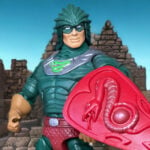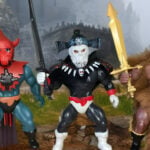



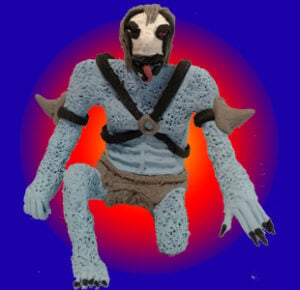
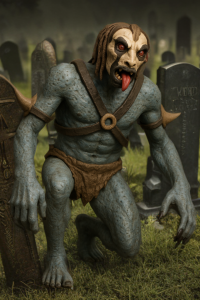
In 2015, the world of Quest for Kimel Drago was born in a small pile of polymer clay and a handful of wire armatures. For eleven years, these characters lived in the ‘vault’—evolving from raw, hand-sculpted prototypes into the digital legends they are today.
This Master Gallery is the definitive visual record of that journey. Below, you will find the first 15 characters to emerge from the archives, categorized by their role in the realm. This isn’t just a portfolio; it’s a testament to the power of original IP in an age of instant generation.
| Character | 2015 Sculpting Milestone | 2026 Digital Evolution |
| Agaric Folke | Mycelium Plate texture focus | Tactical silhouette & fungal shaders |
| Anahita Azar | Flowing silhouette in solid clay | Dynamic “Battle-Priestess” motion |
| Witalis Atrox | Rhinoceros Viper-inspired body | “Void-touched” dark matter textures |
| Caine Reapis | Ghostly drapery & skeletal structure | Ethereal tech & glowing runes |
| Magnus Adamanteus | Layered armor plate proportions | World-specific “Adamantine” runes |
| Gulik Horridus | Leathery hide & low center of gravity | Harvested deep-earth crystal gear |
| Lupus Warwulf | Mastering matted fur needle-texturing | “Warrior-King” tribal armor |
| Gidium | “Organic grotesque” shifting parts | High-ranking chitinous armor |
| Fiendish Cornelius | Gold-leaf & metallic pigment tests | Ornate, twisted Baroque finery |
| Ivar Brun | Precision hard-surface carving | “Steam-Fantasy” mechanical plating |
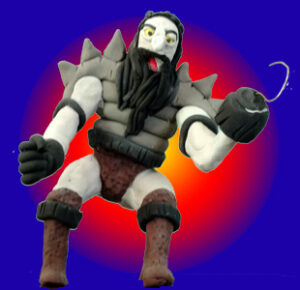
[!TIP] 2015 Prototype Insight: Sculpting Darkstone was a lesson in “controlled chaos.” In 2015, I wanted a character that looked like he was carved out of the cave walls themselves. The challenge with polymer clay was creating those sharp, crystalline edges without them crumbling. I ended up using a flat-blade tool to “shard” the clay, giving him that signature jagged, rock-like texture.
Original Prototype: 2015 (Grey Polymer Clay & Glossy Black “Obsidian” Ink)
Role: Subterranean Guardian / The Living Fault Line.
The Concept: Darkstone was conceived as a “living trap.” He isn’t just a warrior; he is a part of the environment. I wanted him to look like a cluster of rocks until he moved. In the lore of the Quest for Kimel Drago, he is the reason travelers fear the “Echo Tunnels”—you never know if the wall behind you is just stone, or if it’s Creeping Darkstone.
Evolution Note: The 2015 prototype was very “blocky” and static. His 2026 digital destiny has transformed him into a much more fluid threat. We’ve added “internal glow” effects—as if molten energy is pulsing between his obsidian plates—making him look less like a statue and more like a tectonic force of nature.
Explore the Full Bio & 2026 High-Res Renders of Creeping Darkstone →
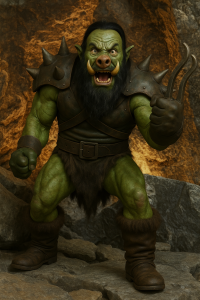
[!TIP] 2015 Prototype Insight: Zaron was an experiment in balance. In 2015, I wanted to capture a “mid-pounce” silhouette. Because polymer clay can be heavy and prone to sagging before it’s cured, I had to build a custom wire armature just to support those massive hooked claws. The focus was on the “Hookfury” stance—making him look like he was ready to spring from the ceiling of a cavern.
Original Prototype: 2015 (Polymer Clay with Reinforced Wire Armature)
Role: Elite Hunter of the Troglodytarum / Scourge of the Lower Canopy.
The Concept: Zaron wasn’t meant to be a tank; he was meant to be a blur. The “Hookfury” name comes from his twin-bladed style—part natural evolution, part harvested bone-tool. I wanted his original sculpt to feel “insectoid” but with the intelligent, calculating eyes of a predator.
Evolution Note: The 2015 version was very focused on the physical blades. His 2026 digital destiny has expanded his “Chitinous Armor” look—we’ve added iridescent textures to his shell and more intricate leather-strapped trophies that suggest he is a veteran of a thousand hunts in the dark.
Explore the Full Bio & 2026 High-Res Renders of Zaron the Hookfury →
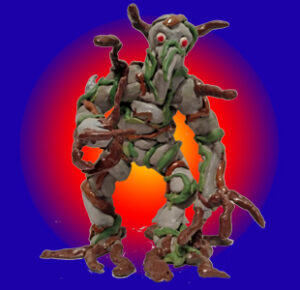
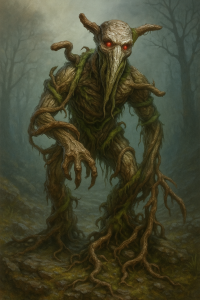
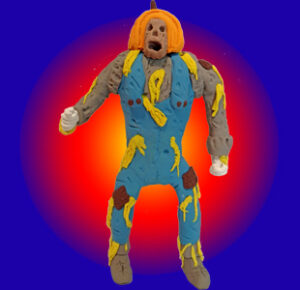
[!TIP] 2015 Prototype Insight: Scarerook was my first real experiment with “texture layering.” In 2015, I didn’t want him to just look like smooth clay; I wanted him to look like rotted wood and burlap. I actually pressed real twine and burlap scraps into the wet polymer clay to leave deep, organic impressions before baking. The challenge was maintaining his spindly, asymmetrical frame without it warping in the oven.
Original Prototype: 2015 (Polymer Clay & Twine-Pressed Textures)
Role: Guardian of the Overgrown Paths / The Silent Watcher.
The Concept: Scarerook was designed as a “psychological” monster. He doesn’t just attack; he looms. I wanted his original 2015 silhouette to be tall, thin, and unsettling—like a dead tree that suddenly grows eyes. He is the ultimate deterrent for those trying to infiltrate the deeper layers of the Undergrowth.
Evolution Note: The 2015 prototype was very earthy and muted. His 2026 digital destiny has leaned into the “Spectral Core”—he now features a hollow chest cavity filled with a flickering, necrotic light that suggests he isn’t just wood and straw, but a vessel for an ancient, trapped spirit.
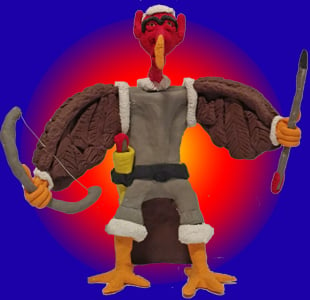
[!TIP] 2015 Prototype Insight: Bonestealer was a study in “unnatural proportions.” In 2015, the challenge was the wings. Creating a wingspan out of polymer clay that wouldn’t snap or sag was nearly impossible without a heavy-duty internal frame. I remember spending hours texturing the “tattered” look of his pinions to make them look like old parchment rather than smooth feathers—giving him that sickly, necrotic feel.
Original Prototype: 2015 (Polymer Clay with Copper-Wire Wing Support)
Role: Sky-Stalker of the Undergrowth / Harvester of the Fallen.
The Concept: Bonestealer represents the “clean-up crew” of the Undergrowth. I wanted a creature that wasn’t just a bird or a man, but a “were-beast” that had succumbed to avian rot. The name comes from his habit of stripping the “Kimel” essence directly from the bones of his prey.
Evolution Note: The 2015 prototype was very brown and earthy. His 2026 digital destiny has introduced much sharper contrasts—we’ve added a “bone-white” mask-like facial structure and elongated his talons to look more like surgical hooks, emphasizing his role as a precise, albeit grisly, scavenger.
Explore the Full Bio & 2026 High-Res Renders of Bonestealer →
[!TIP] 2015 Prototype Insight: The Winter Ghoul was a study in “frozen textures.” In 2015, I wanted the character to look like he was dripping with icicles. I experimented with layering white polymer clay over clear armatures and then using a needle tool to drag the clay into sharp “frozen” points. The challenge was making the clay feel cold and brittle rather than soft.
Original Prototype: 2015 (White & Pale Blue Polymer Clay)
Role: Harbinger of the Eternal Frost / The Glacial Stalker.
The Concept: The Winter Ghoul isn’t a typical undead; he is a manifestation of the “Kimel” energy warped by extreme cold. I designed his original 2015 form to be hunched and jagged, symbolizing the harsh, biting winds of the frozen wastes that leak into the upper Undergrowth.
Evolution Note: The 2015 prototype was very matte and solid. His 2026 digital destiny has added a “Glacial Transparency”—we’ve used sub-surface scattering to make his skin look like deep ice, with glowing blue veins of energy visible beneath the surface, making him feel truly “otherworldly.”
Explore the Full Bio & 2026 High-Res Renders of Winter Ghoul →
This gallery is more than a look back at where Quest for Kimel Drago began; it is the foundation for where it is going next. Each of these 15 figures represents a pivot point in my journey as a creator—from the tactile, messy reality of polymer clay in 2015 to the limitless possibilities of digital sculpting in 2026.
As we continue to unlock the archives, the line between the physical past and the digital future will only continue to blur. Whether you are here for the nostalgia of a hand-sculpted era or the precision of modern design, you are now part of this world’s evolution.
What’s Next? The Undergrowth was just the beginning. There are still nearly 20 characters waiting in the shadows of the vault, including the massive Giant Nullum and the elusive Jaqwalogs.
Join the Quest: Keep an eye out for things to come!
 English English
  Deutsch
  Français
  Português do Brasil
  日本語
日本語  Español
  English (Australia) English English Deutsch
Français
Português do Brasil
日本語
Español
English (Australia)
English (Australia) English English Deutsch
Français
Português do Brasil
日本語
Español
English (Australia)
We use cookies to improve your experience on our site. By using our site, you consent to cookies.
Manage your cookie preferences below:
Essential cookies enable basic functions and are necessary for the proper function of the website.
Statistics cookies collect information anonymously. This information helps us understand how visitors use our website.
Google Analytics is a powerful tool that tracks and analyzes website traffic for informed marketing decisions.
Service URL: policies.google.com (opens in a new window)