

Collectors Are Searching for the Rare DC Universe Classics Toyman
The Dark Side of Playtime
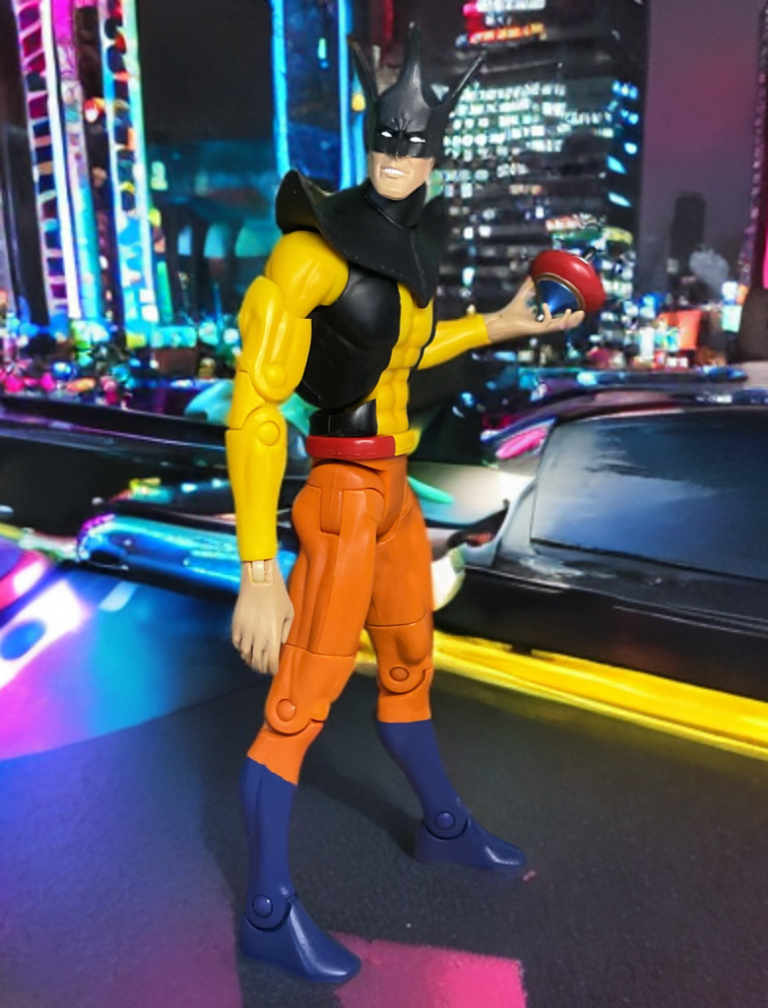
The world of action figure collecting is driven by nostalgia, architectural sculpts, and the thrill of completing iconic rogue galleries. For enthusiasts of Mattel’s historic DC Universe Classics (DCUC) line, few figures offer the exact blend of vibrant visual appeal and unsettling comic book history quite like the 2011 release of Toyman. Emerging in Wave 18, this specific piece stands as a masterclass in translating a deeply eccentric, vintage aesthetic into modern three-dimensional form.
At first glance, the figure’s harlequin aesthetics evoke a sense of whimsical retro charm. Yet, beneath the bright orange pants, primary blue boots, and sun-yellow torso lies the representation of one of Metropolis’s most psychologically fractured minds. This comprehensive analysis delves deep into the definitive action figure incarnation of Winslow Schott, exploring its structural design, historical background within DC Comics lore, and absolute value to the modern toy shelf.
Character Biography: The Genesis of Winslow Schott
Long before he became a persistent thorn in the side of the Man of Steel, Winslow Schott was a gentle soul. He was a shy, brilliant inventor whose lifelong passion was creating joy for children through complex, mechanical playthings. Schott’s life fractured permanently when he was deceptively manipulated into selling his beloved boutique toy company to a cold, calculating military arms manufacturer.
The psychological breaking point arrived when Schott discovered his innocent, innovative drone and mechanical technologies were actively being integrated into state-of-the-art smart bombs. Overwhelmed by betrayal and horror, the inventor weaponized his own craft. He sent a deceptively innocent, highly explosive teddy bear directly to his deceptive former employer—a lethal piece of poetic justice that marked the abrupt, violent birth of the Toyman. Losing his fragile grip on reality, Schott transformed his grief and genius into a crusade of vengeance. Operating under a twisted moral code, this dangerous polymath now crafts lethal novelties to exact final retribution on anyone he deems guilty, cementing his legacy as one of the most volatile and tragic adversaries in the DC Universe.
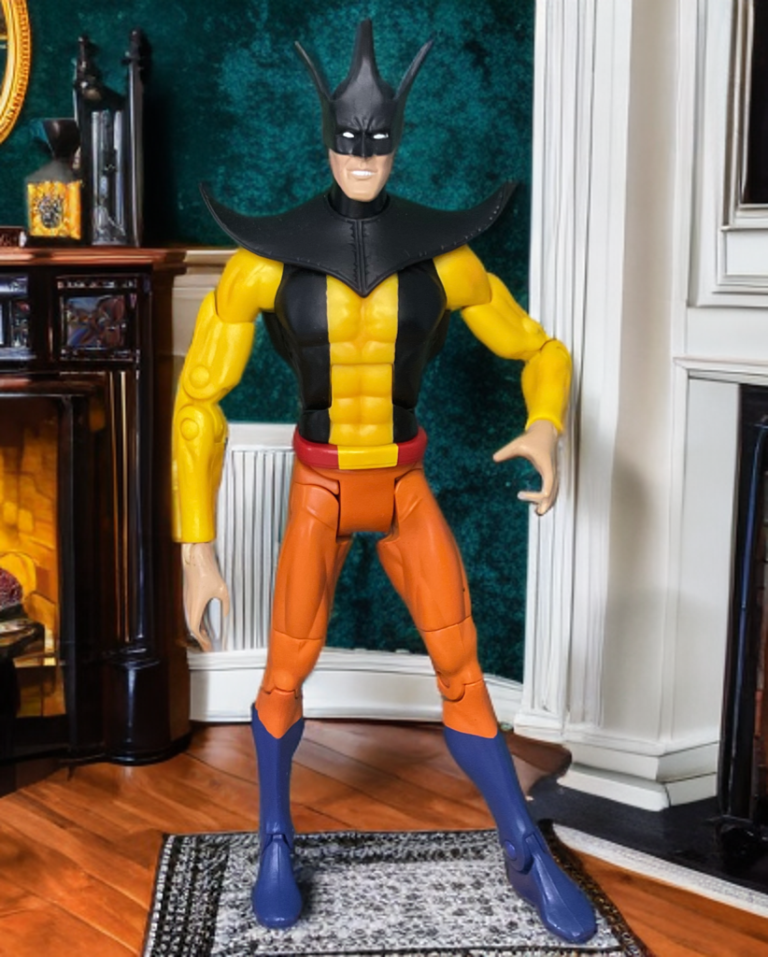
DCUC Toyman: Production & Release Specs
| Production Attribute | Collector Specification |
|---|---|
| Manufacturer | Mattel |
| Product Line | DC Universe Classics (Wave 18) |
| Release Year | 2011 |
| Assortment Number | Figure 03 |
| Sculpting Studio | Four Horsemen Studios |
| Scale Size | 6.5 Inches (16.51 cm) |
| Original Retail Price | $12.99 USD |
| Collect & Connect Part | Right Arm (Apache Chief) |
Design and Sculpt: The Four Horsemen’s Triumph
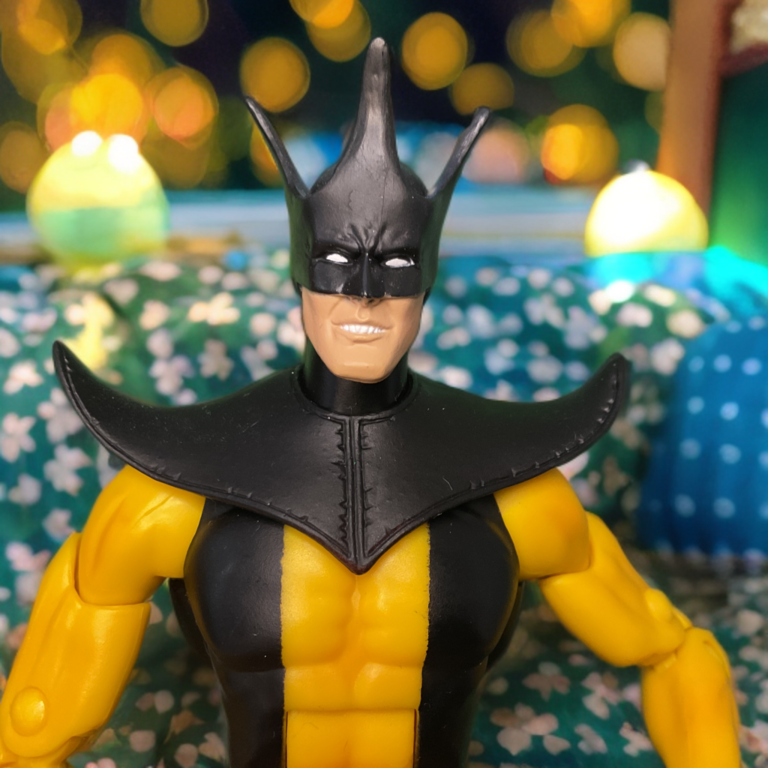
The aesthetic direction of DC Universe Classics Wave 18 took a direct, celebratory nod from the classic Super Friends animation and late Bronze Age comic appearances. Sculpted by the legendary Four Horsemen Studios, Toyman utilizes Mattel’s specialized lean, lanky base body. This body structural choice serves the character impeccably, mirroring his spindly, theatrical comic book silhouette.
Paint Application and Color Fidelity
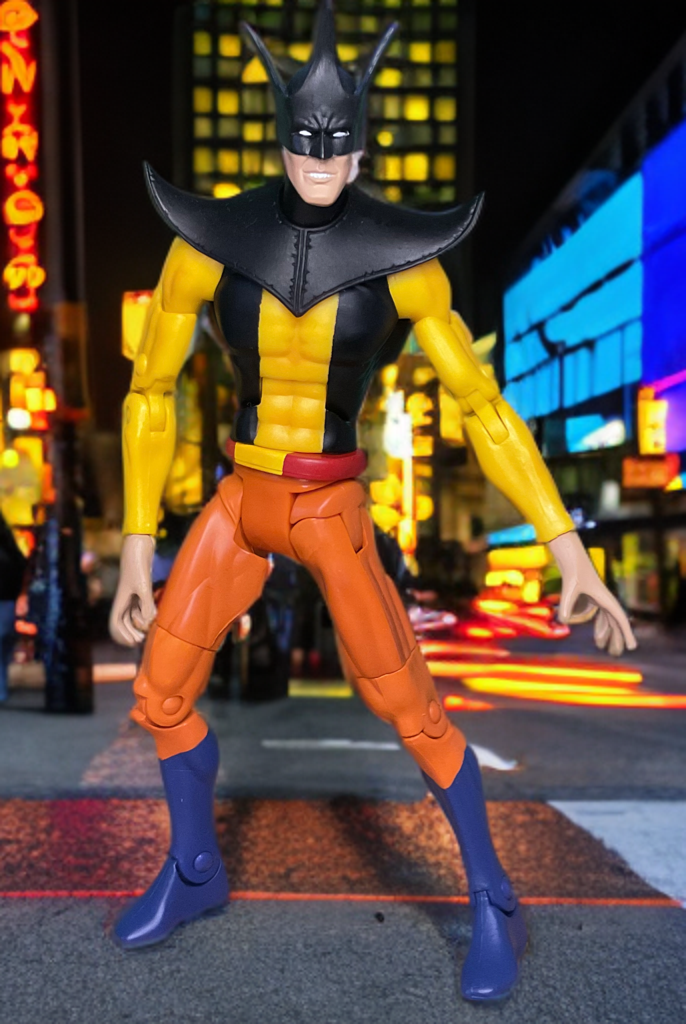
DCUC Toyman: Aesthetic & Paint Deco Breakdown
| Costume Segment | Paint Finish & Application Details |
|---|---|
| Vest & Jester Hood | Coated in deep, uniform matte black for sharp contrast. |
| Waist Details | Features a crisp, tightly registered red and yellow belt line. |
| Legs | Finished in solid, eye-catching comic-accurate orange. |
| Boots | Rendered in a vibrant, oceanic primary blue. |
By eliminating the complex, hard-to-replicate vertical pinstripes seen in some early comic panels, Mattel paid direct homage to the cleaner animation styles while redirecting the production budget into specialized tooling and accessories.
Articulation and Poseability: Engineering the Toyman
The articulation setup on Toyman presents an intriguing engineering compromise characteristic of late-era DC Universe Classics releases. Engineered by Four Horsemen Studios and produced during Mattel’s Wave 18 run in 2011, the figure incorporates 25 distinct points of movement. This array provides an expressive, highly poseable range for dynamic shelf displays, though it operates within the specific design constraints of the shared DCUC buck system.
Upper Body Mobility and Arm Articulation
The true strength of Toyman’s articulation resides in his upper torso and arm engineering. Unlike standard retail figures from the line that relied on basic single-hinge elbows, Toyman incorporates premium double-hinged elbows. This rare engineering choice allows the forearm to fold tightly inward toward the bicep, giving collectors the ability to pose him holding his specialized weaponry, cradling sinister playthings, or gesturing maniacally.
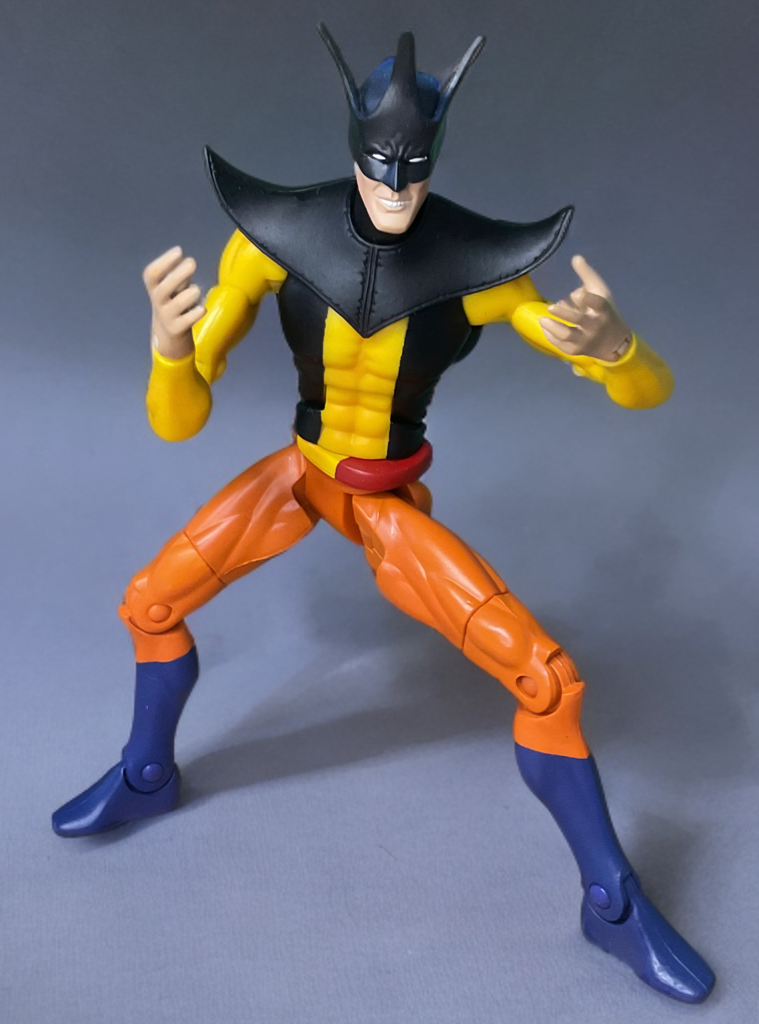
This arm flexibility is augmented by swivel-hinge wrists that tilt laterally, enabling precise aiming angles when holding his accessory arsenal. The neck sits on a generously seated ball joint, yielding a wide range of motion. The head tilt easily captures sinister downward glares or exaggerated, unhinged tilts that match his theatrical, villainous persona. While the mid-abdomen crunch is slightly impeded by the sculpted black overlay collar of his vest, the horizontal waist swivel remains unhindered, allowing collectors to shift his upper body weight for balanced posing.
Lower Body Range, Balance, and Shelf Stability
The lower half of the figure adheres strictly to the classic Four Horsemen design template. The hips utilize Mattel’s signature universal H-hinge system, offering a full range for forward kicks and wide A-frame stances. Upper thigh swivels allow outward leg rotation, which is vital for stabilizing the figure when posed alongside larger DCUC villains like Brainiac or Lex Luthor.
The lower leg assembly represents the figure’s primary mechanical limitation. The knees rely on standard single-hinge joints limited to a strict 90-degree bend, preventing deep crouching poses. Similarly, the ankles feature single-axis pitch movement without ankle rocker swivels. However, because Toyman possesses a relatively lightweight frame compared to bulkier Wave 18 figures, these ankle joints hold their tension well, providing reliable long-term shelf stability without the need for external display stands.
DCUC Toyman: Articulation & Poseability Matrix
| Articulation Point | Joint Type | Functional Display Benefit |
|---|---|---|
| Neck | Ball-Jointed | Exceptional upward and downward tilt for malicious dynamic angling. |
| Shoulders | Swivel-Hinge | Allows clean 90-degree lateral raising and full 360-degree rotation. |
| Elbows | Double-Hinged | Rare inclusion that allows the forearm to fold tightly against the bicep. |
| Wrists | Swivel-Hinge | Highly expressive lateral tilting, essential for aiming lethal toys. |
| Torso | Mid-Abdomen Crunch | Standard forward lean, though slightly restricted by the black overlay collar. |
| Waist | Horizontal Swivel | Full rotation to dynamically alter the center of gravity. |
| Hips | Universal H-Hinge | Standard DCUC layout; allows forward kicks and splits. |
| Thighs | Upper Swivel Cut | Essential for rotating the legs outward into wide, dramatic stances. |
| Knees | Single-Hinge | A minor disappointment; limited to a 90-degree bend. |
| Ankles | Single-Hinge | Solid forward and backward pitch to preserve stability on flat surfaces. |
The inclusion of double-jointed elbows on the slender buck was a major win, as it allowed the figure to hold his lethal novelties close to his chest or pose them in mid-throw positions. The decision to leave the knees as single hinges creates a slightly uneven posing dynamic between the upper and lower body, but the tight tolerances of the joints ensure he stands securely on a shelf without dropping over time.
Lethal Accessories: Death by Playtime
An action figure of Winslow Schott would feel incredibly incomplete without his trademark tools of destruction. Mattel delivered handsomely by providing two completely unique, beautifully scaled weapon accessories that completely embody the character’s dark psyche:
The Explosive Spinning Top
Molded in a striking mix of primary red, yellow, and blue, this accessory features a long winding handle topped with a sculpted mechanical fuse. The grip is tailored perfectly to slide into Toyman’s right grasping hand. It serves as a visual reminder of his comic history, where a simple spinning top could instantly release lethal gases or house a high-frequency sonic disruptor.
The Spiked Yo-Yo of Doom
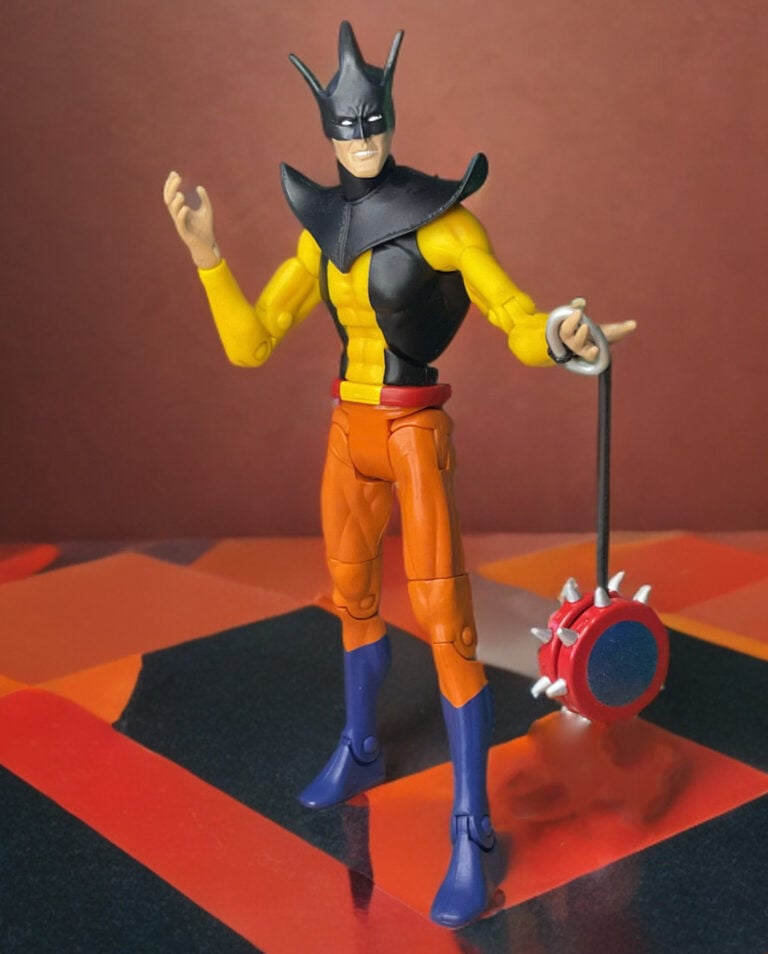
This accessory is a masterpiece of dark humor. It features an oversized, bright blue wheel studded with menacing yellow spikes all along its outer perimeter. Breaking away from standard plastic-molded chain links, Mattel utilized a genuine fabric string that winds completely around the inner spool. The string terminates in a small plastic ring designed to slip directly over the figure’s finger, allowing collectors to simulate a lethal trick shot. Furthermore, his left hand is specially sculpted with fingers slightly splayed, perfectly accommodating a wind-up or casting pose.
Official DC Canon History: The Evolution of Toyman
To appreciate this figure, one must trace the historical footprints of Winslow Schott through official DC Comics continuity. Unlike many rogues who undergo sweeping reality-warping redesigns, Schott’s core tragedy has remained remarkably consistent across decades of comic history.
The Golden and Silver Age Foundations
Created by Don Cameron and Ed Dobrotka in 1943’s Action Comics #64, Toyman originally entered the page as a quirky, slightly eccentric criminal who used giant toy props to pull off elaborate bank heists. As the decades progressed and comic books embraced deeper narrative complexity, his characterization darkened significantly. The whimsey faded, replaced by an increasingly unstable psychological profile. Schott truly became a tragic figure: a man frozen in a state of eternal childhood, incapable of navigating adult society, treating the high-stakes metropolis of the real world like a giant sandbox to be manipulated or broken at a whim.
The Post-Crisis and Modern Era Darkness
Following the absolute cosmic reset of Crisis on Infinite Earths, Toyman’s narrative took a genuinely horrific turn. His mental state fractured completely, leading to deeply sinister storylines. In the iconic Superman: Grounded and Geoff Johns’ Action Comics runs, it was definitively established that Schott’s descent into absolute madness made him one of the most unpredictable threats in Superman’s path.
He wasn’t merely a man playing with wind-up cars; he was a technological savant capable of creating lifelike cybernetic duplicates so advanced they could briefly deceive the Man of Steel’s heightened Kryptonian senses. His actions grew so severe that they resulted in horrific collateral damage, forever separating him from the lighthearted gimmick-criminals of the past. The contrast between this grim, canonical reality and his bright, colorful jester uniform makes this specific action figure design deeply compelling for collectors who value narrative depth.
Collective Value and Shelf Presence
Fourteen years after its initial retail run, the DC Universe Classics Toyman has aged gracefully, steadily climbing the ladder of collector desirability. For fans looking to complete their definitive, comic-accurate Legion of Doom roster, this figure is an absolute, non-negotiable requirement.
No Legion of Doom lineup is complete without both eccentric tech geniuses and brute psionic force. If you are rounding out your classic villain shelf alongside Winslow Schott, be sure to explore our complete breakdown in The Ultimate Guide to Gorilla Grodd: Powers, History, and Toy Review and The Tragic Plastic Masterpiece: Why Every DC Collector Needs the Bizarro Rebirth Figure Now!
The Final Verdict
Mattel’s DC Universe Classics Toyman stands as an exceptional tribute to a classic era of comic design, masterfully executed by the Four Horsemen Studios. It is a physical celebration of how a bright, animated aesthetic can house a dark, compelling character history. Despite minor historical engineering quirks like the single-hinged knees, the figure excels everywhere it counts: boasting crisp paint registration, an incredible head sculpt, and a pair of brilliantly executed, highly unique accessories.
For dedicated collectors of the DC Universe, Winslow Schott is far more than just another standard background villain. He remains a poignant reminder of genius warped by betrayal, and a permanent pillar of Superman’s historic lore. Whether you are looking to finish your prehistoric Super Friends roster, complete a sprawling Legion of Doom display, or simply own a beautifully crafted piece of action figure history, this Toyman release stands tall as an absolute masterpiece of plastic design.
Don’t miss: Fear’s Plastic Phantom: Scarecrow Strikes & Don’t Miss Out on the DC Multiverse Sinestro Corps Figure

 English
  Deutsch
  Français
  Português do Brasil
  日本語
日本語  Español
  English (Australia)