

The Battle of Maggita: A Betrayal Etched in Blood and Ice
In the shadowed annals of Kimel Drago, few events loom as darkly as the Battle of Maggita—the cataclysmic clash that shattered the Twin Kingdoms and set the stage for Magnus Adamanteus’s long quest to reclaim the magical crowns. What began as a glorious defense of freedom ended in treachery, ruin, and an eternal winter that still haunts the north. Here is the full, original account drawn from the survivors’ tales whispered around Highland Downes hearth-fires and the grim warnings of Nithramous the White Wizard.
The Golden Age Before the Storm
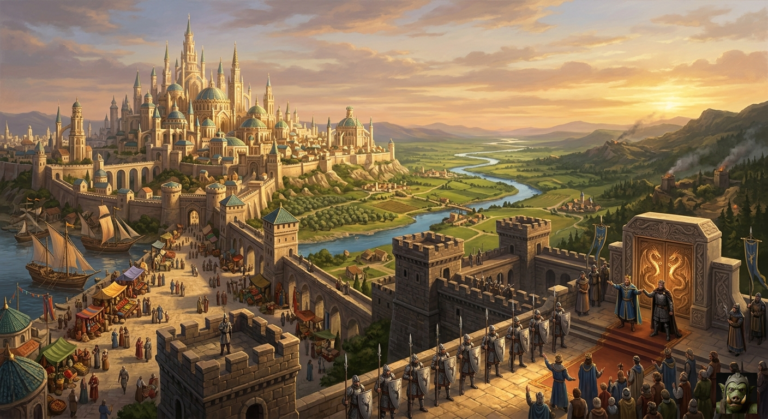
Long before the snows fell, Maggita stood as the radiant heart of the northern realms: a sprawling metropolis of gleaming spires, bustling markets filled with spices from distant Belogrin woods, and towering halls where scholars debated the celestial maps of Nithramous. Beside it lay the stout kingdom of Korbus, its stone walls and disciplined warriors a bulwark of honor. The two cities were bound by blood and alliance—King Leinad of Maggita and King Korbus ruling as steadfast brothers in all but name.
Together they had repelled countless threats: rampaging Weregoats from the wild hills, Agaric Folke raids from the fungal groves, and the occasional mountain-sized tantrum from a grumpy Mountain Boomer. Prosperity flowed like the clear rivers of Aldaren. The legendary Crowns of Kimel Drago—one radiant with the light of unity, the other forged in unyielding strength—rested in their joint vault, symbols of the peace that had lasted generations.
The Serpent Slithers In
The idyll cracked when a humble wanderer appeared at Maggita’s gates: Witalis Atrox, a Black Wizard exiled from realms beyond the Sea of Weles. Cloaked in false humility, Atrox presented King Leinad with the Amulet of Janikorm, a glittering bauble pulsing with seductive power. “A token of alliance,” he claimed, “to strengthen your throne against unseen foes.”
Leinad, ever the optimist (some say too trusting for his own good), accepted the gift. The amulet’s curse took root slowly—whispers of paranoia, sudden distrust of old allies, and a creeping chill in the king’s decisions. Atrox, meanwhile, wormed his way into court as an “advisor,” all while secretly courting discontented nobles and forging pacts with darker forces. Nithramous the White Wizard smelled the rot immediately but was dismissed as overly cautious; Magnus Adamanteus, then just an infant prince, was spirited away to safety by loyalists as tensions rose.
Korbus sensed the gathering storm and marched its armies northward to stand with Maggita. What should have been a united front became the perfect trap.
The Battle Unfolds: Glory Turns to Slaughter
The clash erupted on the frost-kissed plains just north of Maggita, where the land begins its rise toward the Sorghel peninsula. At first, it seemed a heroic stand. Maggita’s gleaming phalanxes and Korbus’s heavy infantry formed an unbreakable line against Atrox’s ragtag horde of summoned horrors and corrupted mercenaries. Warriors sang as they charged; banners of the Twin Kingdoms snapped proudly in the wind.
Then the betrayal struck like a viper in the grass.
At the height of the melee, Atrox activated the amulet’s full curse. King Leinad turned on his own commanders in a fit of maddened rage, ordering charges that exposed flanks and isolated units. Simultaneously, Atrox’s hidden agents within both armies unleashed chaos—poisoned arrows from “friendly” archers, supply wagons set ablaze, and spectral illusions that made brother fight brother. Caine Reapis (then a shadowy figure already bound to Atrox’s will through Naggana the Naga’s dark nurturing) led a brutal flanking force that smashed through Korbus’s center.
The fighting was ferocious and merciless. Maggita’s spires could be seen burning in the distance as the battle spilled toward the city gates. Korbus’s king fell defending a bridge, his final roar a curse upon the traitor wizard. By nightfall, the fields ran red. Thousands perished—proud warriors of both kingdoms cut down not just by enemy blades, but by the poisoned doubt Atrox had sown.
The Aftermath: Ruin and Eternal Winter
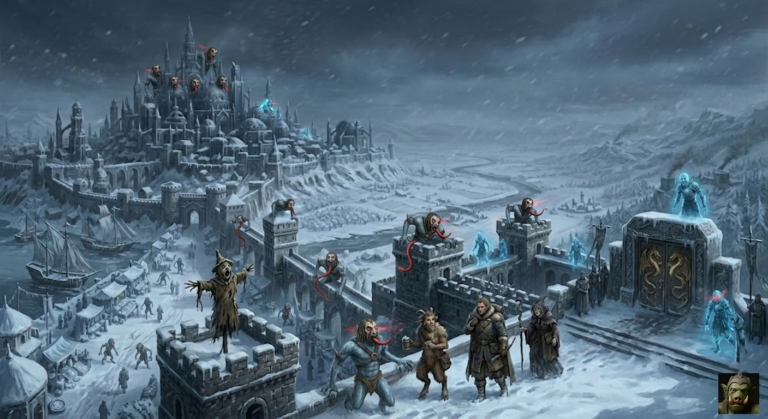
With victory secured through deceit, Atrox did not stop at conquest. He unleashed a cataclysmic ritual, drawing on the life-force of the fallen to curse the land itself. An unnatural winter descended, blanketing the ruins of Maggita and the shattered remnants of Korbus in perpetual ice and snow. The battlefield itself froze mid-carnage, turning the dead into icy monuments.
The Crowns of Kimel Drago were spirited away and hidden deep beneath the snows of Sorghel—Atrox’s twisted joke: anyone seeking them would have to brave the very realm now guarded by the restless spirits of the slain. Those fallen warriors, denied rest by the Black Wizard’s necromancy, rose as the Maggita Winter Ghouls—frostbitten husks driven by a cursed belief that reclaiming the crowns would melt their icy “home” and erase their tormented existence.
Maggita itself survived in moderate ruin, its gleaming spires cracked but still standing as haunted echoes. Korbus was utterly demolished, reduced to scarred badlands where only the bravest (or most foolish) scavengers dare tread. Survivors fled south to what would become the resilient settlements of Aldaren and Highland Downes, carrying tales of the betrayal and raising young Magnus Adamanteus in secret.
Echoes in the Quest for Kimel Drago
Today, the Battle of Maggita is more than ancient history—it is the wound that still festers. Every Winter Ghoul encountered in Sorghel’s blizzards is a grim reminder of fallen friends and betrayed oaths. ScareRook stands sentinel over the approaches, its burlap-masked shrieks echoing the final screams of that fateful day. Delilah the witch speaks of the battle in hushed tones, warning that only by reuniting the crowns can the eternal winter truly break and lay the ghouls to rest.
Yet there is a spark of wit in the tragedy: the survivors of Maggita and Korbus, now united under Magnus, often joke that Atrox’s “great victory” left him ruling a frozen wasteland while they rebuilt warmer, merrier lives in the south—with better ale and fewer icicles in uncomfortable places. Dewclatter the Faun likes to say the Black Wizard won the battle but lost the punchline.
In the end, the Battle of Maggita taught Kimel Drago a bitter truth: the sharpest blade is not steel, but trust—and once shattered, only the greatest of quests can hope to reforge it. Magnus Adamanteus carries that lesson in every step of his journey, turning the ashes of betrayal into the fire of restoration. The crowns await, the ghouls hunger, and the continent holds its breath for the day the ice finally cracks.



 English
  Deutsch
  Français
  Português do Brasil
  日本語
日本語  Español
  English (Australia)