

Transformers Thundercracker Biography: Seeker History
Overview
Thundercracker is one of the most psychologically compelling figures in the Transformers mythos. Historically designated as a Decepticon Seeker—an elite class of aerial warriors specializing in air superiority and tactical bombardment—he operates as a vital component of the Decepticons’ primary vanguard. While he possesses devastating sonic boom-generating capabilities and formidable martial prowess, Thundercracker is defined by a profound moral ambiguity that starkly contrasts with the sadistic tyranny of his peers. Though he remains outwardly loyal to Megatron’s campaign of Cybertronian expansion, his internal landscape is defined by quiet, persistent doubts about the ethical cost of the war. This deep-seated internal conflict and rare sense of personal honor transform him from a standard military grunt into a nuanced, tragic soldier torn between factional duty and a budding conscience.

Origins and Creation: The Dawn of the Seekers
The real-world genesis of Thundercracker traces back to the inception of the Transformers brand in 1984, arising from a landmark partnership between American toy giant Hasbro and Japanese manufacturer Takara. Before entering Western toy aisles, the mold that would become Thundercracker originated in Takara’s Diaclone line as the “Jet Robo” F-15, designed by legendary mechanical designers Shoji Kawamori and Kohjin Ohno. Recognizing the potential of these transforming vehicles, Hasbro acquired the molds and rebranded them for the launch of The Transformers in 1984.
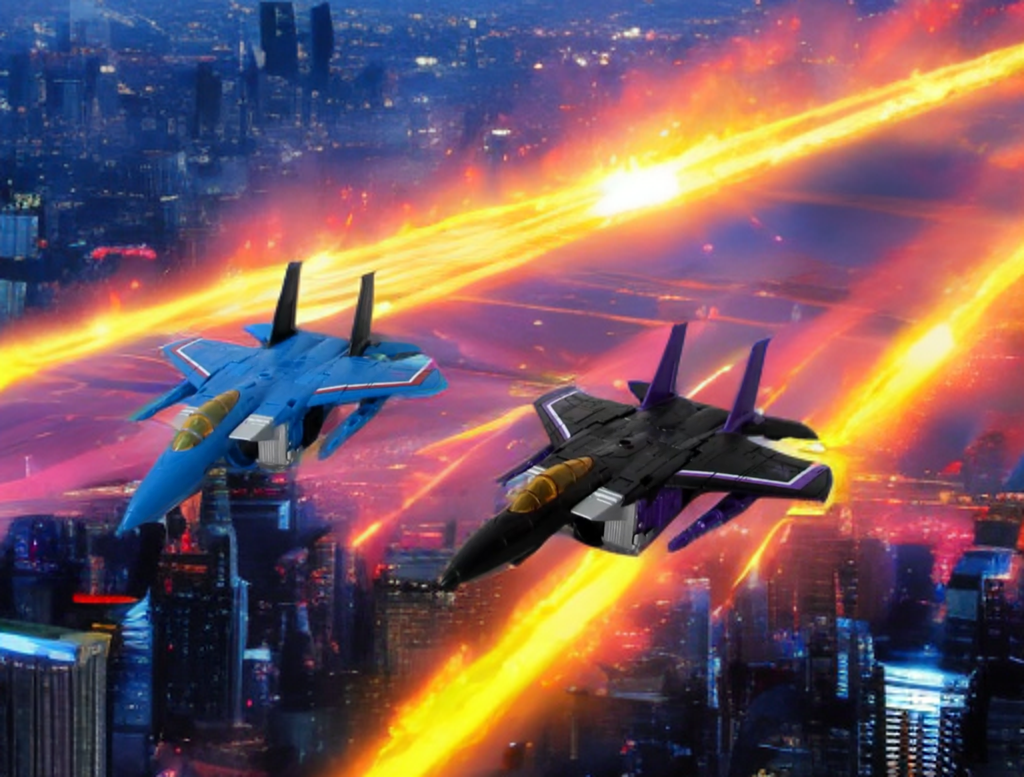
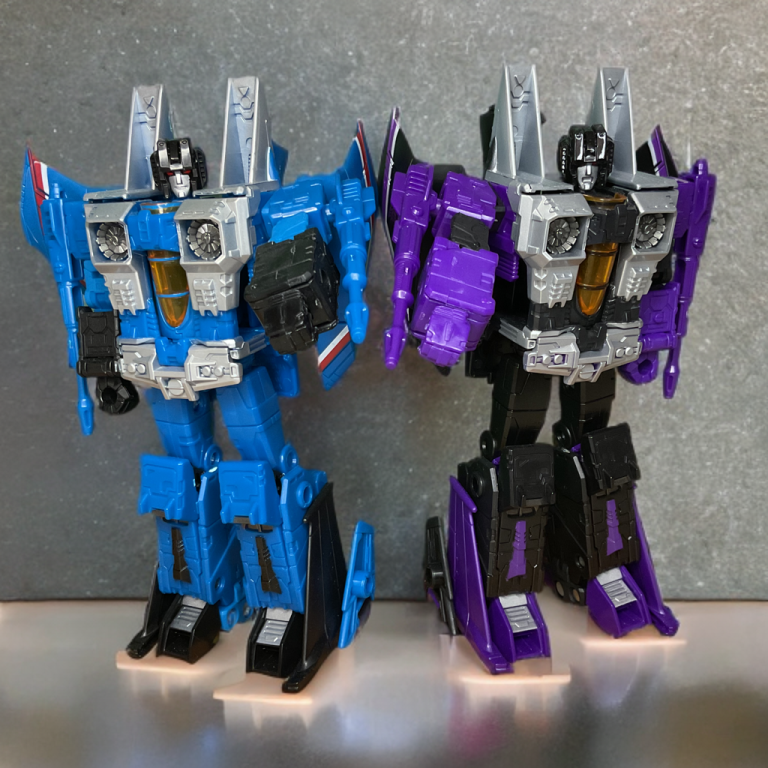
Thundercracker was introduced in the historic first wave of releases, packaged as a beautifully detailed, cobalt-blue McDonnell Douglas F-15 Eagle fighter jet. Alongside the red-and-white Starscream and the black-and-purple Skywarp, Thundercracker formed the foundational “Seeker trio” (initially referred to simply as the Decepticon Planes in early marketing materials). These figures set a high standard for the “robots in disguise” concept, offering highly realistic, military-accurate alt-modes that captured the imagination of a generation.
While the physical toy was a striking visual asset on shelves, it was Marvel Comics editor Bob Budiansky who breathed life into the plastic. Tasked with writing the file card biographies for the packaging, Budiansky chose to bypass standard villain tropes. Instead, he injected Thundercracker with a rich psychological profile of self-doubt and reluctant pride—establishing the very blueprints of ambivalence that creators continue to explore across multimedia today.
Character Specification Sheet
Primary Technical & Faction Data
| Data Field | Character Details & History |
|---|---|
| Name | Thundercracker |
| Faction | Decepticon |
| Subgroup | Seeker |
| Primary Function | Warrior, Aerial Combatant |
| Alternate Mode | Typically a jet (e.g., F-15 Eagle in G1, F-22 Raptor in some modern continuities) |
| Motto | “The deadliest weapon is terror.” (G1) |
In the G1 lore, Thundercracker, like other Cybertronians, hails from the planet Cybertron, where he was created as a warrior before the Great War between the Autobots and Decepticons. His origins are tied to the Decepticon Seekers, a group of aerial combatants known for their speed, firepower, and arrogance. Thundercracker’s design and personality were fleshed out in various media, including the Marvel Comics series, the Sunbow animated series, and later reboots like IDW Comics and the Transformers: War for Cybertron games.
Physical Description and Abilities
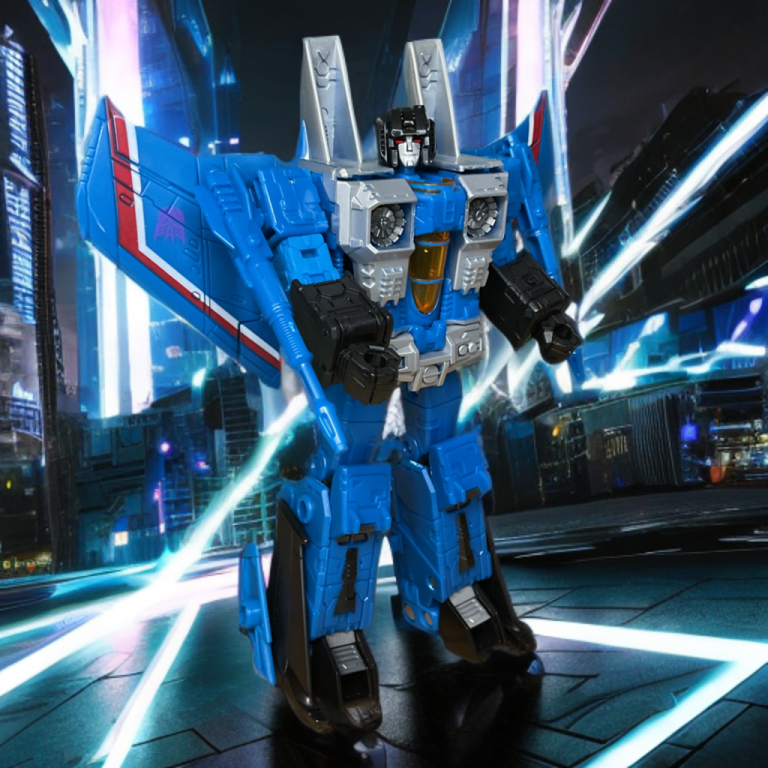
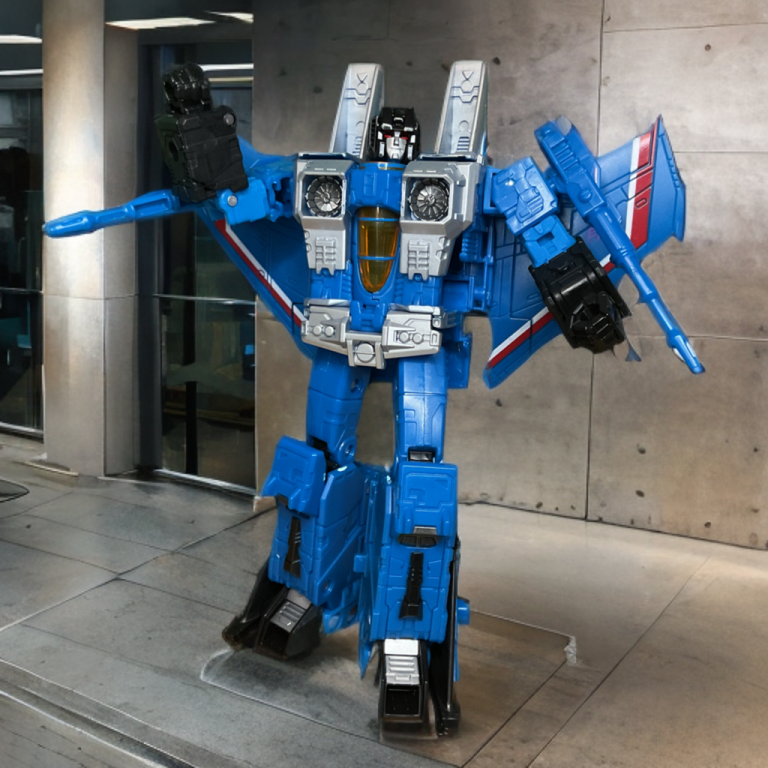
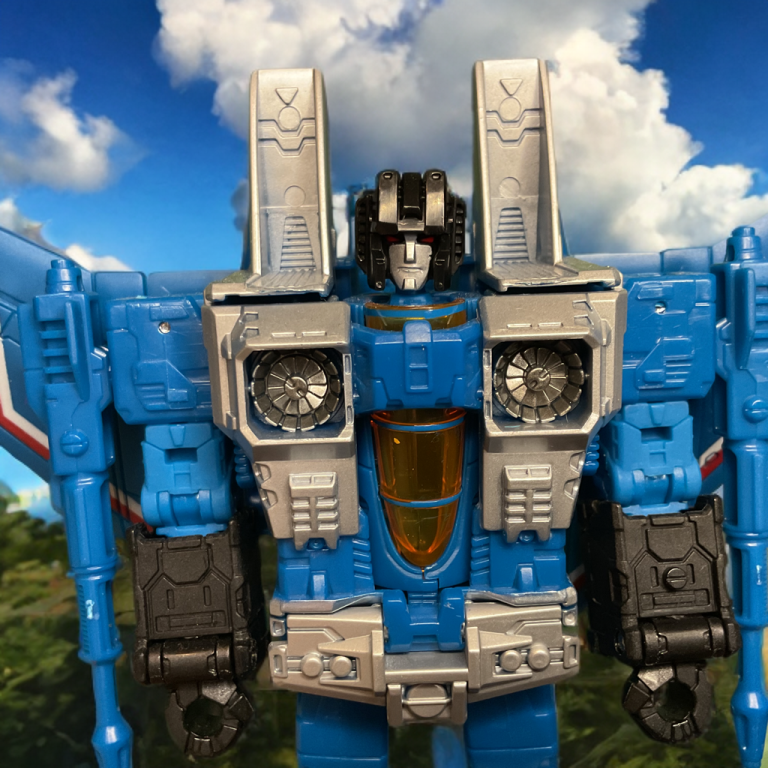
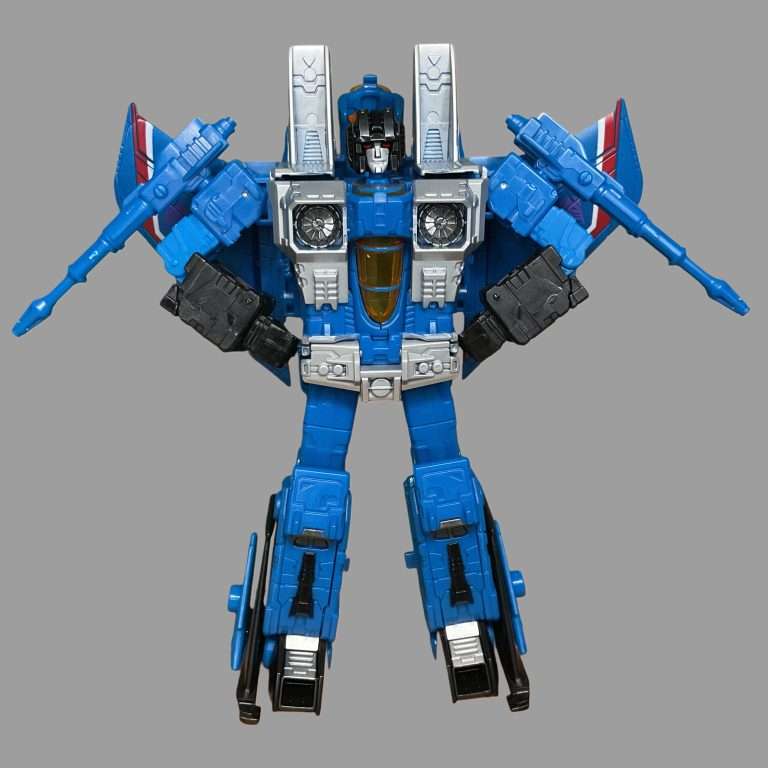
Thundercracker is typically depicted as a sleek, blue-and-black Cybertronian jet with a humanoid robot mode. His alternate mode is most commonly an F-15 Eagle in G1, though modern continuities like the Transformers live-action films and War for Cybertron update him to an F-22 Raptor or similar advanced fighter jet. His color scheme—predominantly blue with black and silver accents—distinguishes him from his fellow Seekers.

Abilities & Vulnerabilities Matrix
Tactical breakdown of Thundercracker's combat profile
| Key Abilities | Weaknesses |
|---|---|
|
Sonic Boom Generation
Thundercracker’s signature ability is creating powerful sonic booms with his jet engines, capable of disorienting enemies, shattering structures, or causing widespread destruction. This ability is often highlighted in both combat and narrative contexts.
Flight and Aerial Combat
As a Seeker, Thundercracker is a master of aerial warfare, boasting superior speed, agility, and maneuverability. His jet mode allows him to engage enemies in high-speed dogfights.
Firepower
Equipped with arm-mounted lasers, missiles, and occasionally a fusion cannon, Thundercracker is a formidable combatant in both robot and jet modes.
Durability
Like most Decepticons, he possesses significant durability, though he is not as heavily armored as ground-based warriors like Megatron or Soundwave. |
Moral Conflict
Thundercracker’s doubts about the Decepticon cause can make him hesitate in battle or question orders, putting him at odds with his comrades.
Arrogance
As a Seeker, he shares the group’s characteristic pride, which can lead to overconfidence or underestimating opponents. |
Personality and Characterization: The Reluctant Decepticon
Thundercracker is defined by a deep-seated internal conflict—a narrative trait that sets him apart from the more straightforwardly villainous Decepticons. While he is loyal to Megatron and actively participates in the Decepticon campaign to conquer Cybertron and Earth, he often questions the morality of their actions.
This tragic ambivalence is rooted directly in his original 1984 G1 toy biography, penned by Marvel editor Bob Budiansky. The bio established a fascinating psychological duality: Thundercracker possesses the aristocratic arrogance common to the Seeker elite—noting that he “despises those who cannot fly” and views ground-bound lifeforms as evolutionary dead ends—yet he harbors profound “doubts about the Decepticon cause.” He is not fully committed to the Decepticon ideology of total conquest and subjugation. Instead, he is a soldier trapped between his natural aerial superiority and a quiet, persistent conscience. This distinct moral grayness makes him a highly nuanced character, caught between military duty, peer pressure from his fellow Seekers, and his own internal ethical boundaries.
Key Personality Traits
The psychological profile of a reluctant warrior
| Trait | Description & Behavior |
|---|---|
| Prideful | As a Seeker, Thundercracker takes deep pride in his aerial prowess and looks down on ground-based Transformers, viewing flight as a definitive mark of evolutionary superiority. |
| Honorable | Unlike Starscream’s persistent treachery or Skywarp’s casual cruelty, Thundercracker possesses a strong sense of personal honor. This often manifests in his reluctance to harm innocent bystanders or his choice to spare weaker opponents. |
| Conflicted | His deep-seated doubts about the righteousness of the Decepticon cause create a constant internal tension, clashing directly with his military loyalty to Megatron and his brotherhood with his fellow Seekers. |
| Introspective | In multiple major continuities, he is portrayed as deeply reflective. Rather than reveling in destruction, Thundercracker actively questions his own role in the war and ponders the heavy cost of the Cybertronian conflict. |
This complexity has made Thundercracker a fan-favorite, especially in continuities like the IDW Comics, where his character is explored in greater depth.
Role Across Transformers Continuities
Thundercracker’s evolution within the Transformers franchise serves as a primary example of how a secondary character can be transformed by varying creative visions. His journey spans from a functional grunt in 1980s media to a fully realized, introspective anti-hero in modern comic iterations.
Generation 1: The Foundation of the Seeker Elite
In the 1984 Sunbow animated series, Thundercracker occupies a tactical role as a loyal Seeker reporting directly to Starscream. While he appears frequently in early episodes to facilitate Megatron’s plans—often utilizing his signature sonic boom ability in iconic engagements like “Fire in the Sky”—the characterization in this medium remains functional rather than deep. He is frequently utilized as a backdrop to the more overt schemes of Starscream or the unpredictable brutality of Skywarp. His G1 animated tenure concludes abruptly in the 1986 film, The Transformers: The Movie, where he is discarded by Starscream and subsequently reformatted by the planet-eater Unicron into the tracker known as Scourge, effectively removing the original Thundercracker from the narrative.
The Marvel Comics continuity, which ran concurrently with the animated series, offers a slightly more nuanced take. Within the American and British comic runs, Thundercracker remains firmly within the Decepticon ranks, yet writers frequently peppered his dialogue with subtle hints of ideological fatigue. He maintains a more consistent presence in the UK-exclusive storylines, where he engages in high-stakes combat against groups like the Dinobots. Despite this increased panel time, his trajectory mimics the cartoon, ultimately leading to his reformatting into Scourge following the events of the film adaptation, which serves as a hard narrative ceiling on his development during the 1980s.
The IDW Publishing Era: A Character Reimagined
The IDW Publishing continuity (2005–2018) stands as the definitive exploration of Thundercracker, elevating him from a background soldier into one of the most sympathetic figures in Cybertronian history. In the early stages of this run, spanning Infiltration through All Hail Megatron, he is introduced as a conventional, loyalist Seeker. However, creators began weaving in intentional fissures in his loyalty, depicting him as a soldier who experiences increasing internal dissonance as he witnesses the indiscriminate destruction the Decepticons inflict upon Earth.
This discomfort evolves into a full-scale abandonment of his former life following the war’s escalation on Earth. During the Transformers ongoing series that began in 2009, Thundercracker is depicted as a lone survivor of the conflict, finding himself stranded on a planet he was previously tasked with conquering. It is here that he undergoes a radical psychological transformation, fueled by a genuine fascination with human media and storytelling. This newfound appreciation for human culture serves as a catalyst for his humanity, most notably symbolized by his adoption of a dog named Buster and his sincere attempts to navigate a peaceful existence far removed from Megatron’s shadow.
As the narrative shifts into the Robots in Disguise and Optimus Prime series, Thundercracker solidifies his status as a reluctant ally to the Autobots. He becomes an active protector of his adopted world, forging genuine connections with human figures such as Marissa Faireborn. His characterization becomes defined by a quirky, recurring obsession with writing screenplays, a detail that perfectly encapsulates his shift from a combatant to an introspective individual seeking purpose beyond violence. His ultimate decision to defend Earth from a terminal Decepticon threat in Optimus Prime marks his final transition into a bona fide hero, proving that his gruff Seeker pride was never a barrier to his fundamental capacity for empathy.
Key Relationships
Allies, leaders, and companions shaping his moral journey
| Character | Dynamic & Significance |
|---|---|
| Starscream | As his immediate Seeker commander, Starscream demands Thundercracker's military obedience, but receives little genuine respect. Thundercracker deeply distrusts Starscream's constant treachery and lack of personal honor, a rift that widens significantly in continuities like IDW where Thundercracker actively rejects the Decepticon path. |
| Skywarp | Thundercracker shares a tight-knit camaraderie and military brotherhood with his fellow wingman. However, this close bond is defined by a stark moral contrast: Skywarp's casual cruelty and malicious pranks stand in opposition to Thundercracker's quiet, honorable reluctance to harm the weak. |
| Megatron | Thundercracker's loyalty to Megatron is driven more by fear of his leader's immense wrath than true ideological alignment. While he respects Decepticon power, he is privately repulsed by Megatron's brutal methods, leaving him constantly torn between military allegiance and his own nagging conscience. |
| Buster (IDW) | In the IDW comic continuity, adopting this small Earth dog serves as the ultimate turning point for Thundercracker's redemption. His fierce protectiveness over Buster symbolizes his growing empathy for human life and his complete departure from the heartless conqueror identity of his past. |
| Marissa Faireborn | His friendship with the human Earth Defense Command (EDC) operative highlights his gradual integration into human society. This unusual partnership bridges the gap between Cybertronian and human, cementing Thundercracker's role as a protector of Earth rather than its destroyer. |
Modern Gaming and CGI Television: The High Moon and Netflix Eras
Thundercracker’s role in modern digital media often returns him to his classic military roots, prioritizing his tactical function as a heavy aerial combatant. In High Moon Studios’ acclaimed video games, Transformers: War for Cybertron (2010) and Transformers: Fall of Cybertron (2012), he serves as a prominent playable character and boss-level asset within the Decepticon campaign. These games emphasize his mechanical prowess, showcasing his devastating sonic attacks and elite aerial maneuvering during high-stakes dogfights over Cybertron.
This stoic portrayal carried over into the subsequent Netflix animated adaptation, the Transformers: War for Cybertron Trilogy (2020–2021). Within this grittier, war-torn CGI narrative, Thundercracker operates primarily as a silent, formidable soldier within Starscream’s Seeker division. While the series focuses heavily on the bleak desperation of the dying planet, it offers little room to explore his deeper moral hesitation or his philosophical doubts about Megatron’s campaign. Instead, he remains a dedicated, highly efficient instrument of Decepticon air superiority, serving as a bleak reminder of his starting point before his eventual redemption arcs in other media.
The Live-Action Cinematic Universe: Background Warfare
Within the live-action films directed by Michael Bay, Thundercracker’s presence is incredibly brief and largely defined by the production team’s reliance on “seeker cloning”—the cinematic practice of reusing CGI fighter jet models to populate massive battle scenes. His first heavily debated appearance occurs in the groundbreaking 2007 film Transformers. While not named on screen, an F-22 Raptor sporting a familiar silhouette participates in the final battle of Mission City, leading many dedicated fans to identify the jet as Thundercracker acting as aerial backup for Starscream.

His official, named cinematic debut occurs briefly in Transformers: Dark of the Moon (2011). He is visually established during the climactic, devastating invasion of Chicago, soaring through the skyline alongside other Decepticon air units. Because the live-action narrative prioritizes human survival and the primary leadership of Starscream and Megatron, Thundercracker receives no individual characterization or dialogue before his off-screen demise during the battle. In the films that followed, his design was occasionally adapted for toy lines, but the films themselves shifted focus to other Decepticon threats, leaving his live-action legacy as a brief easter egg for sharp-eyed collectors.
Alternate Realities: Ego, Tie-Ins, and Comedy
In other television and multimedia continuities, creators have taken highly unique approaches to Thundercracker, occasionally turning his classic traits on their head. In the stylized series Transformers: Animated (2007–2009), he appears as a direct clone of Starscream. In this universe, Starscream’s clones each inherit one dominant, exaggerated aspect of the original’s personality; Thundercracker receives Starscream’s colossal, unchecked ego. This results in a brilliant, comedic caricature who is utterly convinced of his own unmatched brilliance and perfection, presenting a hilarious contrast to the quiet, self-doubting warrior of G1 lore.
While Thundercracker is entirely absent from the main television screen in the CGI series Transformers: Prime (2010–2013), he maintains a presence in the universe’s extensive tie-in literature and comic books. In these canonical side-stories, writers paid direct homage to his classic roots, depicting him as a high-ranking Seeker who quietly harbor serious doubts about the horrific scale of Megatron’s war, even as he executes his missions.
Finally, in the modern series Transformers: Cyberverse (2018–2021), Thundercracker returns as a recurring secondary antagonist. While he remains a loyal soldier to the Decepticon cause, the show infuses him with a lighthearted, modern meta-humor. He is frequently depicted as being desperately obsessed with receiving personal recognition and being noticed by his peers, a playful nod to his decades-long history of being overshadowed by his more loudmouth Seeker brothers.
Cultural Impact and Legacy
Thundercracker’s evolution from a functional, secondary Decepticon into a highly complex, redeemable anti-hero represents one of the most successful long-term character redemptions in the entire Transformers franchise. While many early characters remained permanently anchored to their simplistic 1980s paradigms, his groundbreaking narrative arc in the IDW Publishing comics deeply resonated with fans. By shifting his focus away from perpetual warfare to explore mature themes of personal identity, individual agency, and post-war rehabilitation, IDW established a gold standard for modern Transformers storytelling. His endearing, highly unique fascination with human cinema—particularly his earnest, comedic attempts to draft his own Hollywood screenplays—offered a brilliant layer of vulnerability that made him arguably the most humanized and relatable Decepticon across forty years of lore.
This rich narrative depth is directly reflected in the character’s immense popularity within global fan communities. On major discussion platforms and social media, enthusiasts consistently champion Thundercracker’s nuanced growth as a masterclass in comic book character development, citing his journey as proof that the franchise can deliver sophisticated, emotionally resonant narratives.
Merchandise and Collector Appeal
From a merchandising standpoint, Thundercracker has maintained an enduring presence as an absolute favorite among action figure collectors. This prestige began with his highly sought-after original 1984 G1 toy and has carried through to premium modern iterations, such as the Takara Tomy and Hasbro Masterpiece releases, which capture his sleek F-15 Eagle alt-mode with high-end screen accuracy.
Because of his status as an essential member of the iconic Seeker trio alongside Starscream and Skywarp, Thundercracker is a foundational pillar of Hasbro’s production strategies. He has historically been a premier candidate for highly anticipated repaints and retools across generations. For years, acquiring a classic-style Thundercracker was a notorious challenge for collectors, often restricted to exclusive, high-priced convention releases like BotCon 2007. However, mainstream retail releases—including the highly praised Classics line, the Generations Deluxe Class, the massive Combiner Wars Leader Class, and the incredibly articulate Studio Series 86 Voyager Class—have made his striking, signature blue-and-silver color scheme accessible to the wider collecting public. For toy enthusiasts, displaying Thundercracker alongside his fellow Seekers is not just a visual highlight of their shelves; it is a physical representation of the franchise’s rich history of moral grayness.
Themes and Symbolism
At his core, Thundercracker brilliantly embodies the classic literary archetype of the reluctant warrior. Unlike his Decepticon brothers who find joy in wanton chaos, he symbolizes the quiet, exhausting struggle between institutional duty and an awakening personal morality. He represents the tragedy of a soldier who is trapped in a toxic system not by malice, but by the crippling fear of his leadership and an intense, almost defensive pride in his own natural-born talents.
His extensive journey in modern literature, particularly the IDW continuity, elevates him to a profound symbol of redemption and self-definition. By choosing to step away from a millions-of-years-old civil war, settle on an alien planet, and pursue peaceful, creative interests, Thundercracker demonstrates that past atrocities do not lock a person into a lifetime of destruction. His narrative arc serves as a powerful testament to finding purpose in a shattered, post-war reality, deeply engaging readers who appreciate complex, morally gray characters who must actively work every single day to choose a better path.
Notable Appearances
Essential media, classic episodes, and definitive comic runs
| Media / Continuity | Key Episodes, Issues & Titles |
|---|---|
| G1 Animated Series | Featured heavily in the three-part pilot More Than Meets the Eye, showcased his signature sonic boom in Fire in the Sky, and met his ultimate fate in The Transformers: The Movie (1986). |
| Marvel Comics | Appeared across various classic US releases, alongside stand-out combat roles in the UK-exclusive issues #17 and #18 prior to his eventual reformatting. |
| IDW Publishing Comics | His complete character evolution is charted through major story arcs including All Hail Megatron, his crucial turning point on Earth in The Transformers #31, followed by central roles in the Robots in Disguise and Optimus Prime series. |
| Video Games | Featured as a high-speed playable combatant and key campaign character in High Moon Studios' Transformers: War for Cybertron and its sequel Transformers: Fall of Cybertron. |
| Netflix CGI Series | Served as a stoic, frontline Seeker soldier fighting during the final days of the civil war in both the Siege and Earthrise chapters of the War for Cybertron Trilogy. |
Conclusion
Thundercracker stands as a premier example of the narrative depth achievable within a franchise born from action figures. His transition from a standard Decepticon Seeker to a deeply conflicted, redeemable anti-hero proves that compelling storytelling can thrive in the most unexpected corners of Cybertronian lore. By balancing his formidable aerial prowess and signature sonic boom capabilities with a nagging, persistent conscience, he presents a stark contrast to his purely malicious peers.
Whether he is dominating the skies of Cybertron out of fear and military duty or actively grappling with the moral cost of Megatron’s campaign, Thundercracker represents the enduring appeal of the morally gray warrior. It is this unique friction between his elite Seeker pride and his fundamental capacity for empathy that has cemented his legacy. Ultimately, his journey guarantees his place not just as a striking blue centerpiece on a collector’s shelf, but as one of the most psychologically rich and genuinely humanized characters in the entire Transformers mythos.
 English
  Deutsch
  Français
  Português do Brasil
  日本語
日本語  Español
  English (Australia)