

Why Does a Snake Need a Staff? 6 Most Useless 1980s Action Figure Accessories Ever Made
Back in the golden age of 5½-inch plastic glory, toy companies operated under one sacred rule: more accessories = better toy. Cardback art promised epic battles, endless play possibilities, and heroic (or villainous) warriors fully armed for anything Eternia, Cobra Island, or Cybertron could throw at them.
Then you popped the blister.
Suddenly your stretchy snake warrior was handed a rigid little staff his rubber arms couldn’t grip. Your flying bee got a battle axe his claws couldn’t hold. Your wall-crawling spider received a loud orange laser rifle that screamed “stealth mission ruined.” And don’t even get us started on the firefighting elephant who couldn’t stand up straight once you gave him a heavy axe the size of a telephone pole.
Welcome to the Pointless Accessories Hall of Fame — a no-holds-barred audit of 1980s ergonomic disasters. These are the weapons and gear that looked killer on the packaging but became instant carpet orphans the moment real play began. We’re talking accessories so useless they insulted the character’s own gimmick… yet collectors still pay premium prices today just to own the “loose complete” version.
Editor’s Note: A Moment of Silent Rot
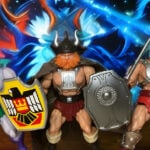
Sharp-eyed “toy historians” (the kind who smell vintage plastic and can identify the factory of origin by the scent of the off-gassing) may notice that some of the photography in this article features Masters of the Universe Origins figures rather than their 1980s counterparts.
While we strive for 1984-levels of authenticity, several of our resident vintage warriors are currently sidelined. Due to a catastrophic case of Leg Band Dry Rot, their limbs are held on by little more than nostalgia and a prayer. To avoid a photoshoot that looked more like a battlefield triage unit than an action-figure retrospective, we’ve subbed in the modern versions. Rest assured, the accessories remain just as ergonomically offensive as they were forty years ago.
— The Management
Because nostalgia doesn’t care about physics.
So grab your magnifying glass, dust off that old toy box, and let’s roast the worst offenders from Masters of the Universe — plus a few dishonorable mentions from other lines that prove the entire 1980s toy aisle was guilty.
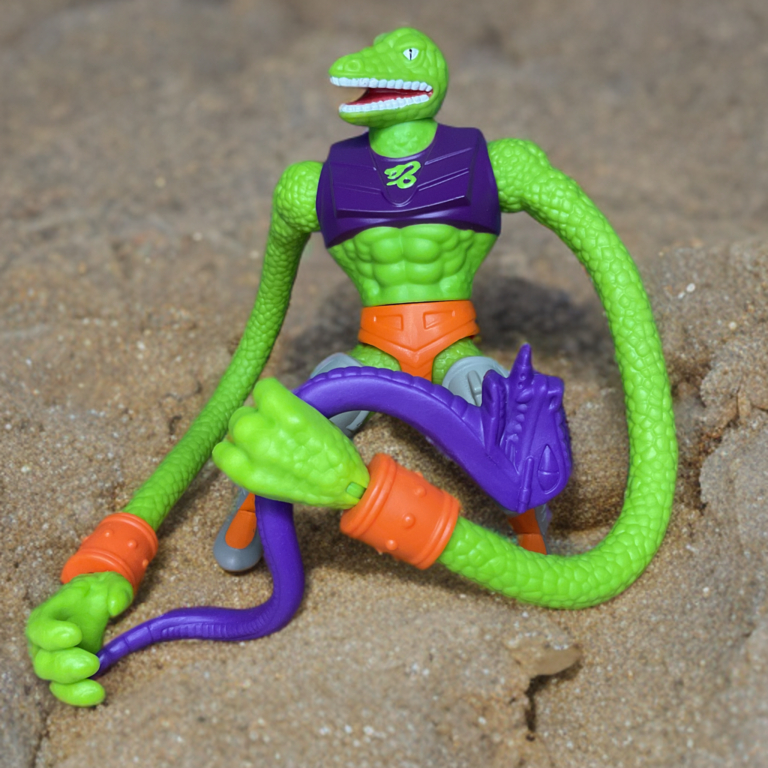
Sssqueeze (Masters of the Universe, 1987) – The “Snake-ception” Staff
The Figure & The Gimmick
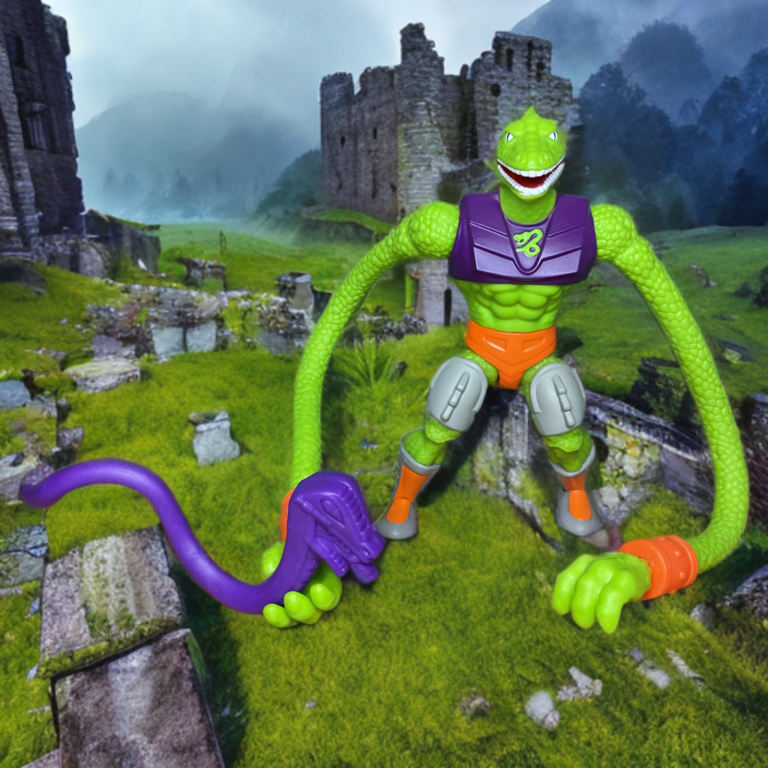
Sssqueeze from the Snake Men was the pinnacle of Wave 6’s “more is more” engineering. While earlier figures relied on spring-loaded waists, Sssqueeze was a tactile masterpiece. His lime-green, wrap-around rubber arms were designed to constrict Heroic Warriors in a literal boa grip. His hands weren’t even hands—they were sculpted snake heads. He was a walking, squeezing nightmare, and the cardback art promised a warrior who could out-wrestle He-Man from six feet away.
Ergonomics Roast: A Case Study in Carpal Tunnel
A Snake Holding a Snake Then came the accessory: a rigid, purple, unpainted Snake Staff. It is the undisputed king of redundant plastic. Trying to make Sssqueeze hold this staff is less about “play” and more about an ergonomic intervention. If you handed a contortionist a briefcase and told him to look tactical while halfway through a backbend, you’d have the visual equivalent of this figure’s combat stance.
The Logical Loop: Why does a man whose arms are giant snakes need to carry a smaller, less effective plastic snake? It’s like giving a professional weightlifter a picture of a dumbbell to carry while he’s training. Sssqueeze was literally “The Weapon,” yet Mattel felt the need to give him a sidearm that was essentially a miniature version of himself.
The Gravity Problem: Sssqueeze’s arms were made of heavy-gauge, poseable rubber over a wire frame. The “Snake Weapon” had a standard straight handle, but Sssqueeze had no opposable thumbs—just fanged snake muzzles. Trying to wedge the staff into his “hand” usually resulted in the arm slowly drooping toward the floor under the weight of the plastic. Instead of an intimidating warrior, he ended up looking like a tired gardener holding a wilted hose.
The Carpet Orphan: Because the staff didn’t “snap” into his grip, it was the first thing to fall off during a backyard battle. It is the reigning champion of the “Found in the Vacuum Cleaner” category of 1980s toys. If you find a vintage Sssqueeze today, there is a 90% chance this purple stick is long gone.
Collector Angle: The Price of Redundancy Despite being a logic-defying accessory, the purple Snake Staff is a high-ticket item for completionists.
The “Loose Complete” Tax: A Sssqueeze figure alone might run you $35–$45, but add that tiny purple staff and the price jumps to the $70–$90 range.
Condition Matters: Because the staff was made of a slightly different plastic than the figure, it’s prone to “tackiness” or stress marks. Finding one that isn’t chewed or bent is a true hunt.
The Bottom Line Sssqueeze didn’t need a weapon; he was the weapon. Giving him a staff was Mattel’s way of saying, “We have one more slot in the plastic mold, let’s just make another snake.” It remains the most redundant accessory in the history of Eternia.
Buzz-Off (Masters of the Universe, 1984) – The Battle Axe He Couldn’t Grip
The Figure & The Gimmick
Released in the big 1984 wave, Buzz-Off was marketed as the “Heroic Spy in the Sky.” Part man, part beetle, this bee-warrior came with massive translucent yellow wings, oversized compound eyes (with removable yellow goggles), and most importantly—giant black claw/pincer hands designed for grabbing, pinching, and looking menacing from above. His whole sculpt screamed “aerial scout and stinger specialist.” The cardback art showed him buzzing around Eternia, wings spread, ready to dive-bomb villains.
Then Mattel threw in the accessory: a big, chunky brown battle axe (a recolored and slightly modified version of the Castle Grayskull weapons-rack axe, complete with an extra loop on the handle for “better” gripping).
Ergonomics Roast: Why This Accessory Was Pure Comedy
Those giant claw hands were never meant to hold standard weapons. The pincers are curved and hook-like, perfect for snatching enemies or perching dramatically—but terrible for wrapping around a straight axe handle.
Try it yourself (every kid who owned him did):
• Jam the axe in → it either falls out the instant you move the arm, or
• It sits at a ridiculous 45-degree angle so Buzz-Off looks like he’s doing some avant-garde interpretive dance instead of swinging for the fences.
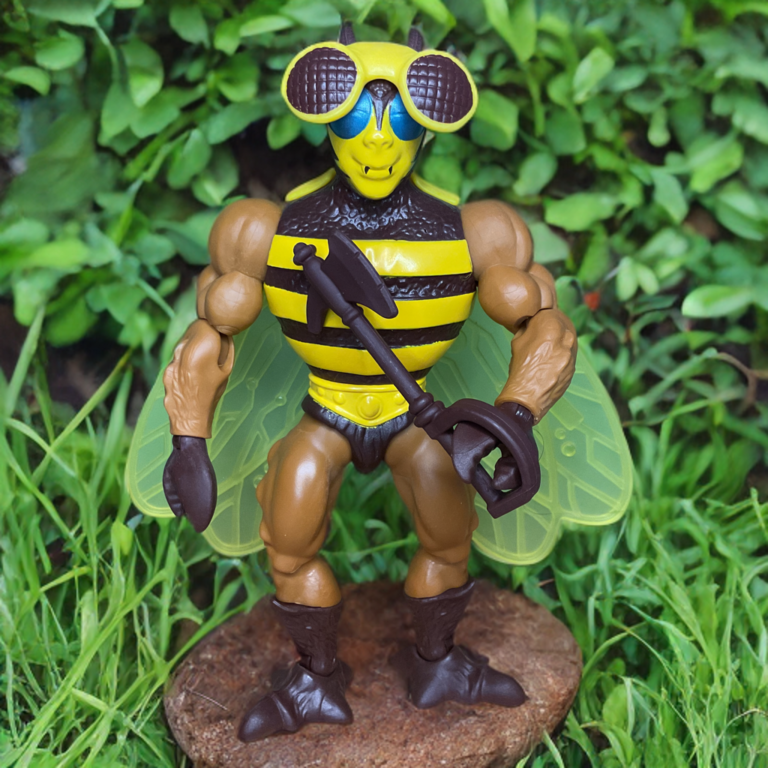
The axe is basically a prop for a character whose entire fantasy was “I fly around and sting people from the air.” Why give the flying bee a heavy melee weapon when his wings and claws already did all the heavy lifting in the cool-factor department?
Collectors have been complaining about this exact issue since 1984. One longtime fan recalled getting him for Christmas ’84 and immediately being disappointed: “The extra hat thingy was crap and he could not hold his axe properly.” Mattel even tried to fix it with that little loop on the handle… it didn’t work terribly well. If the claws had been rotated 90 degrees, maybe it would have made sense. As it stands, the battle axe was dead on arrival for actual play.
Bonus Uselessness
The translucent wings were already the star of the show—they looked incredible when backlit and made Buzz-Off feel like a true aerial threat. The axe just sat there looking lonely on the floor while kids used the figure for buzzing fly-bys and dramatic stinger attacks instead.
Collector Angle: Why People Still Hunt the “Complete” Version
Even though the battle axe added almost zero play value, it’s essential for completionists. Search terms like “Buzz-Off battle axe loose” or “vintage MOTU Buzz-Off complete”on eBay tell the story:
• Loose complete figures (figure + brown axe + goggles + mini-comic) in nice condition regularly sell in the $60–$120+ range depending on paint and wing condition.
• The axe itself is small, easy to lose, and shows up frequently as a “weapon only” part for $10–$25.
• Carded examples? Expect $250–$400+ for a solid one.
That “loose complete” premium proves nostalgia beats logic every time—collectors pay extra just to own the full original set, even if the axe spent most of its life as a carpet orphan.
The Bottom Line
Buzz-Off is peak 1980s toy design logic: Give the flying insect warrior giant claws that can’t hold anything, then hand him a big melee axe anyway. It’s like giving a helicopter a sword and expecting it to work in close combat. The wings carried the figure; the axe was just along for the (very short) ride.
Got a vintage Buzz-Off in your collection? Try the “epic battle pose” with the axe and share how long it stayed in his hand. We already know the answer—pure 1984 chaos.
Webstor (Masters of the Universe, 1984) – The Laser Rifle That Made No Sense
The Figure & The Gimmick
Dropping in the massive 1984 wave alongside Buzz-Off and other heavy hitters, Webstor was billed as the “Evil Master of Escape.” This half-man, half-spider nightmare came with a creepy blue body, red eyes, four extra spider legs sprouting from his back, clawed hands and feet, and a purple backpack rigged with a real working zip-cord mechanism. Hook the grappling line to a high shelf or door, yank the cord, and Webstor would “climb” up like the ultimate stealth infiltrator. Cardback art showed him dramatically scaling castle walls while He-Man and Teela looked on in frustration—pure web-slinging, wall-crawling villain vibes.
Then Mattel tossed in the accessory: a bright orange laser rifle (a new mold at the time, sometimes resembling a futuristic crossbow or blaster with a stock and barrel). It looked cool in isolation… but on Webstor? Total head-scratcher.

Ergonomics Roast: Why This Accessory Was Peak Parts-Bin Logic
Spiders don’t use ranged weapons. They spin webs, drop from ceilings, and pounce. Webstor’s whole identity is silent infiltration and escape—yet here he is with a loud, bright orange blaster that screams “I’m about to announce my presence with authority.”
His hands are clawed and hooked for gripping walls and prey, not for comfortably wrapping around a trigger guard. Jam the rifle in and it either:
• Sits at a weird angle like he’s awkwardly pointing it with his elbow, or
• Slips out the second you try any dynamic pose because those spider claws have zero flat gripping surface.
It feels exactly like Mattel raided the parts bin, grabbed a random gun mold, painted it orange to match the weapons pack aesthetic, and said “good enough for the spider guy.” The rifle is awesome on its own (many collectors still love it for custom displays), but on Webstor it’s the action-figure equivalent of giving Batman a fishing rod. His grappling hook and extra limbs were already doing all the heavy lifting—why saddle him with a noisy blaster he can barely hold?
Early production runs even had color quirks (some rifles matched his body tone before switching to the standard orange), adding to the “thrown together” feel. Kids quickly ditched the gun for pure grappling-hook play while the rifle became another eternal carpet dweller.
Collector Angle: Why “Webstor Laser Rifle Loose” Still Sells
Even though the accessory added almost zero thematic or play value, completionists chase it hard. Search “Webstor laser rifle loose”, “Webstor crossbow complete”, or “vintage MOTU Webstor complete” on eBay and the results prove nostalgia > logic:
• Loose complete figures (Webstor + orange laser rifle + purple backpack/grappling hook + mini-comic) in nice condition go for $50–$90+.
• The rifle alone (easy to lose, prone to stress marks) sells for $10–$25 as a single part.
• Carded examples? Still command $175–$300 depending on condition.
That “loose complete” premium is real—people pay extra just to have the full original blister contents, even if the rifle spent most of 1984–85 lying face-down on the bedroom floor.
The Bottom Line
Webstor is living proof of 1980s toy design at its most gloriously illogical. Give the web-slinging, wall-climbing spider-man a loud orange laser rifle he can barely hold, then market him as a master of stealth and escape. It’s like equipping a ninja with a foghorn. The grappling hook carried the fantasy; the rifle was just there for the cardback checklist.
If you’ve got a vintage Webstor in your collection, try the “sniper from the ceiling” pose with the rifle and report back how long it stayed in his claws. Spoiler: not long. Pure 1984 chaos at its finest.
Behold—the spider who brought a gun to a web fight.
Whiplash (Masters of the Universe, 1984) – The Redundant Lizard Spear
Quick correction for accuracy: While he’s an “Evil Tail-Lashing Reptile,” Mattel didn’t give him a club or a mace to match his brute aesthetic. Instead, he came with a long, thin, bright orange spear—a straight-up recolor of the weapon found in the Castle Grayskull armory. It’s a baffling choice. Why give a guy with a six-inch heavy rubber bludgeon attached to his spine a tiny plastic stick? It’s the action figure equivalent of a tank carrying a pocket knife.
The Figure & The Gimmick
Released in Wave 3 (1984), Whiplash was an instant standout thanks to his massive, scaly green tail. His big selling point was the “tail-thrash” action: the tail was made of a heavy, flexible rubber and wrapped around his waist.
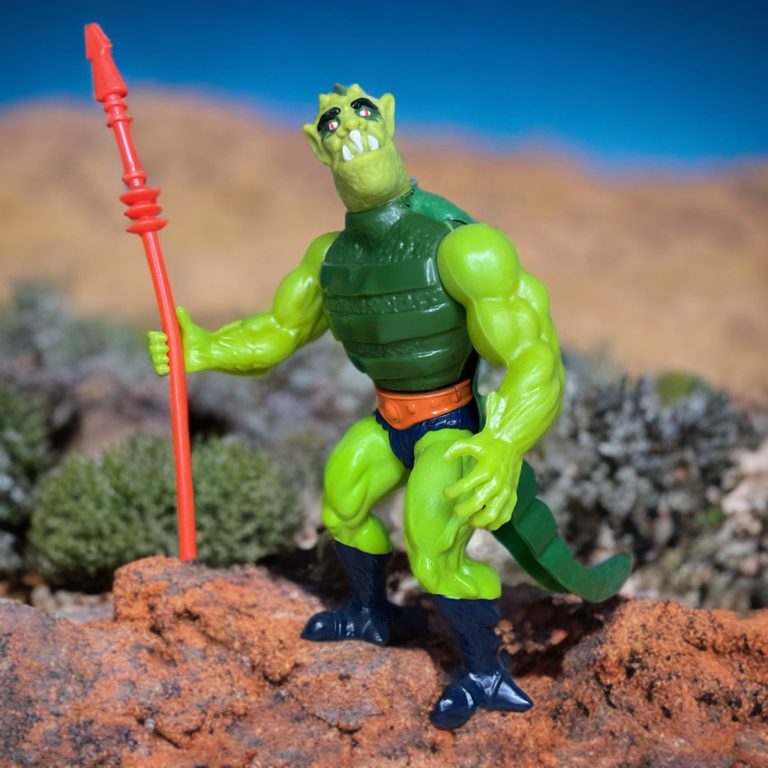
By twisting his spring-loaded torso and letting go, the tail would whip around with enough force to genuinely knock over other figures (and occasionally leave a mark on a younger sibling). With his lizard-man sculpt, teal scales, and mean overbite, he looked like a close-quarters brawler who lived for the crunch of a tail-strike.
Ergonomics Roast: Why This Accessory Was DOA
The spear was fundamentally at odds with the figure’s physics. Whiplash was built for rotation, but the spear was built for… well, nothing he did.
The “Self-Sabotage” Swing: To use his tail-thrash gimmick, you have to twist the torso. If you put the spear in his hand, the long shaft almost always clutched into his own tail or hit his legs during the rotation, effectively acting as a brake on his only cool feature.
The “Hook” Grip: Whiplash’s hands were sculpted in a specific “hook” style. The spear handle was just thin enough that it didn’t “snap” into place; it just sat there. The moment you triggered the spring-loaded tail-flick, the centrifugal force usually sent the orange spear flying across the room before the tail even made contact.
Logic Fail: If Whiplash is close enough to poke a Heroic Warrior with that spear, he’s too close to swing that massive tail. It’s a redundant accessory that actually makes the figure less fun to “fight” with.
Collector Angle: Why People Still Hunt the “Complete” Version
Because that bright orange plastic is a beacon for completionists, the “Spearing Spear” remains a high-priority hunt on the secondary market.
Loose complete figures (Whiplash + orange spear + mini-comic) in good condition typically fetch $60–$100.
The spear itself is a notorious “carpet orphan.” Because it’s thin and neon orange, it was easily lost or chewed by the family dog. Finding a vintage original that isn’t bent or covered in stress marks will cost you $20–$35 just for the plastic accessory.
Carded versions? A mint Whiplash on a 1984 card can easily clear $300–$500. Collectors need that spear to make the shelf look “right,” even though we all know the first thing we’d do is take it out of his hand so he can actually swing his tail.
The Bottom Line
Whiplash is a masterclass in “Parts-Bin Padding.” His tail was one of the most effective and tactile gimmicks in the entire MOTU line—he didn’t need a weapon, he was the weapon. Giving him a spear was like giving a bulldozer a bayonet; it’s unnecessary, gets in the way of the heavy lifting, and usually ends up lost in the dirt.
If you’ve got a vintage Whiplash, try to pull off a “spear-and-tail” combo move. You’ll quickly find out why most of these spears ended up at the bottom of the toy box by 1985.
Man-At-Arms (various MOTU releases, 1982–1987) – The Overloaded Tool Belt Syndrome
The Figure & The Gimmick Duncan, better known as Man-At-Arms, is the ultimate “Heroic Master of Weapons” and He-Man’s right-hand man. Debuting in the very first 1982 wave and appearing in nearly every subsequent release (including the 1984 armor variant and Battle Armor versions), this green-skinned, mustachioed warrior came loaded for bear. His classic look included a blue helmet with a fixed faceplate, orange/red battle armor pieces, brown boots, and of course his signature oversized mace. Cardback art always portrayed him as the ultimate gadget guy—standing tall with a workshop full of tools, ready to repair anything from the Wind Raider to the Jawbridge.
Mattel didn’t hold back on the plastic. Depending on the release, you got:
The big spiked mace
Removable orange battle armor chest plate
Snap-on left arm guard and left leg guard
Sometimes a mini-comic or cross-sell poster
In theory, he was the ultimate tactical specialist. In practice? He suffered from severe Overloaded Guard Syndrome.
Ergonomics Roast: Too Much Bulk, Not Enough Coverage
Man-At-Arms is supposed to be Eternia’s premier weapons master and inventor. So why did Mattel give him a pile of asymmetrical armor pieces that were logically flawed and physically difficult to keep on during play?
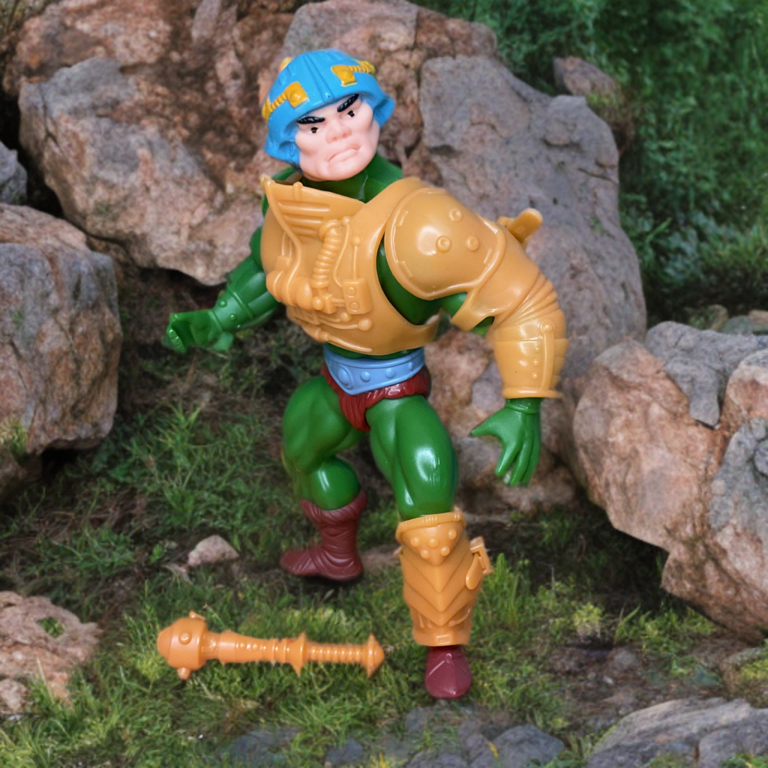
The problems stacked up fast:
Those snap-on armor pieces were notoriously finicky—the tiny tabs would stress or snap, and the leg guard would pop off the second you tried to make Duncan take a “heroic step” toward Skeletor.
His big mace looked awesome but rarely stayed securely in his grip. The handle was just thick enough that it would slip, twist, or pop out the second you tried any dynamic swing pose.
Trying to outfit him with the full gear turned him into a walking (and toppling) hazard. Because Mattel only gave him armor for his left side, the figure felt visually and physically unbalanced. One wrong move and his leg guard would scatter across the floor like orange confetti.
It’s the classic 1980s “more is better” philosophy taken to ridiculous extremes—the “protect the left side, forget the right” problem in glorious plastic form. Kids quickly learned to either leave the loose leg guard in the toy box or just use the mace alone while the rest became permanent residents of the “lost parts” drawer.
Bonus Uselessness
His removable chest armor was cool for customization… until you realized the clips would stretch and the armor would rattle. He was at his best when stripped down to basics—proving that sometimes less really is more, even for the Master of Weapons who seemingly forgot to armor his dominant sword-fighting arm.
Collector Angle: Why People Still Hunt the “Complete” Version
Despite the frustration factor, Man-At-Arms remains one of the most sought-after figures for completionists. Search terms like “Man-At-Arms mace loose”, “vintage MOTU Man-At-Arms complete”, or “1982 Man-At-Arms accessories” light up eBay constantly:
Loose complete figures (with mace + chest armor + arm guard + leg guard) in good condition typically sell for $40–$90+ depending on variant and paint wear.
Individual armor pieces (especially the small leg or arm guards) can fetch surprising money because they were the very first things to fall off in a sandbox.
Carded or mint-in-package examples from early waves still command serious collector premiums.
That “loose complete” tax is alive and well—people pay extra just to own every finicky clip, even if half of them spent the 1980s hiding under the refrigerator.
The Bottom Line
Man-At-Arms is the patron saint of Overloaded Guard Syndrome. Mattel gave the ultimate weapons master so many individual, snap-on pieces that he became a walking cautionary tale about “more parts = more things to lose.” The big mace was iconic, but the asymmetrical leg armor was basically designed to disappear. His real superpower? Surviving decades of kids losing half his kit and still looking like the coolest mentor on Eternia.
If you’ve got a vintage Man-At-Arms in your collection, do the ultimate test: try to pose him with every armor piece attached and see how long it takes before that leg guard hits the floor. We already know the answer—pure 1980s toy chaos.
Snout Spout (Masters of the Universe, 1986) – The Droopy Fire Axe
Quick correction for accuracy (because toy historians are brutal): Snout Spout didn’t come with a hose or a ladder—he came with a massive, bright Fire Axe. While it fits the “firefighter” aesthetic, it’s logically hilarious. Why give a guy whose entire head is a high-pressure water cannon a heavy melee weapon? If you’re close enough to swing an axe, you’re way too close to use the giant metal trunk attached to your face. It’s like giving a riot squad water cannon a pocket knife.
The Figure & The Gimmick
Released in Wave 5 (1986), Snout Spout was marketed as the “Heroic Firefighter.” His big selling point was the “water-blasting” action: you popped the plug on his massive silver backpack, filled it with water, and pumped a button on his back to watch a stream of water shoot out of his elephant trunk. He featured a unique, somewhat melancholic robotic elephant head and a sturdy orange and blue sculpt. The whole gimmick screamed “I’m here to douse the fires of Evil-Lyn,” but the execution turned him into a soggy mess.
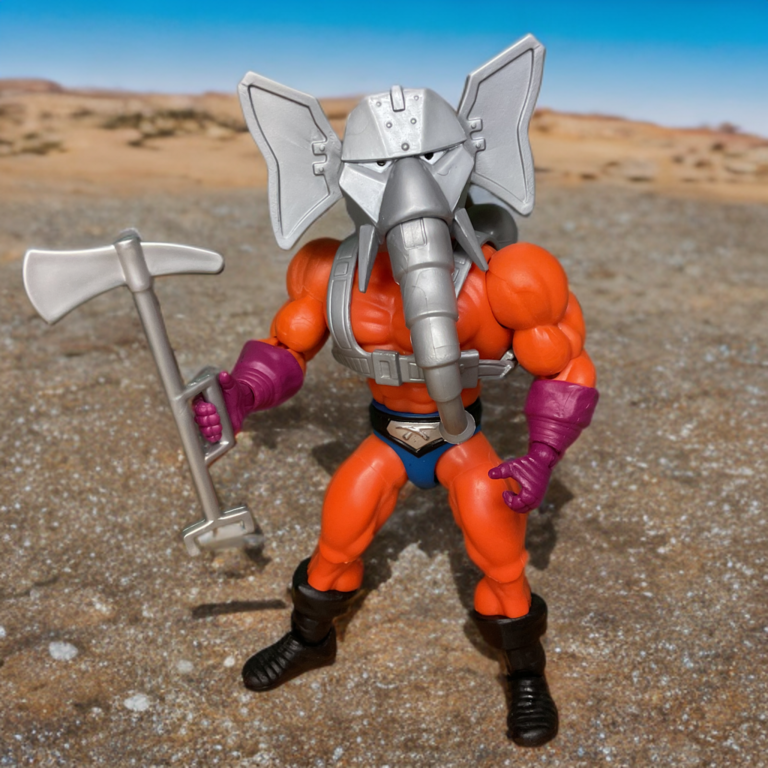
Ergonomics Roast: Why This Accessory Was DOA
The Fire Axe was an ergonomic nightmare for two very specific, plastic-related reasons:
The “Wet Noodle” Grip: To facilitate the water-pumping gimmick, Snout Spout’s torso and arms were often made of a slightly softer, more pliable plastic than the earlier MOTU figures. His hands had almost zero “snap.” Jam the heavy orange axe into his fist, and within seconds, the weight of the blade would cause the handle to slide down until the axe head was resting sadly on his toes.
The Center of Gravity Crisis: Snout Spout was already incredibly back-heavy due to the water reservoir in his backpack. If you tried to pose him with the axe raised in a “heroic strike,” the shift in weight would almost always cause the figure to tip over backward. He was a firefighting elephant who spent most of his time staring at the ceiling of the toy box.
The Gimmick Conflict: Using the water-squirt feature required two hands or a very steady grip on the torso. Trying to hold the axe while pumping the water was a recipe for a dropped weapon and a frustrated kid. Most players ditched the axe immediately to focus on the “wetting down the cat” portion of the afternoon.
Collector Angle: Why People Still Hunt the “Complete” Version
Despite the fact that the axe is a total pain to display, it is a “Holy Grail” for those looking to finish a Wave 5 set.
Loose complete figures (Snout Spout + orange fire axe + plug + mini-comic) in good condition regularly sell for $75–$125.
The axe itself is one of the most lost accessories in the line. Because it’s a separate piece that didn’t stay in his hand, it often ended up at the bottom of a bin or in the vacuum. Finding a loose original axe can cost $30–$50 alone.
Carded versions? Expect to pay $350–$500 for a clear bubble and a non-yellowed snout. The “loose complete” premium is driven by the fact that Snout Spout looks naked without that orange axe, even if the axe is the reason he keeps falling off your shelf.
The Bottom Line
Snout Spout is the poster child for “over-engineering.” Mattel gave us a brilliant, water-squirting elephant-man and then felt the need to toss in a heavy axe he couldn’t hold and didn’t need. His trunk was the star of the show; the axe was just a trip hazard. It’s like giving a fire truck a sword—cool on paper, but a disaster in the driveway.
If you’ve got a vintage Snout Spout, try to get him to hold the axe for more than five minutes without it slipping. We already know the result: a face-plant, a soggy carpet, and pure 1986 chaos.
Honorable Mentions from Other Lines (Because the 1980s Toy Aisle Was a Lawless Place)
Not every pointless accessory came from Eternia. The 1980s were a wild time across the entire action figure aisle—budget lines, military toys, and transforming robots all suffered from the same “more stuff = better toy” disease. Here are some all-star runners-up that deserve a spot in the Hall of Fame.
Remco Mighty Crusaders / Archie Comics Figures (1984) – The Legendary Floppy “Remco Shield”
Remco’s short-lived Mighty Crusaders line (based on the Archie Comics super-team) gave us heroes like The Shield, The Web, and villains with names that sounded like rejected cereal mascots. Almost every figure came with a big, oversized shield—often called the “Secret Sonic Signaling Shield” on the packaging.
The problem? Those shields were comically floppy, oversized, and had weak pegs or tabs that barely gripped the figure’s arm. Pose them in a heroic stance and the shield would sag, twist, or outright fall off like a cheap pizza box lid. Collectors still joke about the “Remco shield” as the ultimate shelf-faller. It’s a running punchline in vintage forums: “If your figure stays upright with the shield attached, congratulations—you’ve achieved the impossible.”
Collector note: Search “Remco Mighty Crusaders shield loose” or “Mighty Crusaders complete” on eBay. Those floppy shields are surprisingly hard to find in good shape, driving up prices for “loose complete” sets even though they never stayed put during actual play.
G.I. Joe 1980s Figures – Tiny Hyper-Specific Tools & Battle Corps Backpacks
Hasbro’s G.I. Joe: A Real American Hero line was famous for its incredible detail… sometimes too much detail. Certain figures (especially in the later Battle Corps era and accessory packs) came with ridiculously tiny tools, hoses, communicators, or specialty backpacks that looked amazing on the cardback but had zero staying power.
Those little bits would pop off with the slightest breeze, roll under the fridge, or get vacuumed up forever. The Battle Corps figures in particular were notorious for floppy backpacks and gear that added visual clutter but almost no play value. It’s the ultimate “too much gear, not enough pegs” syndrome—great for army-building photos, terrible for actual battlefield play.
Collector note: Hunt for “G.I. Joe Battle Corps backpack loose” or specific accessory packs. The tiny pieces command decent money because everyone lost them in the early 90s.
Transformers Generation 1 (1984–1988) – The King of Colored Plastic Kibble
Ah, the grand champion of useless accessories: Transformers G1. Many figures came with weapons, missiles, or “tools” that were basically random colored plastic kibble with no clear attachment point once the robot transformed into a vehicle, cassette, or gun.
Some guns didn’t store anywhere in vehicle mode. Some “weapons” were just extra panels that looked cool in robot form but became pointless dangling bits in alt-mode. Fans still debate the absolute worst offenders in collector forums—everything from paper-thin stickers to projectiles that launched themselves into oblivion the first time you transformed the toy.
It was peak 1980s logic: “We made him turn into a truck… now give him a gun he can’t hold and nowhere to put it.” The kibble added to the “complexity” marketing, but in real life it just became shelf decoration or floor hazards.
Collector note: Search “G1 Transformers useless accessories” or specific “kibble” complaints. Some of those random weapons still sell surprisingly well to completionists who refuse to display a figure without every original part.
The Bottom Line on These Honorable Mentions
Whether it was a floppy Remco shield, a vanishing G.I. Joe backpack, or a pile of G1 kibble that served no purpose in either mode, the 1980s toy industry proved one universal truth: if it could be molded in plastic and shoved into a blister pack, it was going on the figure—playability and common sense be damned.
These cross-line offenders show that MOTU wasn’t alone in its ergonomic crimes. The entire aisle was guilty.
Pro Tip: The “Loose Complete” Premium (2026 Market Guide)
If you’re hunting for these figures on the secondary market, you’ll notice a steep “Accessory Tax.” Because these parts were so easy to lose or break, the plastic weapon is often worth almost as much as the figure itself.
Collector’s Note: Beware of “Repros” (reproductions). While they look great on a shelf, they have zero resale value. Test your orange accessories with a UV light; vintage Mattel plastic has a specific glow that modern 3D prints usually can’t mimic!
The Pointless Accessories Hall of Fame: Price Index (2026)
| Character | “Pointless” Accessory | Value (Accessory Only) | Value (Loose Complete) | The “Why” Behind the Price |
| Sssqueeze | Purple Snake Staff | $25 – $35 | $75 – $95 | Rigid plastic vs. rubber hands; the first thing to fall off and vanish. |
| Buzz-Off | Brown Battle Axe | $15 – $25 | $65 – $120 | Small handle and zero grip friction; a permanent resident of the vacuum bag. |
| Webstor | Orange Laser Rifle | $20 – $30 | $60 – $95 | High-contrast orange makes it a “carpet orphan” beacon; prone to stress marks. |
| Whiplash | Orange Spear | $20 – $35 | $70 – $110 | Thin, fragile mold; frequently found with teeth marks or snapped tips. |
| Man-At-Arms | Leg/Arm Guards (Set) | $15 – $25 | $50 – $90 | Finicky snap-on clips that stress or shatter during the first “heroic step.” |
| Snout Spout | Orange Fire Axe | $30 – $45 | $85 – $135 | Heavy head + slick hands + water feature = immediate loss or breakage. |
The "Leg Integrity" Market Guide (2026 Snapshot)
| Character | Key “Pointless” Accessory | Value (Accessory Only) | Value (Original “Tight” Legs) | Value (Loose/Broken Legs) | The “Why” Behind the Price |
| Sssqueeze | Purple Snake Staff | $25 – $35 | $120 – $155 | $45 – $65 | Rigid plastic staff; falls out of rubber hands instantly. |
| Buzz-Off | Brown Battle Axe | $15 – $25 | $95 – $130 | $40 – $60 | Small handle; easily lost in toy bins or vacuums. |
| Webstor | Orange Laser Rifle | $20 – $30 | $110 – $145 | $50 – $75 | Prone to stress marks and “carpet orphan” status. |
| Whiplash | Orange Spear | $20 – $35 | $105 – $140 | $45 – $70 | Thin mold; frequently chewed or snapped. |
| Man-At-Arms | Leg/Arm Guards (Set) | $15 – $25 | $85 – $115 | $35 – $55 | Snap-on clips break or pop off during basic play. |
| Snout Spout | Fire Axe | $30 – $45 | $140 – $185 | $60 – $90 | Heavy head + soft hands = high loss rate. |
A Collector’s Grading Tip for 2026:
When browsing eBay or Mercari, look for these three “Leg Status” keywords to know exactly what you’re getting:
“Factory Tight”: The holy grail. The figure stands on its own without leaning. The internal vulcanized rubber band hasn’t begun to “sweat” or crack. Expect to pay a 25–40% premium.
“Restrung/Repaired”: The original band snapped and was replaced with a modern O-ring or bungee cord. It stands great for display, but purists who want “all-original” parts will bid less.
“The Bambi”: Internal dry rot has won. The legs are held on by the shorts alone. Great for a “fixer-upper” project, but a nightmare for anyone who actually wants to pose their Master of the Universe.
Pro Tip: If you see a vintage figure standing perfectly straight in a photo without a stand, check the ankles. If the feet are slightly flared outward, it’s likely a high-quality restringing job. If the feet are parallel and it’s still standing, you’ve found a “time capsule” figure!
Since we’re deep in the 2026 collecting season, it’s only fair to remind your readers that the “plastic gold” market can be as unstable as a vintage Snout Spout on a high shelf.
Here is a sharp, dry market volatility warning to wrap up your guide.
⚠️ 2026 Collector’s Market Volatility Warning
Please Note: Action figure “investing” is roughly as predictable as a 1984 spring-loaded waist mechanism. While the prices listed in this guide reflect current Q1 2026 secondary market averages (compiled from eBay, Heritage Auctions, and that one guy at the back of the local toy show who refuses to take Venmo), the market is subject to extreme fluctuations based on the following “Plastic Black Swan” events:
The “Netflix Effect”: If a character suddenly gets a three-episode arc in a new streaming series, expect their “Useless Accessory” price to double overnight.
The Reissue Crash: The moment a high-end “Masterpiece-scaled” or Origins version of a character is announced, “Loose/Broken” vintage prices often crater as casual fans jump ship for the version that actually stands up.
Macro-Economics vs. Micro-Plastic: High-grade, AFA-archived figures generally hold value, but “loose complete” mid-tier figures are highly sensitive to the general economy. If gas prices go up, that orange Webstor rifle is the first thing people stop bidding on.
The “Repro” Plague: As 3D printing tech hits 10μm resolution, the market is flooded with high-quality fakes. Always perform the “Blacklight Test” or the “Flex Test” before dropping $40 on a translucent wing.
The Bottom Line: Buy because you love the weird, 1980s ergonomic disasters—not because you think a purple snake staff is a retirement plan. If the market crashes tomorrow, you should at least be happy holding a lizard-man with a useless spear.
1980s Toys — Where Logic Went to Die (in Plastic)
From Sssqueeze’s pointless snake staff to Buzz-Off’s grip-defying axe, Webstor’s stealth-ruining laser rifle, Snout Spout’s toppling fire axe, and Man-At-Arms’ arsenal of vanishing fiddly bits, one truth rings clear: Mattel and their contemporaries were obsessed with stuffing every blister with extra plastic, playability and common sense be damned.
The floppy Remco shields, vanishing G.I. Joe backpacks, and mountains of G1 Transformer kibble only prove it wasn’t just Eternia — the whole action figure aisle was a glorious mess of over-engineering. These accessories rarely enhanced play. They just looked cool on the cardback, drove kids (and later collectors) crazy, and still command “loose complete” prices decades later.
That’s the beautiful insanity of 1980s toys. We knew the shield would fall off, the axe would make him face-plant, and half the tiny tools would disappear under the couch by day two… yet we kept buying, kept hunting missing pieces on eBay, and kept loving every ridiculous minute of it.
So here’s to the Pointless Accessories Hall of Fame — may your vintage figures forever remind us that sometimes the dumbest design choices create the strongest memories.
May your cardback art guide you, and may the pegs stay strong.

 English
  Deutsch
  Français
  Português do Brasil
  日本語
日本語  Español
  English (Australia)