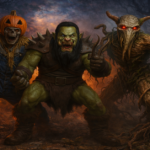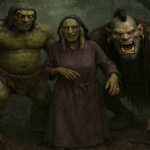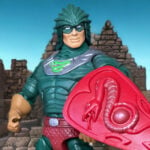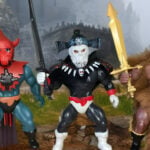

Every world has a beginning. Before the digital renders, the deep lore entries, and the sprawling character bios that now populate Fantasy Action Figures, the world of Kimel Drago existed as a humble collection of artifacts on a workbench.
In 2015, the journey began not with a keyboard, but with polymer clay.
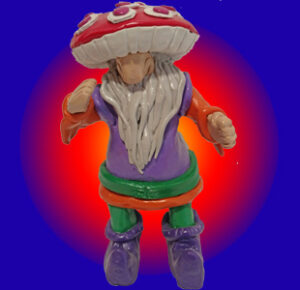
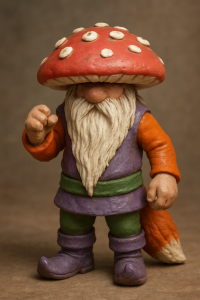
There is a specific kind of magic that happens when you physically sculpt a character into existence. Long before Agaric Folke became a fan-favorite mushroom warrior in our digital galleries, he was a physical sculpture, shaped by hand to capture the exact “feel” of a world I was only beginning to understand.
In this “Origins” deep-dive, I’m opening the vault to show you the original 2015 prototypes. These aren’t just toys; they are the “DNA” of the Quest for Kimel Drago.
In an era of instant digital creation, why start with something as permanent and tactile as clay?
Texture and Weight: You learn the “heft” of a character when you have to balance them on a wire armature.
Organic Evolution: As the clay was molded, the characters often spoke back, changing their shapes and, eventually, their destinies within the lore.
Authentic Foundations: These artifacts serve as the bedrock for everything you see on this site today.
[!TIP] 2015 Prototype Insight: Agaric was one of the very first characters sculpted for the Quest for Kimel Drago. In the original polymer clay version, you can see the focus was on the “Mycelium Plate” texture—a design element that survived through every iteration over the last decade.
Original Prototype: 2015 (Polymer Clay & Wire Armature)
Role: Guardian of the Undergrowth / Sentinel of the Great Mycelium.
The Concept: Agaric was born from the idea of a “living defensive line.” Unlike traditional knights in steel armor, Agaric’s protection is a biological byproduct of the forest he protects—hardened fungal plates that can absorb impact and heal over time.
Evolution Note: While the 2015 clay sculpt had a more “primitive” and bulky silhouette, his modern design in the Quest for Kimel Drago has become more tactical, reflecting his role as a swift, silent protector of the fungal borders.
Explore the Full Bio & 2026 High-Res Renders of Agaric Folke →
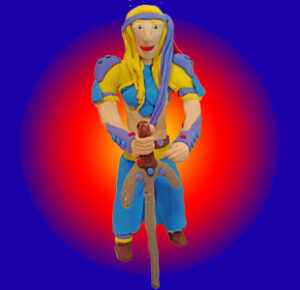
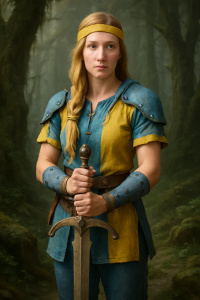
[!TIP] 2015 Prototype Insight: Sculpting Anahita in 2015 presented a unique challenge: how to represent fire and light in solid polymer clay. The original prototype focused heavily on her flowing silhouette and decorative headpiece, establishing the “ancient Persian-inspired” aesthetic that defines her character today.
Original Prototype: 2015 (Polymer Clay & Wire Armature)
Role: High Priestess of the Eternal Fire / Protector of the Solar Spire.
The Concept: Anahita was envisioned as a living conduit for elemental fire. In the early Quest for Kimel Drago sketches, she served as the spiritual heart of her faction, blending elegance with the volatile power of the Sacred Flame.
Evolution Note: The 2015 sculpt was more static, emphasizing her regal robes. Her modern 2026 iteration leans into her “battle-priestess” role, with more dynamic movement in her design and refined magical artifacts that reflect her status as a top-tier elemental.
Explore the Full Bio & 2026 High-Res Renders of Anahita Azar →
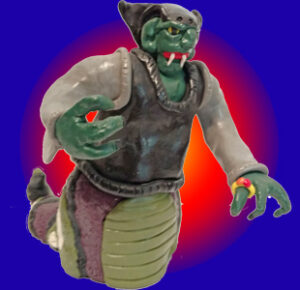
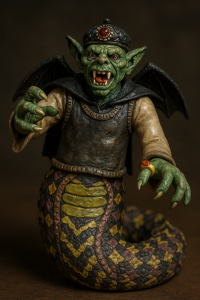
[!TIP] 2015 Prototype Insight: Witalis was all about the “Wizard’s Silhouette.” In 2015, the goal was to create a sense of imposing height and dark authority. The original polymer clay sculpt focused on the high, sharp collar and the flow of his robes, using deep incisions in the clay to create the look of heavy, enchanted fabric that had weathered many dark rituals.
Original Prototype: 2015 (Polymer Clay, Wire Armature, & Dark Resin Accents)
Role: Arch-Mage of the Void / Weaver of Shadow Lore.
The Concept: Witalis was designed to be the intellectual threat of the series—a character who wins through forbidden knowledge rather than brute force. I wanted his original form to look “stiff” and “composed,” as if he were holding back a tidal wave of dark energy. A longtime venomous snake keeper, the body mold is inspired by a pet rhinoceros viper. The name Atrox, is taken from the western diamondback rattlesnake.
Evolution Note: The 2015 prototype was a classic “Evil Mage” look. His 2026 evolution has seen him “ascend,” with his design now featuring more “Void-touched” elements—shimmering dark matter textures and artifacts that look like they are literally tearing the air around him.
Explore the Full Bio & 2026 High-Res Renders of Witalis Atrox →
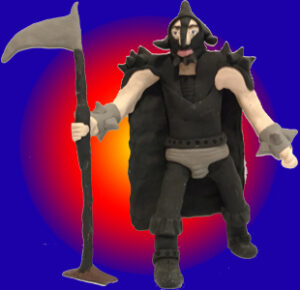
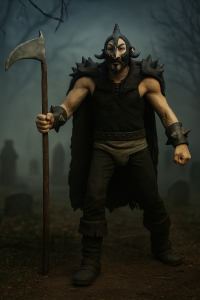
[!TIP] 2015 Prototype Insight: Caine was a study in drapery and skeletal structure. In 2015, the challenge was to make polymer clay feel “weightless”—giving his tattered robes a sense of ghostly movement while maintaining a rigid, intimidating frame. The original sculpt established his signature scythe and the haunting, hollow-eyed gaze that defines the character.
Original Prototype: 2015 (Polymer Clay, Wire Armature, & Matte Black Finish)
Role: Reaper of the Forgotten / Sentinel of the Grey Veil.
The Concept: Caine wasn’t designed to be a standard “Grim Reaper.” He is a specific entity within the Quest for Kimel Drago who harvests the essence of those lost between worlds. I wanted his 2015 form to look ancient, like a relic that had been standing in the rain for centuries. I took at least some inspiration from Dirk Blackpool from Wizards and Warriors.
Evolution Note: The 2015 prototype was very minimalist, focusing on the silhouette of the cloak. His modern 2026 design has incorporated “Ethereal Tech”—spectral wisps and glowing necrotic runes that make him feel less like a ghost and more like a powerful, multidimensional force.
Explore the Full Bio & 2026 High-Res Renders of Caine Reapis →
[!TIP] 2015 Prototype Insight: Magnus was designed to be the physical “anchor” of the collection. The 2015 clay prototype was all about testing the proportions of heavy plate armor. To get that “Adamantine” look, the sculpt utilized layered clay segments to mimic overlapping metal, a detail that has become even more intricate in his modern 2026 design.
Original Prototype: 2015 (Layered Polymer Clay & Wire Armature)
Role: Commander of the Adamantine Guard / Front-line Defender.
The Concept: The name “Adamanteus” was chosen to reflect a character that simply cannot be moved. He was envisioned as a living wall—the person you want standing between your party and a dragon. It’s also the scientific name for the eastern diamondback, a powerful snake you don’t want to mess with.
Evolution Note: The original 2015 sculpt was very “High Fantasy,” featuring a more traditional knightly silhouette. His modern evolution has integrated more unique, world-specific runes and specialized “Diamond-Grade” textures on his armor to distinguish him from a standard medieval warrior.
Explore the Full Bio & 2026 High-Res Renders of Magnus Adamanteus →
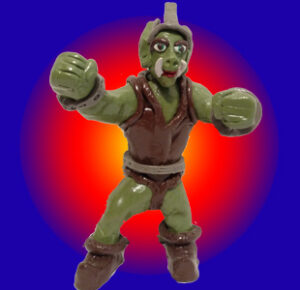
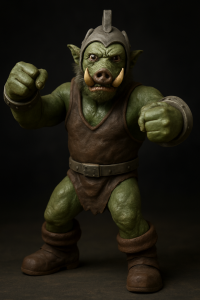
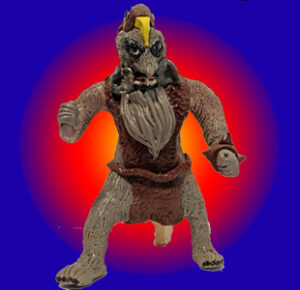
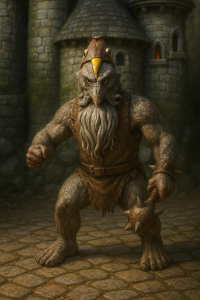
[!TIP] 2015 Prototype Insight: Gulik was an exercise in “subterranean anatomy.” The 2015 polymer clay sculpt focused on a low, predatory center of gravity and a thick, leathery hide. I used blunt texturing tools to give his skin a “cavern-worn” feel—making him look like a creature that has spent centuries navigating the narrow, jagged tunnels of the deep.
Original Prototype: 2015 (Polymer Clay, Wire Armature, & Earth-Tone Pigments)
Role: Scout of the Deep Tunnels / Vanguard of the Troglodytarum.
The Concept: Gulik was designed to be the ultimate survivor. He isn’t a mindless monster; he’s a cunning hunter who uses the environment to his advantage. The name “Horridus” was chosen to reflect the fear he instills in those who wander too far into the dark. It’s also the scientific name for the timber rattlesnake.
Evolution Note: The 2015 prototype featured more basic bone-shard weapons and a simpler loincloth. His modern 2026 iteration has seen a “cultural” upgrade—incorporating harvested crystals from the deep earth into his gear and more complex tribal scars that tell the story of his many victories in the lightless depths.
Explore the Full Bio & 2026 High-Res Renders of Gulik Horridus →
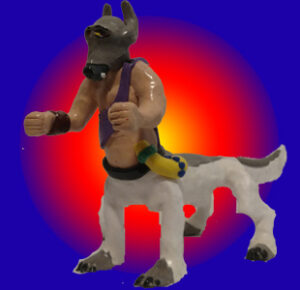
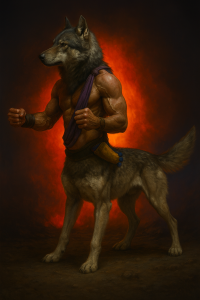
[!TIP] 2015 Prototype Insight: Sculpting Lupus in 2015 was all about mastering “Fur Texture.” To achieve the shaggy, matted look of a Wilkolach warrior in polymer clay, I used specialized raking tools and fine-point needles. This physical texture was essential to give him a sense of “wild weight” that carries through to his modern design.
Original Prototype: 2015 (Textured Polymer Clay, Wire Armature, & Acrylic Wash)
Role: Chieftain of the Wilkolach Tribes / Primal Hunter.
The Concept: Lupus was designed to represent the raw power of nature. He isn’t a lycanthrope, he’s more like a centaur. He’s part of a distinct culture—the Wilkolach. I wanted his 2015 sculpt to look like he was wearing his history, with scars and tribal markings etched directly into the clay.
Evolution Note: The 2015 prototype was very “beast-heavy,” focusing on a feral, four-legged-capable posture. His 2026 evolution has refined him into a “Warrior-King” silhouette—still savage and animalistic, but with more intricate tribal armor and weapons that signify his leadership over the Wilkolach.
Explore the Full Bio & 2026 High-Res Renders of Lupus Warwulf →
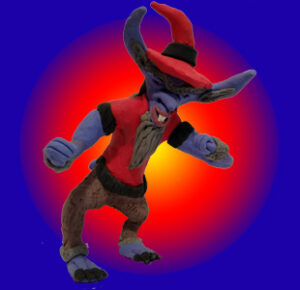
[!TIP] 2015 Prototype Insight: Gidium was an exercise in “organic grotesque” sculpting. In 2015, the challenge was to make the polymer clay look like it was comprised of multiple shifting parts—simulating the “Verminog” essence. The original sculpt focused on a hunched, predatory posture that hinted at his ability to command the swarms of the Underdark.
Original Prototype: 2015 (Polymer Clay, Paint, Wire Armature, & Gloss Varnish)
Role: Harbinger of the Swarm / Commander of the Verminog Hordes.
The Concept: Gidium represents the filthy, creeping, inescapable spread of the swarm. He was designed to look like a creature that is never truly alone—even his physical form feels like a gathering of smaller, more malevolent forces.
Evolution Note: The original clay model used gloss varnishes to give him a “wet,” insectoid sheen. His modern 2026 design has evolved into a more sophisticated threat, trading some of the raw “slime” look for intricate, chitinous armor plating that reflects his status as a high-ranking general in the dark armies.
Explore the Full Bio & 2026 High-Res Renders of Gidium the Verminog →
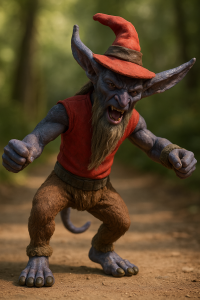
[!TIP] 2015 Prototype Insight: Cornelius was an experiment in “ugly-cool” aesthetics. The 2015 clay prototype focused on his exaggerated features and spindly proportions. Interestingly, the “Gilded” aspect of his name wasn’t just flavor—the original sculpt was one of the first to experiment with gold-leaf effects and metallic finishes to signify his obsession with wealth and stolen finery.
Original Prototype: 2015 (Polymer Clay, Paint, Wire Armature, & Gold Pigment)
Role: Master of Coin / The Corrupted Merchant of the Shadow Realms.
The Concept: Cornelius was designed as the antithesis of the selfless heroes. He represents greed and the corrupting influence of the Gidling curse. I wanted him to look like someone who had dressed himself in the spoils of war but remained inherently “fiendish” underneath.
Evolution Note: In 2015, he was a more grounded, goblin-esque figure. His modern 2026 design has leaned further into the “Gilded” title, with more ornate, baroque armor and magical artifacts that look like they were plucked straight from a royal treasury—only twisted for his dark purposes.
Explore the Full Bio & 2026 High-Res Renders of Fiendish Cornelius →
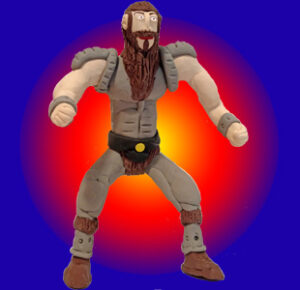
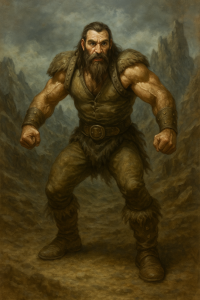
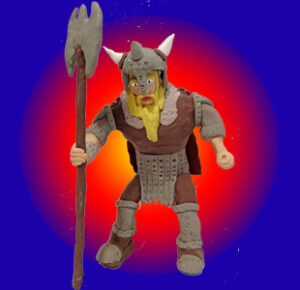
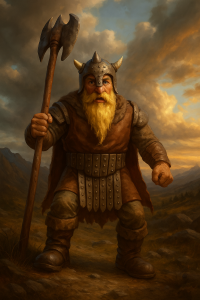
[!TIP] 2015 Prototype Insight: Sculpting Ivar was a test of precision. In 2015, capturing the “hard-surface” look of dwarven armor and mechanical tools using polymer clay required a steady hand and custom carving tools. The original sculpt established his low center of gravity and the iconic “heavy-duty” feel of his gear.
Original Prototype: 2015 (Polymer Clay, Wire Armature, Paint, & Metallic Pigments)
Role: Master Smith of the Iron Peaks / Lead Engineer of the Kimel Drago Expedition.
The Concept: Ivar was designed to be the “backbone” of the group. He isn’t just a warrior; he’s the reason the team’s equipment stays functional. His design was inspired by cold-weather survival gear and ancient mining aesthetics.
Evolution Note: The 2015 prototype featured a very traditional fantasy beard and thick tunic. Over time, his design has evolved to incorporate more “Steam-Fantasy” elements—specifically more intricate plating and specialized gauntlets for his engineering work.
Looking back at these 2015 prototypes is more than just a trip down memory lane. It’s a reminder that every legendary hero and every terrifying villain in the Quest for Kimel Drago started with a single lump of clay and a spark of imagination.
These ten “Founders” established the rules of our world—the elemental balance of Anahita Azar, the organic resilience of Agaric Folke, and the creeping greed of Fiendish Cornelius. They represent the transition from physical artifacts to a sprawling digital universe, but the heart of the design remains the same: a dedication to unique, character-driven fantasy.
While these ten characters are the cornerstone of the collection, the vault is far from empty.
I still have over 20 more original prototypes waiting to be revealed. From the chattering hordes of the deep tunnels to the forgotten scouts of the frozen wastes, the evolution of Kimel Drago is an ongoing saga.
Coming Soon in Part II:
The primitive scouts that paved the way for the Great Expedition.
More “Then vs. Now” comparisons that show just how far these designs have come.
Stay tuned—the vault has only just been cracked open.
 English English
  Deutsch
  Français
  Português do Brasil
  日本語
日本語  Español
  English (Australia) English English Deutsch
Français
Português do Brasil
日本語
Español
English (Australia)
English (Australia) English English Deutsch
Français
Português do Brasil
日本語
Español
English (Australia)
We use cookies to improve your experience on our site. By using our site, you consent to cookies.
Manage your cookie preferences below:
Essential cookies enable basic functions and are necessary for the proper function of the website.
Statistics cookies collect information anonymously. This information helps us understand how visitors use our website.
Google Analytics is a powerful tool that tracks and analyzes website traffic for informed marketing decisions.
Service URL: policies.google.com (opens in a new window)