

Fear’s Plastic Phantom: Scarecrow Strikes
In the shadowy underbelly of Gotham City, where the line between nightmare and reality blurs like fog on a moonless night, one villain has always stood out for his ability to turn the mind against itself. Jonathan Crane, better known as the Scarecrow, isn’t your typical caped crusader’s foe armed with gadgets or brute force. No, his weapon is far more insidious: fear itself. And now, just in time for the spookiest season of the year, McFarlane Toys has brought this iconic antagonist to life—or at least to your display shelf—with their DC Multiverse Scarecrow (DC Classic) action figure. Released in 2025, this 7-inch marvel isn’t just a toy; it’s a meticulously crafted homage to one of Batman’s most psychologically tormenting adversaries.
As Halloween approaches, what better way to celebrate the macabre than by examining a figure that embodies the essence of fright? This review will delve deep into the Scarecrow’s official canon history, tracing his origins from the pages of Golden Age comics to his enduring presence in the DC Universe. We’ll explore how McFarlane Toys has translated this complex character into plastic, scrutinizing every detail from sculpt to accessories. Along the way, expect a blend of historical facts, design analysis, and collector insights that highlight why this release is a timely treat for fans. But beware: once you unbox this Scarecrow, your other figures might start looking a bit… intimidated.

The Origins of Terror: Scarecrow’s Canonical Beginnings
To truly appreciate McFarlane’s take on the Scarecrow, one must first understand the man behind the mask—or rather, the burlap sack. Jonathan Crane made his debut in the DC Comics universe in World’s Finest Comics #3, published in the fall of 1941. Created by Batman’s own architects, Bill Finger and Bob Kane, Crane was introduced as a lanky, scarecrow-costumed criminal who wielded fear as his primary tool. His initial appearance portrayed him as a disgraced professor turned villain, a theme that would evolve but remain core to his character.

In his earliest canonical outing, Crane is depicted as a psychology professor at Gotham University, obsessed with the study of fear. Bullied relentlessly during his childhood for his awkward, bookish demeanor, Crane channeled his traumas into academic pursuits. However, his methods crossed ethical lines when he conducted unauthorized experiments on students, using fear-inducing techniques to test psychological responses. This led to his dismissal after a particularly reckless demonstration involving a firearm in class, which accidentally injured a student. Seeking revenge, Crane donned the Scarecrow persona, drawing inspiration from the rural effigies meant to ward off birds—but in his twisted mind, designed to instill dread in humans.
This origin story has been refined over decades, but key elements persist in official canon. In post-Crisis continuity, such as detailed in Batman Annual #19, Crane’s backstory delves deeper into familial abuse. As a child, he endured horrific experiments at the hands of his own father, a chemist who tested fear serums on young Jonathan, locking him in dark rooms filled with terrifying stimuli. These experiences forged his fascination with phobias, leading him to develop his signature fear toxin—a hallucinogenic gas that amplifies victims’ deepest anxieties, often manifesting as nightmarish visions.

Throughout the Silver and Bronze Ages, Scarecrow appeared sporadically, clashing with Batman and Robin in stories that emphasized psychological warfare over physical confrontations. Notable arcs include his alliances with other Rogues Gallery members, such as in the “Long Halloween” storyline by Jeph Loeb and Tim Sale, where he participates in Holiday’s murder spree, using his toxin to manipulate events from the shadows. In this canon event, Scarecrow’s role underscores his preference for subtlety, often riding a horse-drawn cart through Gotham’s streets, evoking old-world horrors amid modern chaos.
Moving into the Modern Age, Scarecrow’s character gained layers through retcons that maintained factual consistency with earlier tales. In “Batman: The Killing Joke” influences and beyond, his fear toxin became a staple in Batman’s battles, forcing the Dark Knight to confront his own demons—literally. One pivotal moment comes in “Batman: Hush,” where Scarecrow’s toxin is used to exacerbate Batman’s paranoia, highlighting how Crane’s intellect makes him a perpetual threat. Official DC biographies emphasize that unlike brawlers like Bane or schemers like the Riddler, Scarecrow’s power lies in exploitation of the psyche, making him uniquely dangerous in a city already rife with madness.
Scarecrow’s evolution continued in the New 52 and Rebirth eras, where his origins were streamlined but retained the core trauma narrative. In “Batman: The Dark Knight” series, Crane is shown refining his toxin in abandoned farms, tying back to his scarecrow motif. He’s also featured in major crossovers like “Fear State,” where he orchestrates a city-wide panic, proving his relevance in contemporary storytelling. Factually, across all these iterations, Scarecrow remains a symbol of intellectual villainy, his lanky frame and ragged attire contrasting Batman’s physical prowess, emphasizing brains over brawn.
Beyond comics, Scarecrow’s canonical presence extends to animated adaptations and films, always grounded in his fear-based arsenal. In “Batman: The Animated Series” (1992-1995), voiced by Henry Polic II, Crane’s episodes like “Nothing to Fear” showcase his toxin inducing phobias, from spiders to failure. This portrayal influenced Nolan’s “Batman Begins” (2005), where Cillian Murphy’s Crane uses the toxin in a more realistic, pharmaceutical context, aligning with comic facts while adapting for screen. In video games like the “Arkham” series, Scarecrow’s sequences force players into hallucinatory realms, faithfully recreating his comic-induced terrors.
These factual elements—Crane’s abusive upbringing, academic downfall, and toxin mastery—form the backbone of why Scarecrow endures as a fan favorite. He’s not just a villain; he’s a mirror to Batman’s own fear-driven motivations, a psychological foil that questions the nature of heroism.
Unboxing the Nightmare: A Detailed Look at the McFarlane Figure
Now, let’s turn our gaze to the star of this Halloween release: the McFarlane Toys DC Multiverse Scarecrow (DC Classic) action figure. Priced at around $26.99 and hitting shelves in 2025, this piece was announced with pre-orders opening on September 18, perfectly timed to capitalize on spooky season vibes. McFarlane Toys, known for their hyper-detailed collectibles, has outdone themselves here, capturing the essence of Scarecrow’s classic comic look in a 7-inch scale that’s both imposing and intricate. This can also be said for Kalibak from a few years back and Captain Cold from 2025.

Upon unboxing, the figure arrives in standard McFarlane packaging: a windowed box showcasing the Scarecrow in a dynamic pose, sickle in hand, with a backdrop that evokes Gotham’s eerie alleys. The art card included features stunning character artwork on one side and a concise biography on the back, reading: “Dr. Jonathan Crane has spent as much time lurking in the dark corners of the human psyche as he has hiding in the shadowy parts of Gotham City. Obsessed with the idea of fear in its many forms, Crane has adopted the role of the Scarecrow, a living embodiment of things that go bump in the night.” It’s a nice touch for collectors who appreciate lore alongside their toys.
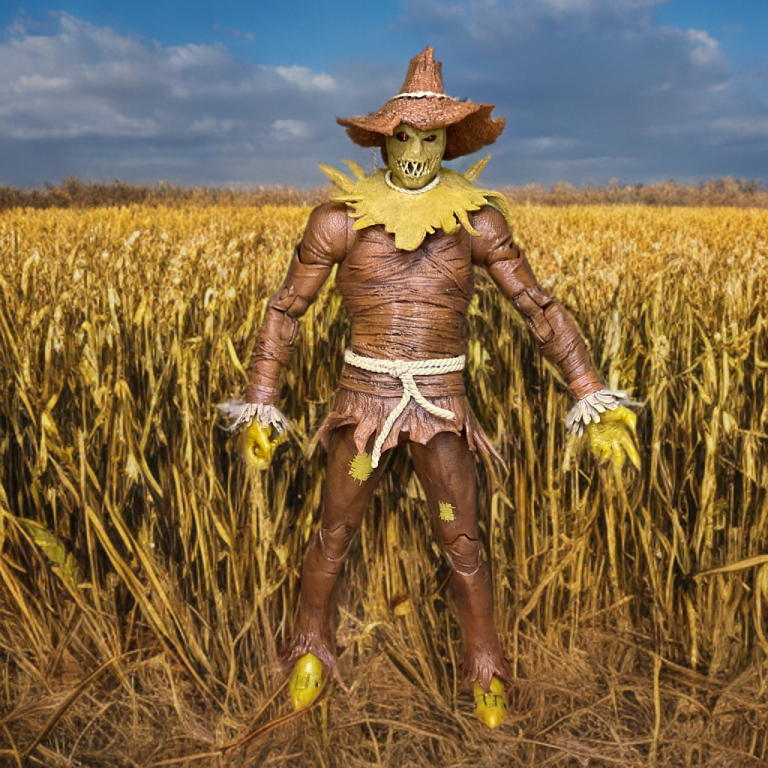
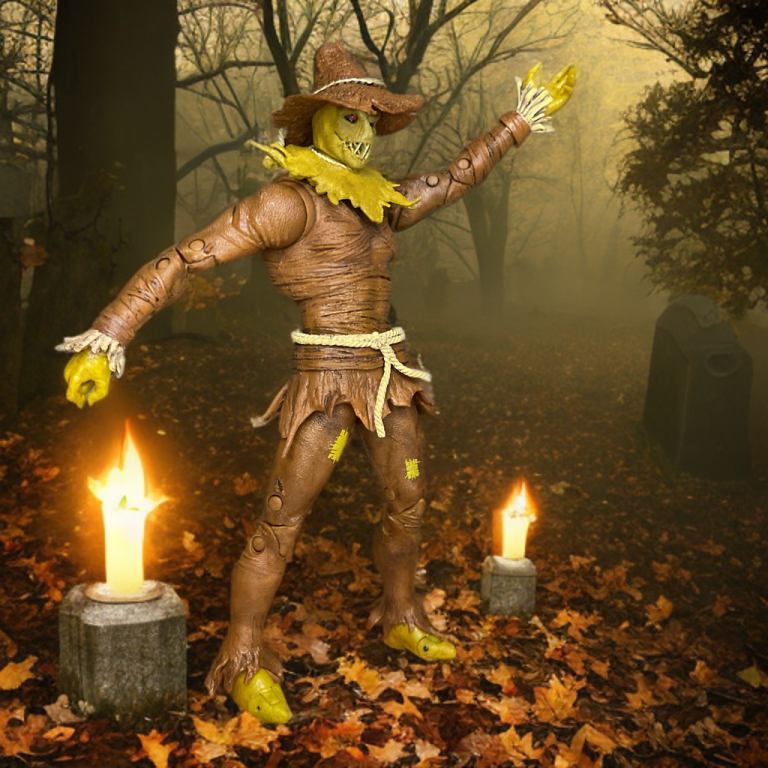
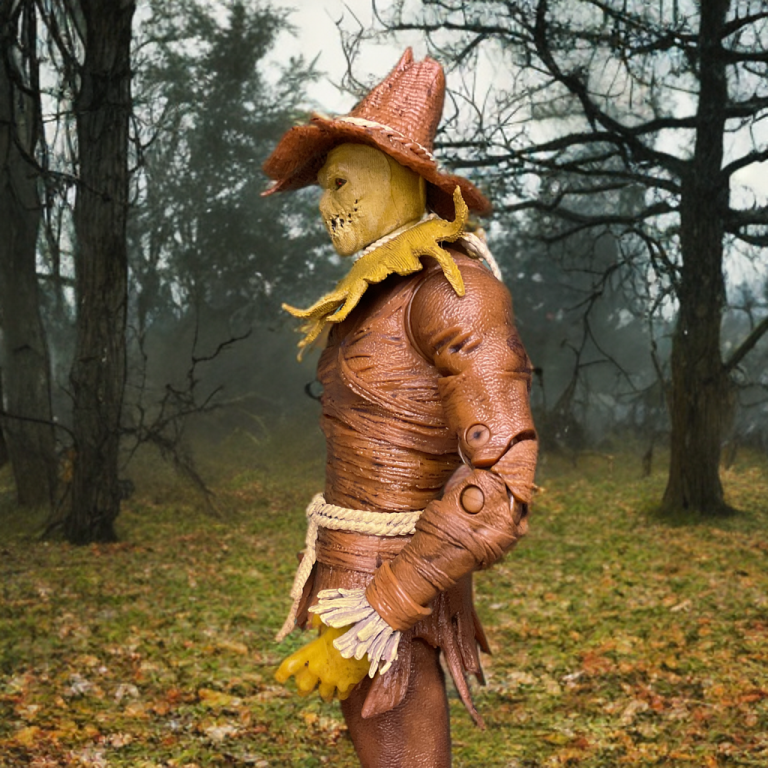
The sculpt is where this figure truly shines—or perhaps lurks. Standing at approximately 7 inches, Scarecrow’s lanky proportions are faithfully recreated, with elongated limbs that mimic his comic depictions from the 1940s onward. The burlap sack mask, complete with stitched mouth and hollow eyes, exudes a homemade horror vibe, textured to look like weathered fabric rather than smooth plastic. Straw protrudes from the neck, cuffs, and boots, painted in a yellowish hue that suggests age and decay, perfectly aligning with canonical illustrations where Scarecrow’s costume is pieced together from farm scraps.
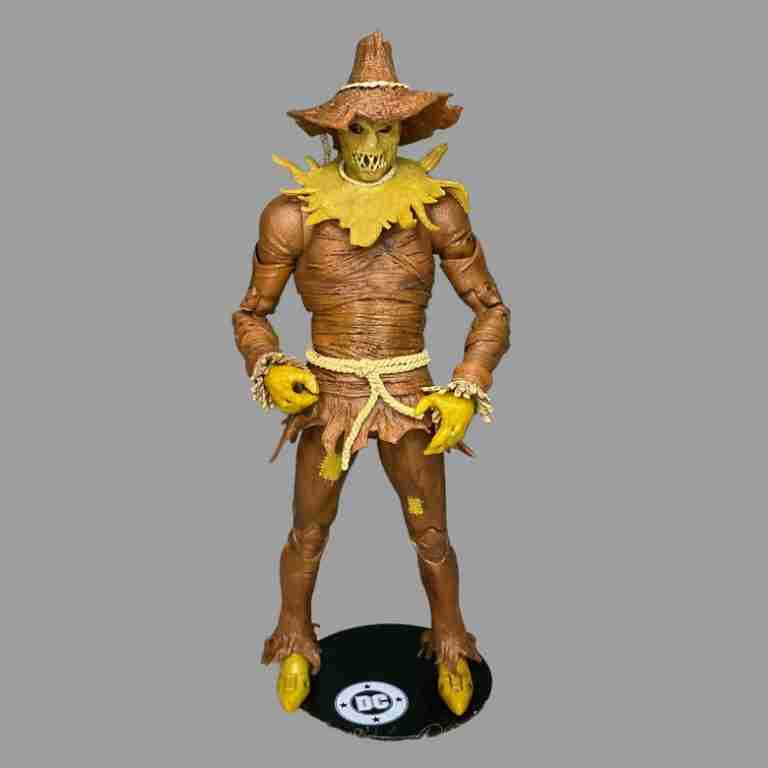
Detailing extends to the body suit, which appears wrapped in rope and tattered cloth, with subtle tears revealing “skin” underneath—though in true comic fashion, it’s more monstrous than human. The paint application is top-notch, with earthy browns and greens dominating, accented by metallic sheen on the sickle blade. No sloppy overspray here; even the gloves and boots have a leathery finish that pops under light. Compared to earlier DC figures from McFarlane, like their Batman variants, this Scarecrow feels more organic, less armored, which suits his non-combatant nature.
Articulation is a highlight, boasting up to 22 moving parts for “ultra articulation.” This includes double-jointed knees and elbows, swivel wrists, ball-jointed shoulders, and a highly poseable neck that allows for menacing head tilts. You can position him lunging forward with his cane raised, or crouched in ambush, replicating scenes from comics like his debut where he terrorizes victims from the shadows. The ankles rock for stability on uneven surfaces, and the waist twist adds dynamism to action poses. For display purposes, the included base—a simple black disc with DC logo—keeps him upright, though his lightweight build means he stands fine without it.
Accessories elevate this from good to great. The sickle, a nod to Scarecrow’s agricultural theme, fits snugly in his right hand, its curved blade detailed with nicks and rust for realism. The cane, often used in comics to dispense fear gas, is a straight staff with a hooked end, perfect for dramatic gestures. Then there’s the skull— a macabre prop that could represent a victim’s remains or a psychological tool, as seen in various arcs where Crane uses props to amplify dread. These items aren’t just add-ons; they encourage storytelling, letting collectors recreate canonical moments like Scarecrow’s revenge plots or toxin deployments.
In terms of scale compatibility, this figure integrates seamlessly with other DC Multiverse releases. Pair him with McFarlane’s Batman (DC Classic) for a showdown diorama, or alongside villains like the Joker for a Rogues Gallery setup. His height towers slightly over standard heroes, emphasizing his eerie, elongated silhouette—a factual callback to Kane’s original designs where Scarecrow’s appearance was meant to unsettle.
Quality control is solid, with no loose joints or paint defects noted in official previews and early reviews. The plastic feels durable, resistant to fingerprints, and the matte finish reduces glare for photography. For Halloween enthusiasts, this figure’s thematic timing couldn’t be better—imagine it perched on a mantle, casting long shadows under orange lights, evoking Crane’s canonical love for autumnal terrors.

Critically, how does it stack up against prior Scarecrow figures? McFarlane’s version outshines older Mattel or Hasbro attempts, which often skimped on details like straw texturing or accessory variety. In the Multiverse line, it’s comparable to their Riddler release, sharing the same articulation standard but with a unique horror aesthetic. Value-wise, at under $30, it’s a steal for the level of craftsmanship, especially with the collectible card that adds resale appeal.
Beyond the Figure: Scarecrow’s Lasting Impact in DC Canon
Delving further into Scarecrow’s factual legacy, his role in major events underscores his importance. In “Knightfall,” Crane allies with Bane, using toxin to weaken Batman psychologically before the back-breaking climax. This collaboration highlights his strategic mind, often overlooked in favor of flashier villains. Similarly, in “No Man’s Land,” Scarecrow thrives in Gotham’s post-earthquake anarchy, preying on survivors’ fears to carve out territory.
His toxin has evolved canonically too—from simple gas in early comics to advanced biochemical agents in modern tales. Formulas vary, but effects remain consistent: vivid hallucinations tailored to individual phobias. Batman’s repeated exposures have led to immunity developments, as in “Arkham Asylum: A Serious House on Serious Earth,” where Crane’s attempts falter against the prepared vigilante.
In team-ups, Scarecrow’s intellect shines. As part of the Injustice League or Secret Society of Super-Villains, he provides psychological insights, manipulating allies and enemies alike. Fact-based arcs like “Blackest Night” see him confronting his own fears when resurrected as a Black Lantern, a rare vulnerability moment.
Media adaptations keep his canon alive. In “The Batman” (2022) universe extensions, echoes of Crane appear, while animated films like “Batman: Assault on Arkham” feature him deploying toxin in high-stakes heists. These portrayals stay true to comics, avoiding embellishments for dramatic effect.
Conclusion
As the leaves turn and jack-o’-lanterns flicker, McFarlane’s Scarecrow (DC Classic) action figure emerges as a fitting tribute to Jonathan Crane’s enduring terror. From his 1941 debut to modern epics, Scarecrow’s canonical journey is one of psychological depth, mirrored flawlessly in this detailed collectible. With its ultra articulation, thematic accessories, and faithful sculpt, it’s more than a toy—it’s a portal to Gotham’s darkest corners. Whether you’re a seasoned collector or a Halloween hobbyist, this release invites you to face your fears head-on. Just remember: in the world of DC, the scariest monsters are the ones we create ourselves. Pick one up before it vanishes into the night—your shelf will thank you, even if your nerves won’t.



 English
  Deutsch
  Français
  Português do Brasil
  日本語
日本語  Español
  English (Australia)