

Weregoats
The Cursed Guardians of Sorghel
Origins and the Curse
The weregoats are a tragic race inhabiting the perilous region between the fallen city of Maggita and the fortified stronghold of Sorghel. Once ordinary humans from a small, tight-knit farming community, their lives were irrevocably altered during the catastrophic fall of Maggita. The Black Wizard Witalis Atrox, a figure of immense power and malevolence, unleashed a devastating curse upon these villagers as part of his campaign to cement his dominion over the region. This curse transformed them into the weregoats, a hybrid of human and beast, forever bound to serve as unwitting guardians of Sorghel and, by extension, the will of Witalis Atrox.
The curse is tied to the cycle of day and night. By day, the weregoats retain their human forms, appearing as somber, weary individuals haunted by their fate. As the sun sets, they undergo a painful transformation into goat-like humanoids, their bodies twisting into a grotesque amalgamation of human and caprine features. This transformation reverses at dawn, returning them to their human state, only to repeat the cycle each night. The curse not only alters their physical form but also burdens their souls with despair, rendering them melancholic and withdrawn.
Physical Characteristics
In their human form, weregoats are indistinguishable from ordinary humans, though their demeanor betrays their suffering. Their eyes are often sunken, their faces etched with sorrow, and their movements sluggish, as if weighed down by an invisible burden. They dress in tattered remnants of their former lives—simple farmer’s garb, now worn and faded from years of hardship.
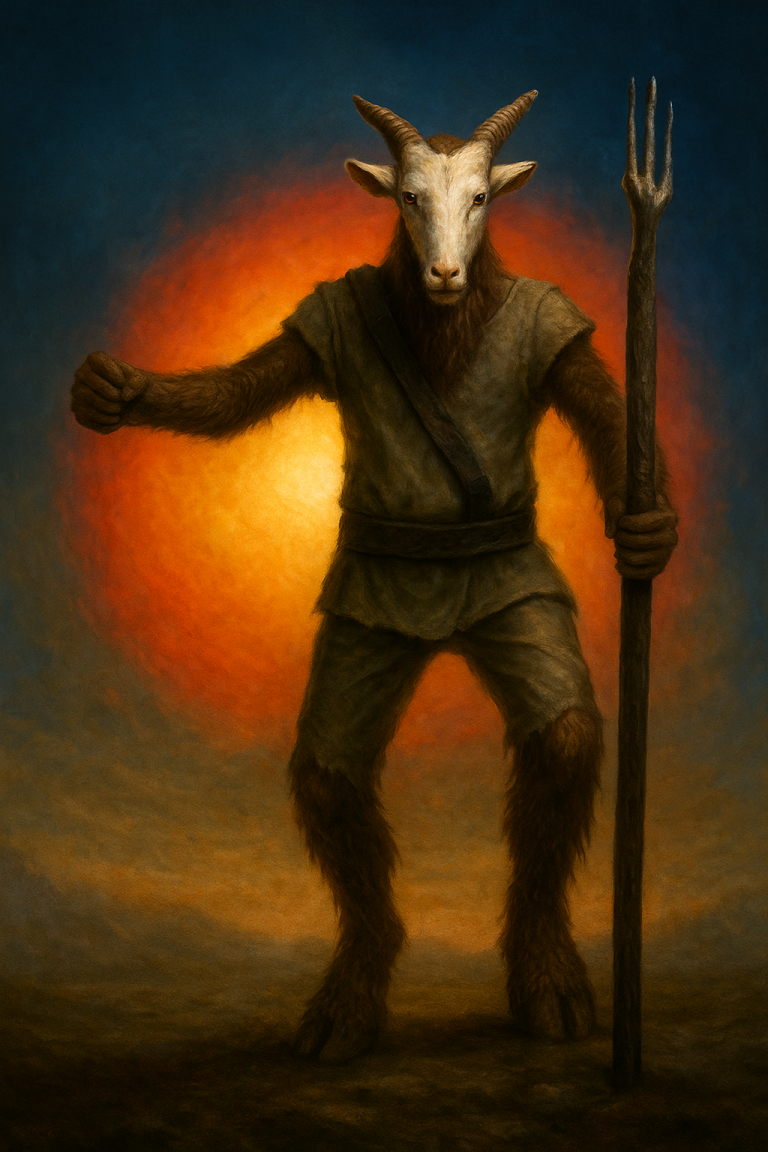
In their nocturnal, goat-like form, weregoats are a terrifying sight. They stand upright on digitigrade legs, their bodies covered in coarse, matted fur that ranges from pitch black to mottled gray. Their heads take on caprine traits, with elongated snouts, curved horns, and unsettling, glowing eyes that pierce the darkness. Their hands, though still human-like, sprout sharp claws capable of rending flesh, and their teeth are jagged, suited for both combat and intimidation. Despite their monstrous appearance, there remains a haunting trace of humanity in their movements, a reminder of the people they once were.
Behavior and Dual Nature
The weregoats’ behavior shifts dramatically between day and night, a direct consequence of their curse. During the day, they are passive and reclusive, wandering the desolate lands between Maggita and Sorghel or lingering near the ruins of their former homes. Encounters with them in human form are melancholic, as they speak little, their voices heavy with unspoken grief. They avoid discussing their curse, perhaps out of shame or fear, and while they pose no threat during daylight hours, they are wary and untrusting of outsiders.
At night, the weregoats become ferocious and unrelenting. Driven by the curse’s influence, they transform into aggressive predators, patrolling the region around Sorghel with a territorial zeal. They attack any intruders with savage ferocity, using their claws, horns, and teeth to devastating effect. Their role as guardians of Sorghel is not one they chose but one enforced by Witalis Atrox’s dark magic, which compels them to protect the stronghold and its secrets. This duality—peaceful by day, monstrous by night—makes them both pitiable and dangerous.
Role in the Region
The weregoats serve as an unwitting extension of Witalis Atrox’s power. Sorghel, a fortress of dark renown, benefits from their presence as a first line of defense against would-be invaders or adventurers seeking to challenge the Black Wizard’s authority. The weregoats’ nocturnal patrols make the region a treacherous place to travel after dark, and their reputation has spread fear among local populations. Tales of their transformations and relentless attacks have become the stuff of legend, discouraging all but the bravest or most foolhardy from venturing near Sorghel.
Despite their role as guardians, the weregoats are not loyal to Witalis Atrox by choice. Their actions at night are driven by the curse, not by allegiance, and their human selves harbor a deep resentment for their enslavement. This internal conflict adds a layer of tragedy to their existence, as they are trapped between their lost humanity and their monstrous duties.
Cultural and Social Impact
The weregoats are a cautionary tale among the people of the surrounding regions. Their story is often recounted as a warning of the dangers of crossing powerful sorcerers like Witalis Atrox. Villagers speak in hushed tones of the cursed farmers, whose once-idyllic lives were shattered by dark magic. Some communities view the weregoats with pity, offering prayers for their salvation, while others see them as a symbol of the Black Wizard’s cruelty, a reminder of the cost of defying his will.
The weregoats themselves have no society of their own in the traditional sense. Their human forms are too consumed by grief to form meaningful bonds, and their beastly forms are driven by instinct and compulsion. Occasionally, travelers report seeing small groups of weregoats in human form gathered near the ruins of their old village, as if drawn by fading memories of their past lives. These moments are fleeting, however, as the curse ensures they remain isolated and tormented.
Encounters and Survival Strategies
Travelers moving between Maggita and Sorghel must exercise extreme caution, particularly at night. The weregoats’ transformations are predictable, tied to the setting and rising of the sun, which offers some opportunity for safe passage. The following strategies may help avoid a deadly encounter:
Travel by Day: The weregoats are harmless in their human form, making daytime travel the safest option. However, be prepared for their somber demeanor and reluctance to engage.
Avoid Sorghel at Night: The weregoats’ nocturnal patrols are relentless near the stronghold. If night travel is unavoidable, seek shelter in elevated or fortified locations where their claws and horns are less effective.
Use Light to Deter: Weregoats in their beastly form are sensitive to bright light, which can disorient them. Torches or magical illumination may provide a brief window to escape an attack.
Do Not Provoke: In human form, weregoats are unlikely to attack unless provoked, but antagonizing them may trigger a defensive response, especially if they feel cornered.
Know the Terrain: The area between Maggita and Sorghel is dotted with ruins and dense thickets, which the weregoats use to their advantage during ambushes. Stick to open paths where possible to reduce the risk of surprise attacks.
Potential for Redemption
The weregoats’ curse is a source of fascination for scholars, priests, and adventurers seeking to undo Witalis Atrox’s magic. Some believe that defeating the Black Wizard or destroying the artifact responsible for the curse—rumored to be hidden within Sorghel—could free the weregoats from their torment. Others argue that the curse is permanent, woven into their very essence, and that death is the only release. Attempts to communicate with the weregoats about their condition are met with silence or despair, as they seem resigned to their fate.
Conclusion
The weregoats are a haunting embodiment of the Black Wizard Witalis Atrox’s cruelty, their lives a testament to the devastating power of dark magic. Caught between their lost humanity and their cursed existence, they roam the lands between Maggita and Sorghel as both victims and predators. Travelers would do well to heed their tragic tale, avoiding the region at night and treating its cursed inhabitants with caution and compassion. For the weregoats themselves, hope remains a distant dream, overshadowed by the relentless cycle of their transformation and the will of the wizard who damned them.
 English
  Deutsch
  Français
  Português do Brasil
  日本語
日本語  Español
  English (Australia)