

The Rise of Gulik Horridus: Lord of the Troglodytarum
In the shadowed crags of the Odsted Mountains, where the air is thick with the stench of sulfur and the echoes of clashing steel, the Troglodytarum thrived as a race forged in fire and blood. Their clans—Ironflames, Stonebreakers, Bloodfowlers, and others—were bound by strength, survival, and the grim worship of Grimskog, the Stone Tyrant. Among these fierce warriors, none would cast a darker shadow than Gulik Horridus, a figure whose name would become synonymous with terror and dominion. His ascent to leadership was no mere accident of fate but a brutal symphony of cunning, betrayal, and unrelenting ambition, orchestrated under the seductive promises of the Black Wizard, Witalis Atrox.
A Harsh Beginning
Gulik was born into the Ironflames, the most powerful clan of the Troglodytarum, known for their mastery of black ore and the forging of weapons that could cleave stone. His birth was unremarkable, lacking the omens that marked figures like Zaron the Hookfury. Gulik was not of noble blood, nor was he blessed by a blood moon. His father, a low-ranking Warlord named Brakoc, was a brutal but unexceptional warrior who died in a skirmish with the Bloodfowlers over a contested mining vein. Gulik’s mother, a fierce huntress, raised him in the shadow of the Ironflames’ forges, teaching him the value of survival through cunning as much as strength.
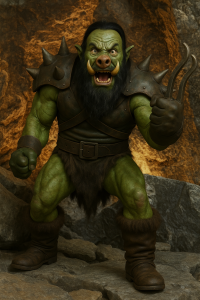
From a young age, Gulik showed a sharp mind and a ruthless streak. At seven, during his trial of worth—a ritual where young Trogs must slay a beast or foe to prove their place—he did not merely kill his quarry, a cave wyrm, but trapped it in a collapsing tunnel, ensuring its death was slow and agonizing. His peers whispered of his cruelty, but the Shamans saw potential, noting his ability to outwit stronger opponents. This knack for strategy set him apart in a society that prized brute force, planting the seeds of his ambition.
The Spark of Ambition
As Gulik grew, he became a Warlord under Chieftain Vogarar, a towering figure whose rule over the Ironflames was ironclad. Vogarar’s reign was marked by prosperity, as the clan’s forges churned out weapons traded across Naheld and Chaosforos. But Gulik, now a seasoned warrior with a reputation for leading devastating raids, chafed under Vogarar’s rule. He saw the Chieftain’s reliance on tradition—blood oaths, ritual sacrifices, and alliances with weaker clans—as a weakness that left the Ironflames vulnerable to growing threats, particularly the Black Wizard Witalis Atrox, whose influence was creeping into the Odsted Mountains.
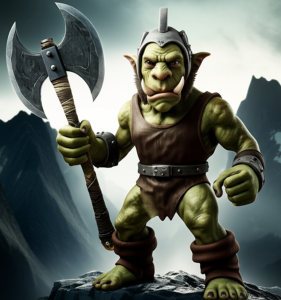
Atrox’s emissaries first arrived under the guise of trade, offering promises of wealth and power in exchange for Troglodytarum warriors to serve in his campaigns across Kimel Drago. Vogarar, wary of Atrox’s dark magic, refused, valuing the clan’s autonomy and the will of Grimskog. Gulik, however, saw opportunity. He began secret meetings with Atrox’s agents, learning of the wizard’s vision for a unified Kimel Drago under his rule—a vision that promised Gulik a kingdom of his own. The Black Wizard’s words were honeyed poison, and Gulik drank deeply, his ambition ignited by the prospect of rising above his station.
The Betrayal
Gulik’s path to power began with a calculated betrayal. The Ironflames’ rivalry with the Bloodfowlers had escalated, with both clans vying for control of a rich black ore vein deep in the mountains. Gulik proposed a bold raid to seize the vein, volunteering to lead a warband. Vogarar, trusting Gulik’s cunning, approved the plan. But Gulik had other intentions. In the dead of night, he sent a false message to the Bloodfowlers, claiming Vogarar sought peace and would meet them unarmed at the Vein of Grimskog. Simultaneously, he poisoned Vogarar’s mead with a rare venom extracted from cave scorpions, weakening the Chieftain without killing him outright.
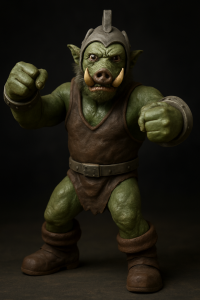
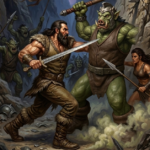
When the Ironflames and Bloodfowlers met, Gulik orchestrated chaos. He signaled his loyal warriors—those he had swayed with promises of power—to turn on their own clan. The weakened Vogarar, betrayed and surrounded, fought valiantly but was overwhelmed by the combined forces of Gulik’s traitors and the Bloodfowlers. As Vogarar fell, Gulik seized the moment, challenging the Bloodfowlers’ leader, a brutish Chieftain named Korgul, to single combat. In a display of ruthless efficiency, Gulik used his knowledge of the terrain to trap Korgul in a narrow crevasse, where he slit the Chieftain’s throat and claimed victory.
The Rendfeast and Rise to Power
With Vogarar dead and the Bloodfowlers leaderless, Gulik declared himself Chieftain of the Ironflames and demanded a Rendfeast to solidify his claim. The ritual combat was a formality; none dared challenge him after witnessing his treachery and cunning. In the flickering light of the Ironflames’ forges, Gulik consumed a portion of Vogarar’s flesh, a gruesome act that cemented his dominance. To unify the fractured clans, he offered the Bloodfowlers a blood oath, promising them a share of the black ore in exchange for their allegiance. The Stonebreakers, impressed by his audacity, soon followed, drawn by his vision of a united Troglodytarum under Atrox’s banner.
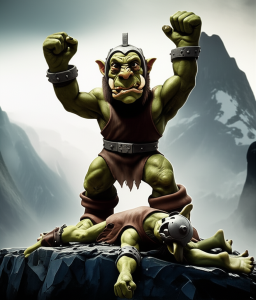
Gulik’s leadership was not born of loyalty but fear and ambition. He restructured the clans, centralizing power under his command and appointing loyal Warlords to oversee the others. He introduced new rituals, blending the traditional worship of Grimskog with tributes to Atrox, framing the Black Wizard as a harbinger of their god’s will. The Shamans, initially resistant, were silenced through intimidation or replaced with those loyal to Gulik’s cause. His army grew, bolstered by outcasts and mercenaries lured by Atrox’s promises, and the Troglodytarum became a formidable force, raiding far beyond the Odsted Mountains into the Gravelands and Chaosforos.
The Pact with Atrox
Gulik’s alliance with Witalis Atrox was the cornerstone of his power, but it was a double-edged sword. Atrox provided resources—blacksteel weapons, arcane artifacts, and knowledge of Kimel Drago’s hidden paths—that elevated the Troglodytarum’s strength. In return, Gulik sent warriors to serve in Atrox’s campaigns, their raids sowing chaos to weaken Magnus’s forces. Gulik reveled in the power, believing Atrox’s promise of a kingdom in Naheld. Unbeknownst to him, Atrox saw the Troglodytarum as pawns, their ferocity a tool to be used and discarded once Kimel Drago was conquered.
Gulik’s loyalty to Atrox deepened his ruthlessness. He crushed dissent within the clans, branding resistors with the Mark of the Outcast and exiling them to the Gravelands. Among these was Zaron the Hookfury, whose own betrayal and transformation into a hook-handed terror mirrored Gulik’s rise but also served as a warning of Atrox’s manipulative reach. Gulik’s raids grew bolder, targeting not just rival clans but human settlements, their spoils fueling the Troglodytarum’s war machine and Atrox’s dark ambitions.
The Iron Tyrant of the Gravelands
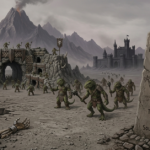
By the time Gulik Horridus was recognized as the undisputed leader of the Troglodytarum, he had transformed the clans into a disciplined, if brutal, army. His stronghold in the Gravelands became a fortress of jagged stone and black ore, a symbol of his iron rule. His warriors, driven by fear and greed, struck at dusk, their war cries echoing across Kimel Drago. Gulik’s name inspired terror, his spiked armor and cruel axe a harbinger of death. Yet, his ambition blinded him to Atrox’s true intentions, setting the stage for a potential downfall.
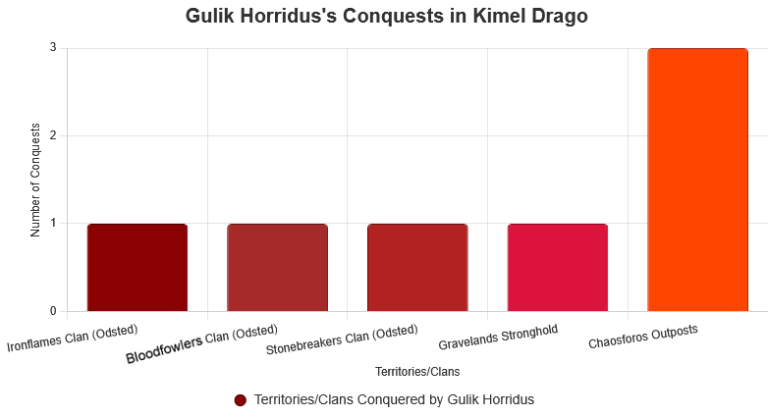
For Magnus and those who sought to reclaim the hidden crowns of Kimel Drago, Gulik represented a formidable obstacle. His control over the Troglodytarum made the Odsted Mountains a near-impenetrable bastion, and his raids disrupted any hope of unity among the free peoples. Yet, the divisions within the clans—between those loyal to Atrox and traditionalists who revered Grimskog—offered a glimmer of hope. A cunning strategist like Magnus might exploit these fractures, or perhaps rally outcasts like Zaron to undermine Gulik’s rule from within.
Legacy of the Horridus
Gulik Horridus’s rise was a testament to the Troglodytarum’s brutal ethos, where strength and cunning carved paths to power. His story was one of betrayal, sacrifice, and unrelenting ambition, shaped by the harsh peaks of the Odsted Mountains and the dark promises of Witalis Atrox. As leader, he forged the Troglodytarum into a weapon of chaos, but his reliance on Atrox’s lies left him vulnerable. In the saga of Kimel Drago, Gulik stood as both a tyrant and a pawn, his fate intertwined with the quest for dominion over a land torn by war and prophecy.
 English
  Deutsch
  Français
  Português do Brasil
  日本語
日本語  Español
  English (Australia)