

Eternia’s Dark Secret: How the 1982 Castle Grayskull Box Art Pulled the Ultimate Barbarian Bait-and-Switch
Part 2 of 4 in a 4 part limited series. (1, 2, 3, 4)
The Birth of the Barbarian Deception
If you think the “diaper” era of 1984 was a bait-and-switch, you haven’t traveled back far enough. In 1982, the toy aisles of America were haunted by a version of Eternia that didn’t just feel like a fantasy—it felt like a threat. Before the bright neons and the moral lessons of the Filmation cartoon, Masters of the Universe was a dark, moody, and unapologetically savage property. This was the “Pre-Filmation” window, a brief moment in toy history where the marketing wasn’t handled by corporate focus groups, but by a lone artist with a palette of oil paints and a deep love for Frank Frazetta.
Enter Rudy Obrero. While the later years of the line were defined by the heroic symphonies of William George and Earl Norem, the 1982 launch was defined by Obrero’s shadows. This was the era of the “8-Back” cardbacks, where the stakes were higher, the atmosphere was thicker, and the plastic was… well, let’s just say the gap between the oil paint and the styrene was a yawning chasm of childhood disillusionment.
Rudy Obrero: The Architect of 8-Back Anxiety
Rudy Obrero didn’t just paint toys; he painted an apocalypse. When Mattel hired him to illustrate the first wave of packaging, they didn’t give him a style guide because one didn’t exist. There was no “He-Man Bible” yet. Obrero was handed the early prototypes—blocky, stiff-legged figures with “Power Punch” waists—and told to make them look like legends.
He succeeded too well. Obrero’s style was characterized by desaturated greens, volcanic oranges, and a sense of scale that made the characters look like ants in a world of giants. His work on the 1982 “8-Back” cardbacks (so named because they featured the original eight figures on the reverse) didn’t just sell a product; it sold a mythology that the actual toys couldn’t possibly inhabit.
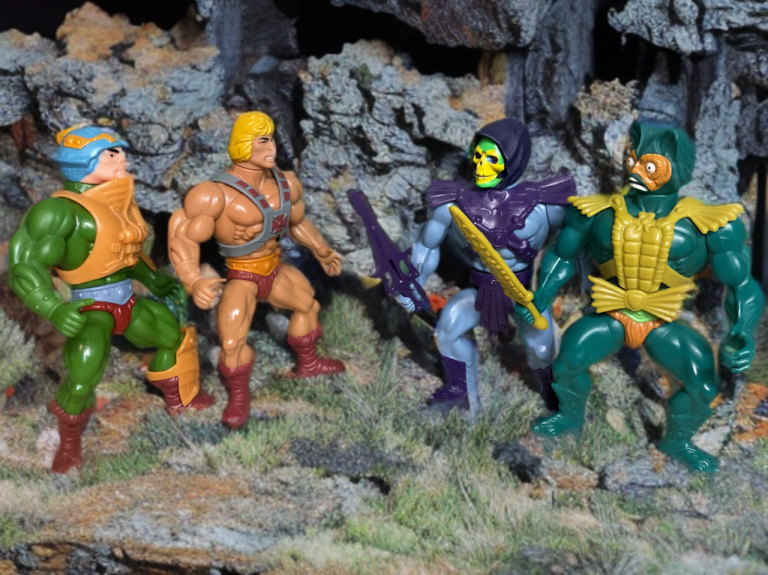
The 1982 Castle Grayskull: A Masterpiece of Marketing Malpractice
The crown jewel of the Obrero era is the original Castle Grayskull box art. In Obrero’s painting, the castle is a terrifying, limestone skull-fortress rising out of a mist-covered mountain range. The sky is a toxic, swirling green, and the lighting suggests a world where the sun has long since died. He-Man and Battle Cat are positioned in the foreground, looking tiny and vulnerable against the sheer scale of the jaw-bridge.
The Reality Check: When you finally tore through the cardboard, the “Skull-Fortress of the Gods” was a two-piece, blow-molded plastic shell. It wasn’t a mountain; it was a green suitcase with a handle. The “Jaw-Bridge” didn’t lead into a dark abyss of ancient secrets—it led into a cramped plastic interior with a cardboard floor. The “fearsome” elevator was operated by a literal piece of black string and a plastic counterweight that fell off if you pulled too hard. Obrero promised a gothic horror masterpiece; Mattel delivered a very expensive piece of luggage.
THE OBRERO "ATMOSPHERE VS. REALITY" INDEX
Quantifying the 1982 gap between moody oil paint and blow-molded styrene (Scale 1-10)
Battle Cat and the Recycled Predator
If the castle was a deception, Battle Cat was a heist. Obrero’s 1982 Battle Cat box art is a study in primal fear. The cat isn’t just a mount; it’s a predator. Its eyes are slitted, its muscles ripple under dark, olive-drab fur, and its armor looks like battle-hardened iron forged in the pits of Snake Mountain.
The Fact-Check: The 1982 Battle Cat toy was one of the most famous examples of “part-sharing” in toy history. To save on tooling costs, Mattel simply took the tiger mold from their 1970s Big Jim line, painted it bright “Crayola” green, and slapped a red plastic saddle on its back. Obrero’s art used shadows to hide the fact that the cat had zero articulation—it was a static, hollow hunk of plastic. While the art showed a beast mid-stalk, the toy had a facial expression that looked more like a confused housecat than a “Fighting Tiger.”
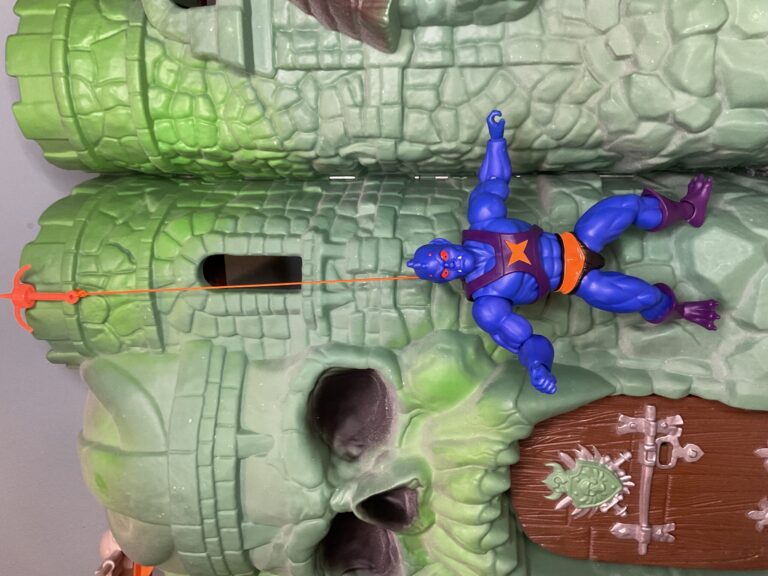
Technical Deceptions: The “Half-Sword” and the Rubber Band Crisis
As any administrator of a site like fantasyactionfigures.com knows, the 1982 era wasn’t just about the art; it was about the specific, often frustrating engineering of the toys. This was the “8-Back” period, and it came with two major technical “lies” that defined the era.
1982 ENGINEERING FAILURE VULNERABILITY
Tracking tool-sharing shortcuts and catastrophic design point-failures
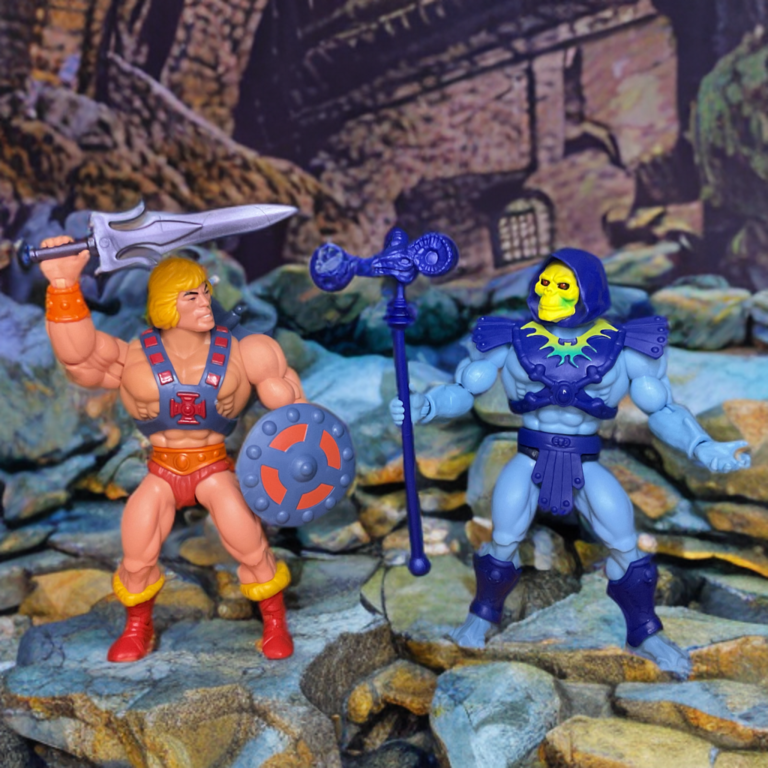
The Half-Sword Saga
The box art for He-Man and Skeletor always featured massive, gleaming broadswords. In Obrero’s paintings, these were weapons of mythic power.
The Reality: The actual toys came with “Half-Swords.” The back of the blade was hollowed out with pegs and holes so that He-Man’s silver half could “snap” together with Skeletor’s purple half to create a single sword.
The Deception: Not only did the “Full Power Sword” look ridiculous with a giant seam down the middle, but the plastic was so soft that the pegs often sheared off within forty-eight hours of play. The “weapon of the gods” was essentially a plastic puzzle piece that didn’t fit.
The Projectile Hip Phenomenon
While later figures (1984–1987) used a more durable rubber tension strap for the hips, the early 1982 “8-Back” figures were notorious for their internal O-ring failure.
The Fact: The legs were held to the torso by a black rubber band under high tension. In the early batches, these bands were often too tight or made of a compound that reacted poorly to oxygen.
The Result: You would be staring at your Obrero-inspired display, and suddenly, He-Man’s leg would fire across the room like a projectile. It wasn’t “Power Punch” action—it was spontaneous self-destruction.
The Cross-Sell Mirage: The “Diorama” Lie
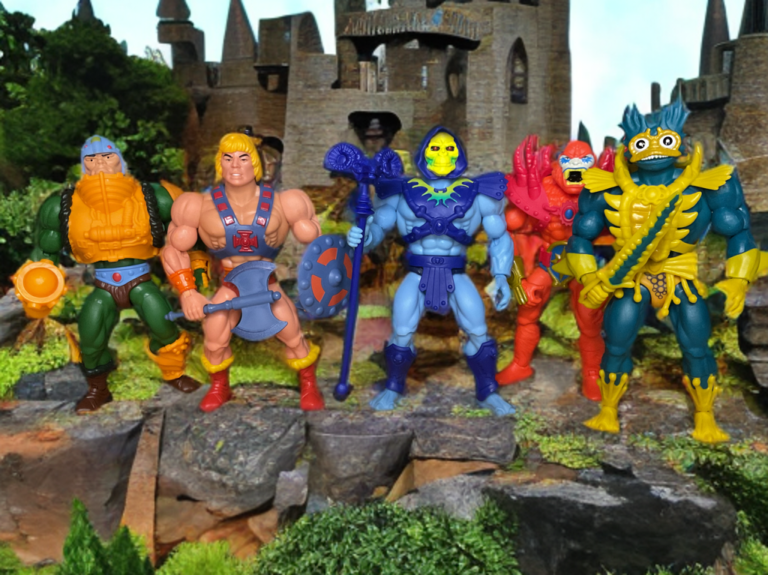
The back of every 1982 cardback featured the “Cross-Sell” art—tiny, hand-painted vignettes of the characters in action. These were often Obrero originals that showed the figures in epic, wide-angle battles.
The 8-Back Checklist: He-Man, Skeletor, Man-At-Arms, Beast Man, Stratos, Teela, Mer-Man, and Zodac.
The Illusion: The art showed Teela as a fierce warrior-queen and Stratos as a soaring aviator. In reality, Teela’s “Power Punch” waist made her look like she was perpetually doing a hula dance, and Stratos’s “wings” were just two pieces of plastic glued to his forearms that prevented him from even putting his arms down.
THE CROSS-SELL MIRAGE INDEX
How the 8-Back vignette art promised dynamic action but gave us static poses
The Art Was the Adventure
So, why do we still care? Why do pristine 1982 Rudy Obrero boxes now fetch thousands of dollars on the secondary market? It’s because Obrero understood something that the Mattel accountants didn’t: The toy was never the destination; it was the key.
The box art didn’t lie to us; it gave us the blueprints for the adventure we were supposed to have. We saw the moody, desaturated mist of Obrero’s Eternia and we used our imaginations to fill in the gaps left by the hollow plastic and the “suitcase” castle. The 1982 era was the most honest the brand ever was—it was raw, it was weird, and it relied on the art to do the heavy lifting.
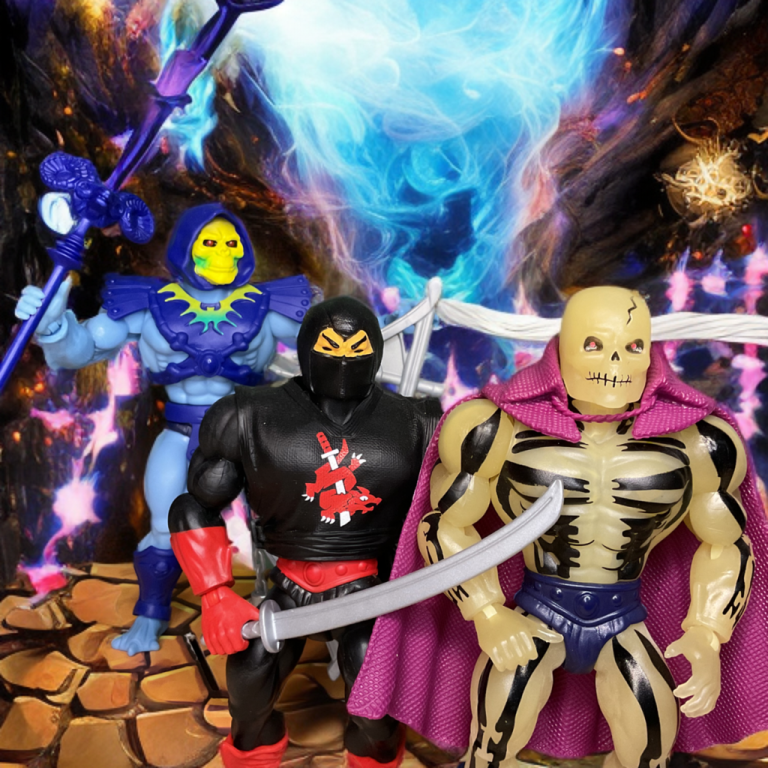
The box art promised a barbarian epic. The toy delivered a bright green tiger and a string-operated elevator. But for those of us standing in the aisle of a toy store in 1982, that Obrero painting was enough to make us believe in the Power of Grayskull. We weren’t buying a “fuzzy diaper”; we were buying a ticket to a world that was far more interesting than our own.
And that, Your Honor, is the greatest marketing “crime” ever committed—and we’d all pay to be victims of it one more time.
 English
  Deutsch
  Français
  Português do Brasil
  日本語
日本語  Español
  English (Australia)