

Lord Masque & Shokoti MOTU History: Filmation Legacy Explained
In the mythic expanse of Masters of the Universe (MOTU), where Eternia’s fate hangs in the balance between cosmic heroism and primordial evil, few villains evoke the chilling allure of ancient darkness like Lord Masque and Shokoti. This enigmatic duo, bound by servitude and sorcery, represents the franchise’s fascination with buried terrors that threaten to plunge the world into eternal night. Emerging from the temporal chaos of the Sands of Time, Lord Masque, the shape-shifting sentinel, and Shokoti, the Gar sorceress of apocalyptic ambition, form a symbiotic force of deception and dread. Their tale, confined to the 1983 Filmation series’ two-part “House of Shokoti” arc, weaves a compact yet potent narrative of horror-infused fantasy, blending archaeological intrigue with Lovecraftian undertones.
Debuting in an era when MOTU’s Filmation run (1983–1985) defined its sword-and-sorcery ethos, Masque and Shokoti embody the cyclical resurgence of forgotten evils, their story a cautionary parable of ambition and betrayal. Masque, the Evil Keeper of the Demon Mask, serves as Shokoti’s shadowy vanguard, while she, the self-proclaimed Goddess of Darkness, seeks to shroud Eternia in perpetual shadow. This combined biography synthesizes their canonical histories from Filmation episodes, scripted by Larry DiTillio and directed by Lou Kachivas and Marsh Lamore, alongside supplementary materials like their Masters of the Universe Classics (MOTUC) action figure bios. We will explore their origins in Eternia’s bifurcated past, dissect their intertwined roles and powers, recount their confrontation with He-Man, and celebrate their plastic resurrections in 2013 and 2016. Through this lens, Masque and Shokoti emerge as haunting archetypes of deception and cosmic malice, their silhouettes lingering in MOTU’s ever-expanding lore.
Ancient Origins: The Dark Hemisphere and the House of Darkness
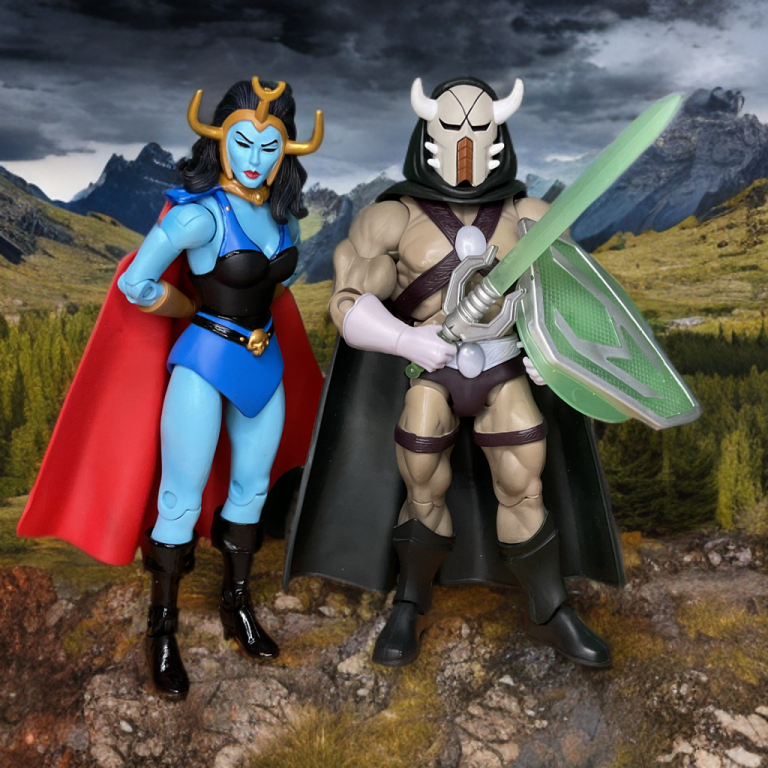
Eternia, a planet scarred by eons of cataclysmic conflicts, hosts a dual nature—light and dark hemispheres—where ancient civilizations rose and fell, leaving artifacts of immense power. Shokoti, a blue-skinned Gar sorceress, hails from the Dark Hemisphere, where she ascended to near-divine status through magic fueled by primordial darkness. Her MOTUC bio describes her as Eternia’s most dangerous sorceress, orchestrating a grand conspiracy to awaken the Sleeping Beast—a colossal demon of living shadow exiled to Despondos—to blanket the planet in eternal night. Her Gar kin, fearing this apocalypse, lured her into sunlight, a force antithetical to her nocturnal essence, and, with the sage Ro and his council of wizards, magically cleaved Eternia into hemispheres to isolate her influence. They sealed Shokoti and her beast within the House of Darkness, a pyramidal temple of obsidian, submerging it into the Sands of Time—a temporal desert where past, present, and future blur.
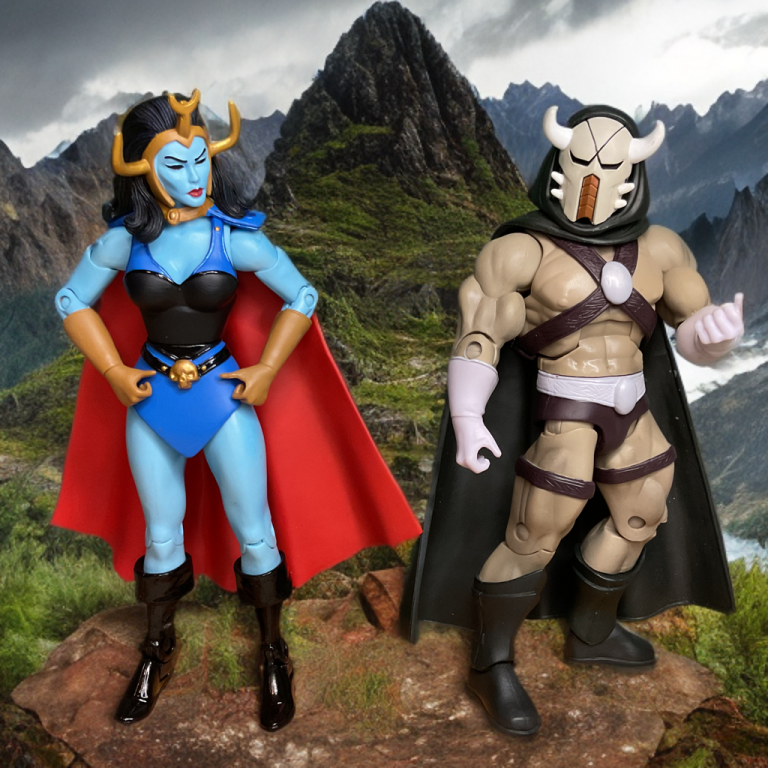
Lord Masque’s origins are murkier, coalescing within this liminal void. Described as an “evil shape-shifting wizard” and “Evil Servant of Shokoti” in his 2016 MOTUC bio, Masque spent centuries wandering the Sands, bound by an unbreakable pact to guard Shokoti’s prison. Whether a summoned spirit, a cursed soul, or an extension of her sorcery remains ambiguous, enhancing his mystique. His existence is tied to the House’s secrecy, sustained by its dark energies, his Demon Mask a conduit for his powers and a cage for his form. Together, Shokoti and Masque represent a symbiotic hierarchy: she, the apocalyptic architect, and he, her spectral enforcer, tasked with heralding her return. Their backstory mirrors myths of sealed demons and cursed guardians, underscoring MOTU’s theme of cyclical evils buried beneath Eternia’s surface.
The Awakening: Roles in “House of Shokoti” Episodes
The two-part “House of Shokoti” arc, episodes 40 and 41 of the Filmation series, marks the duo’s sole canonical appearance, blending archaeological horror with heroic triumph. Part 1 opens with the House intermittently emerging from the Sands, drawing the attention of royal archaeologist Melaktha and his team near a desert fortress. The Sorceress alerts He-Man to these anomalies, prompting an expedition with Prince Adam (He-Man’s alter ego), Ram Man, Orko, and Battle Cat. Lord Masque, sensing the intrusion, orchestrates a counterstrike from his glyph-riddled lair, allying with Trap Jaw to deploy robotic spiders against the fortress, masking the House’s rising silhouette. He vows to awaken Shokoti’s Sleeping Beast to spread darkness across Eternia, his rasping voice (John Erwin) dripping with menace.
Masque’s shape-shifting prowess shines as he disguises himself as “Racca,” a nomadic guide, infiltrating the heroes’ group. He sabotages their wind sleds with dark incantations and summons Reptile Men and a colossal sand digger for ambushes, showcasing his command over desert fauna and minions. At the excavation site, as Melaktha unearths the House’s apex, Masque chants atop a ritual dais to fully manifest the pyramid, conjuring a sand monster to stall He-Man. Orko’s accidental heroism—yanking off the Demon Mask—exposes Masque’s void-like essence, and He-Man shatters the mask, causing Masque to dissolve into smoke, his robes collapsing empty. Melaktha notes, “He seemed more like an evil shadow than a real person,” leaving his ontology a mystery.
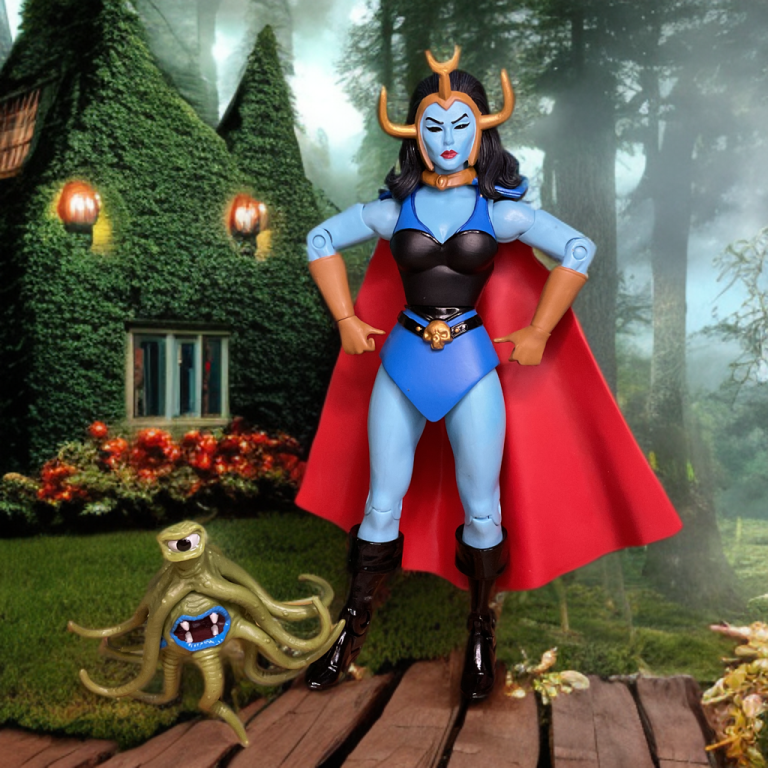
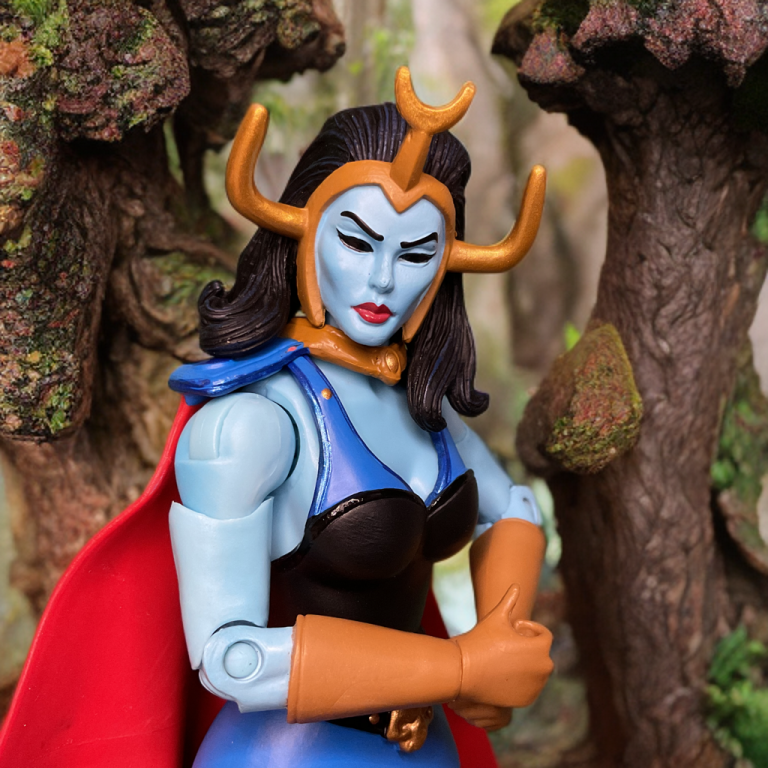
Part 2 shifts to Shokoti’s awakening. Melaktha identifies the structure as the House of Darkness, and his apprentice Stanlan, defying orders, breaches its entrance with Ram Man, triggering a spectral mask that drags him inside. He-Man leads a rescue into the pyramid’s labyrinth, where Shokoti materializes in her iconic form: pale-blue skin, jet-black hair, bronze horned headdress, red cape, and skull-buckled leotard (voiced by Linda Gary). She reveals her plan to sacrifice intruders to the Sleeping Beast, subduing He-Man with illusory traps and Darkling minions—shadowy imps that swarm relentlessly. Stanlan, guided telepathically by the Sorceress, wields He-Man’s Power Sword to deflect Shokoti’s necrotic blasts, freeing the captives. He-Man topples a statue into the Beast’s summoning pool, dissolving it and causing Shokoti to vanish in a flash, her pyramid sinking back into the Sands. The episodes close with a moral on the folly of reckless exploration, Stanlan wiser for his bravery.
Powers and Design: A Symphony of Deception and Darkness
Shokoti’s arsenal, rooted in her bond with primordial darkness, blends illusion with destruction. She weaves phantasms—floating masks, spectral voices, and mirage-like traps—to disorient foes, binding He-Man with illusory chains in Part 2. Her necrotic energy blasts, crimson bolts that drain vitality, stun even the mightiest warriors, while her Darklings overwhelm with numbers. The Sleeping Beast, her ultimate weapon, promises planetary darkness, its summoning tied to her ritualistic artifacts. Sunlight weakens her, a vulnerability exploited in her imprisonment and defeat. Her design—pale-blue Gar skin, obsidian hair, bronze headdress, and blood-red cape—evokes Egyptian deities twisted by infernal allure, crafted by Robert Lamb to radiate seductive menace.
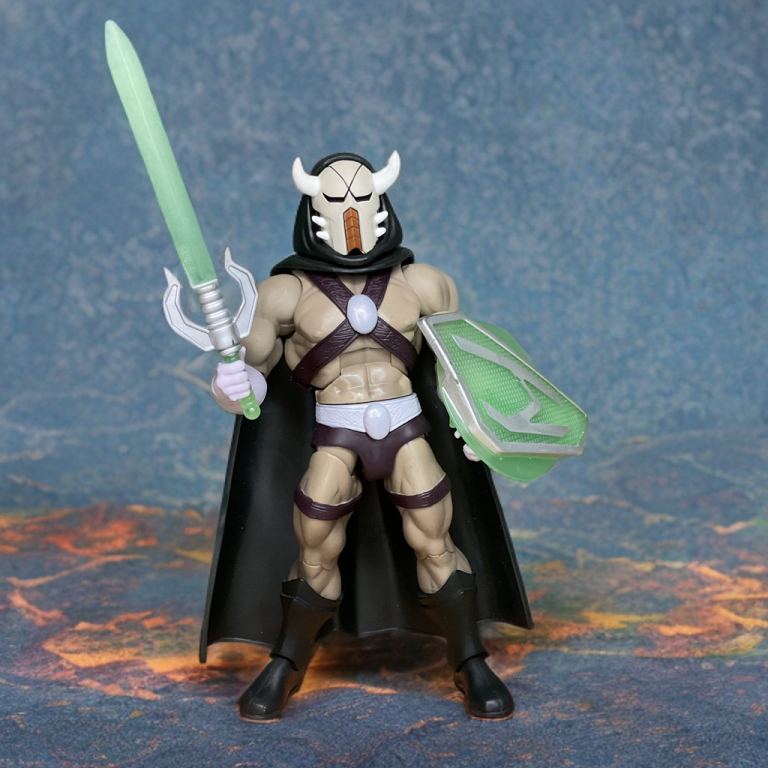
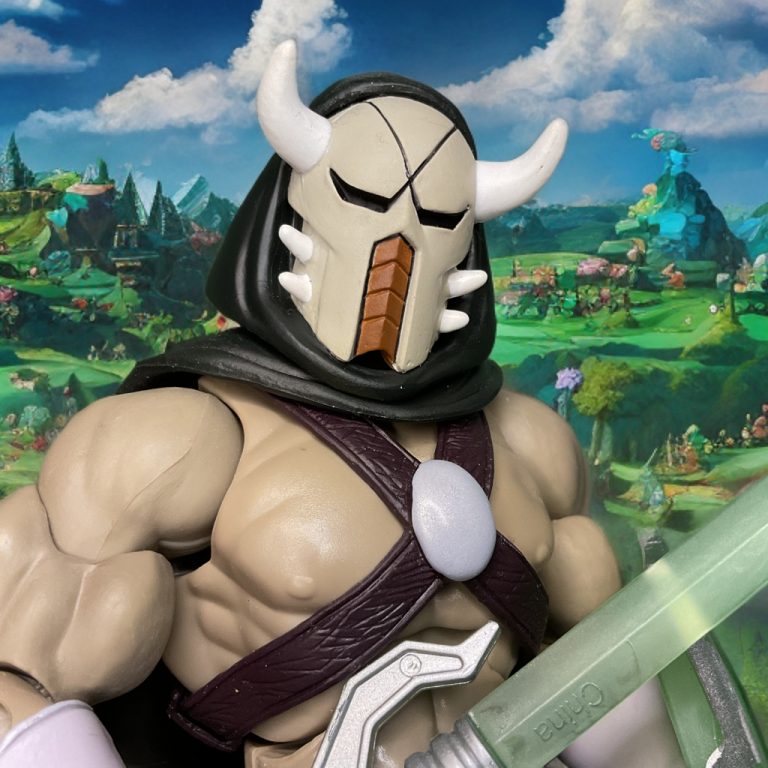
Lord Masque’s powers complement Shokoti’s, emphasizing subtlety over brute force. His Demon Mask, designed by Don Manuel, amplifies his darkness, granting shape-shifting to mimic personas like Racca with eerie precision and teleportation via a “black cloud” of flame and smoke. He conjures sand monsters, commands robotic spiders and Reptile Men, and disables machinery with corrupting mist, his 2016 bio noting his ability to summon “demon armies” from Eternia’s crust. His gothic design—billowing purple cape, spiked pauldrons, and asymmetrical horned mask—suggests a medieval inquisitor warped by infernal pacts, his sibilant voice contrasting Skeletor’
The Toy Legacy: Masters of the Universe Classics Revival
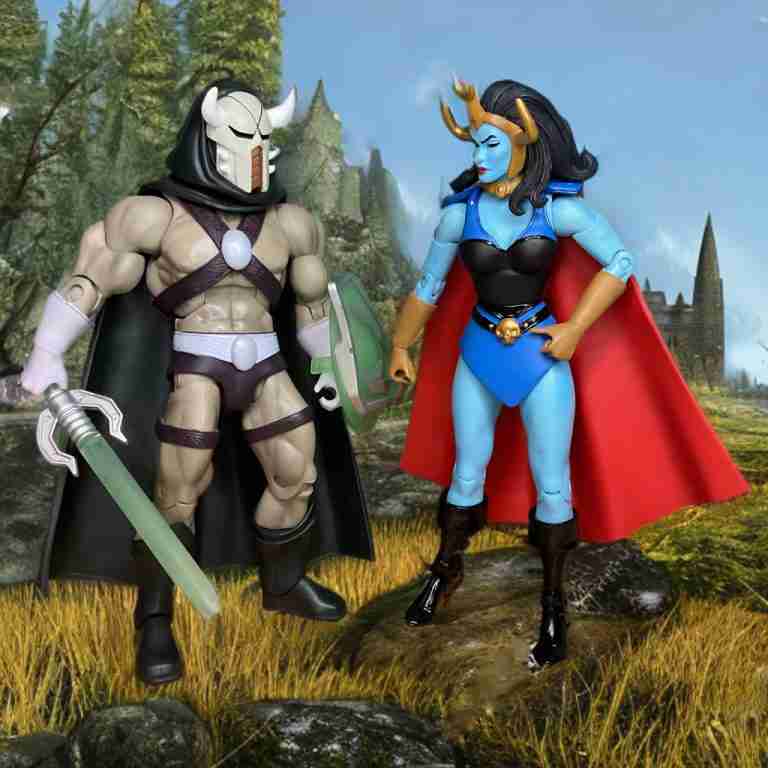
Despite their narrative brevity, Masque and Shokoti found immortality in the MOTUC line. Shokoti’s 2013 release, part of the Club Filmation subscription, replicates her animated form with a 7-inch figure, featuring articulated limbs, a removable red cape, and a horned beast companion. Priced at $25, its bio expands her Gar betrayal and apocalyptic ambitions, with glow-in-the-dark headdress variants boosting collector appeal. Lord Masque followed in 2016 as the Collector’s Choice line’s inaugural figure, a $24, 7-inch sculpt with 30 articulation points, a translucent green sword, shield, and removable cape. His bio portrays him as a timeless wanderer, its glow-in-the-dark mask (in variants) and cloud-form accessories evoking his episode feats.
Both figures, exclusive to subscribers, sold out swiftly, commanding premiums on secondary markets. Collectors praised their fidelity—Shokoti’s headdress and Masque’s dynamic posing—fostering dioramas of the House of Darkness. These releases, from 2008–2019’s MOTUC ecosystem, highlight Mattel’s commitment to canon obscurity, bridging animation and toyetic legacy for Filmation purists.
Legacy and Canonical Echoes
Confined to two episodes, Masque and Shokoti’s resonance endures through thematic depth. Shokoti’s Darklings reappear in She-Ra: Princess of Power (1985), and her pyramid’s temporal mechanics echo in tales like “The Ancient Mirror of Avathar.” Masque prefigures villains like the Faceless One, his mask motif recurring in the 1983 “Masks of Power” minicomic, though not directly tied. Neither appears in minicomics, DC Comics, or reboots like 2002’s series or 2021’s Revelation, cementing their Filmation exclusivity. Shokoti’s Gar heritage bridges to expanded lore, while Masque’s dissolution leaves questions of his nature unanswered.
Their defeats—Masque via Orko’s pluck, Shokoti via Stanlan’s courage—reinforce MOTU’s morals: heroism triumphs through camaraderie and inner strength. In fan discourse, Shokoti ranks among the scariest villains, her illusions evoking unease, while Masque’s obscurity fuels allure. Their story warns of ambition’s abyss and the fragility of light against resurgent darkness.
Conclusion
Lord Masque and Shokoti, the veiled sentinel and sorceress of Eternia’s buried nightmares, weave a saga of deception and dread in MOTU’s annals. From Masque’s centuries-long vigil and Shokoti’s hemispheric tyranny to their fiery defeats under He-Man’s blade, their intertwined tale is one of thwarted apocalypse. In Filmation’s canvas, they challenge heroes with illusion and shadow, their House of Darkness a monument to forgotten horrors. Revived in 2013 and 2016 as MOTUC figures, they bridge eras, inviting reflection on the shadows beneath Eternia’s dunes. As the planet basks in light, their echoes linger—whispers of darkness that forever hunger, a haunting reminder that even the deepest tombs may stir.

 English
  Deutsch
  Français
  Português do Brasil
  日本語
日本語  Español
  English (Australia)