

MOTU Rattlor: The Striking Snake Man Serpent of Eternia
In the vast, myth-shrouded world of Eternia, where heroes clash with villains in eternal struggles for power, few figures embody the sly menace of the ancient reptilian hordes quite like Rattlor. As a key player among the Snake Men, this elongated-necked warrior has slithered through countless tales of conquest and betrayal. His story weaves through the fabric of Eternia’s history, from shadowy imprisonments to explosive battles that shake the very foundations of Castle Grayskull. For collectors and enthusiasts alike, Rattlor represents not just a fearsome foe, but a symbol of the enduring allure of these legendary conflicts. Let’s uncoil the details of his existence, exploring the twists and turns that make him a standout in the Masters of the Universe saga.
The Ancient Roots of a Reptilian Warrior
Rattlor’s origins trace back to the prehistoric era of Eternia, a time when the Snake Men ruled with iron fangs under their dread leader, King Hiss. This race of humanoid serpents, known for their cunning and venomous ambitions, sought dominion over the planet, clashing with early defenders and mystical forces. Rattlor emerged as a prominent figure in this empire, his name evoking the ominous sound of his tail vibrating in warning—or triumph.
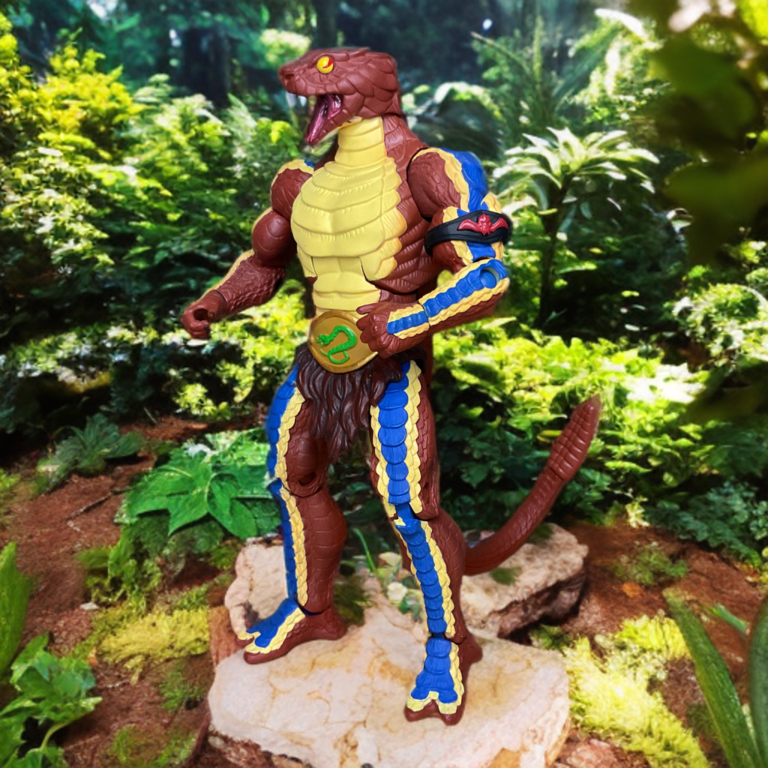
During the great wars that pitted the Snake Men against the rising powers of Eternia, Rattlor served as a frontline enforcer. The Snake Men, led by King Hiss, unleashed terror across the lands, their armies slithering from hidden lairs to strike at unsuspecting villages and strongholds. Rattlor’s role in these early campaigns was pivotal; his ability to extend his neck like a coiled spring allowed him to lash out at enemies from unexpected distances, turning the tide in skirmishes where brute force alone faltered. Imagine the chaos: a battlefield echoing with the hisses of serpents, and amid it all, Rattlor’s head darting forth like a living whip, catching heroes off guard.
But glory was short-lived. The Council of Elders, guardians of Eternia’s balance, intervened. In a cataclysmic confrontation, they sealed King Hiss and his loyal followers—including Rattlor—into a timeless void beneath Snake Mountain. This imprisonment lasted for millennia, a frozen exile where the Snake Men plotted their return. Rattlor, ever the patient predator, bided his time in this ethereal prison, his rattles silenced but his hatred simmering.
Eons later, the seal weakened. Descendants of the ancient Snake Men, like Kobra Khan, began probing the void. In one fateful breach, Rattlor was the first to escape, clawing his way back to Eternia’s surface. Disoriented but undeterred, he allied with opportunistic forces to orchestrate a full revival of his kin. This marked the beginning of Rattlor’s modern era, where old grudges resurfaced in new wars.
Ascendance in the Ranks: General of the Fangs
Upon his liberation, Rattlor quickly reasserted his position within the Snake Men hierarchy. As General, he became the right-hand enforcer to King Hiss (or King Hssss in some retellings, emphasizing his serpentine lisp). His loyalty was unwavering, a sharp contrast to the scheming undercurrents among other villains. In the reformed Snake Men army, Rattlor coordinated assaults with precision, his strategic mind as deadly as his physical strikes.
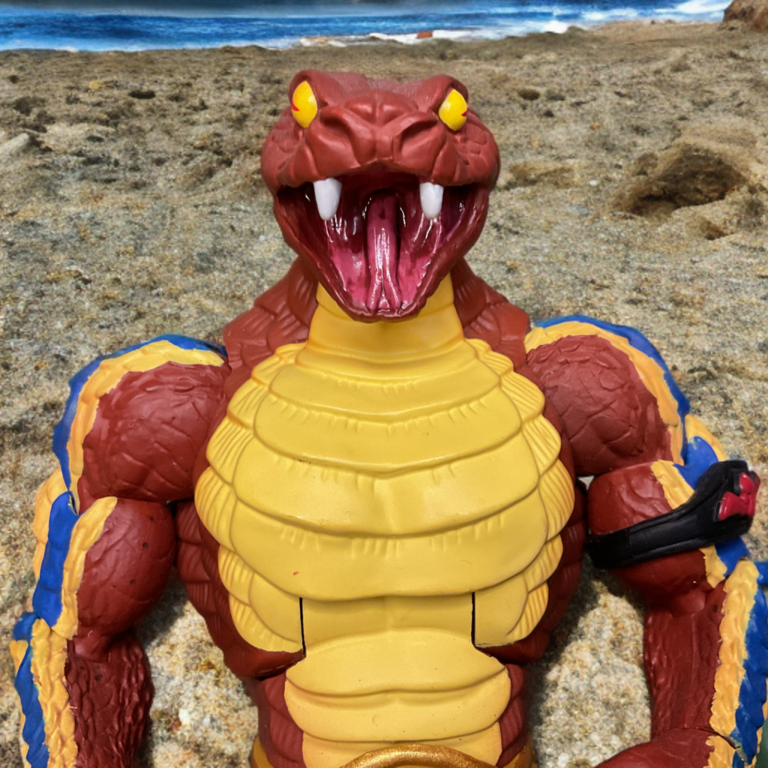
One notable chapter involved a temporary detour into the service of the Evil Horde. Banished to another dimension after a dimensional mishap, Rattlor and his comrade Tung Lashor found themselves under Hordak’s command. Here, Rattlor adapted to the Horde’s brutal tactics, participating in raids on Etheria and beyond. His rattles served as a unique communication tool, often translated by Tung Lashor for the non-reptilian members. This period honed Rattlor’s versatility; he learned to operate in alien environments, from the Whispering Woods to the Fright Zone, always plotting a return to Eternia.
When King Hiss summoned him back, Rattlor shed his Horde affiliations like old skin. Displeased with this detour, Hiss reprimanded him, but Rattlor’s proven track record secured his reinstatement. Back on Eternia, he spearheaded efforts to reclaim Snake Mountain from Skeletor, the bone-faced usurper who had claimed it as his lair. In a daring betrayal, Rattlor collaborated with Evil-Lyn to steal mystical artifacts, paving the way for the Snake Men’s resurgence.
Under Rattlor’s command, the Snake Men launched ambitious campaigns. They attempted to harness the power of Serpos, the ancient snake deity, transforming Snake Mountain into a living behemoth. Rattlor’s forces clashed with He-Man and the Masters, their battles echoing through valleys and ruins. In one intense encounter, Rattlor used his molted skin as a decoy to escape imprisonment, a clever ruse that left his captors baffled. His generalship shone in these moments, blending raw aggression with serpentine guile.
Yet, not all was harmonious. Tensions arose with Kobra Khan, whom Rattlor viewed as a diluted pretender—a mere descendant rather than a pure-blooded Snake Man. This rivalry simmered, with Rattlor often undermining Khan’s attempts to curry favor with King Hiss. Such internal frictions highlighted the Snake Men’s fractious nature, where loyalty was a double-edged sword.
The Inner Coils: Traits and Talents
What makes Rattlor tick? At his core, he’s a creature of instinct and hierarchy. Silent much of the time, he prefers action over words, letting his tail’s ominous vibrations speak volumes. When he does vocalize, it’s often in terse hisses, conveying disdain or commands. This reticence adds to his aura of mystery; foes never quite know when his neck will snap forward in attack.
Physically, Rattlor is a marvel of reptilian engineering. His neck extends dramatically, allowing strikes from afar, while his tail rattles to intimidate or signal allies. Armor-clad in scales that blend with Eternia’s rocky terrains, he’s built for ambush warfare. In combat, he’s relentless, using his environment—caves, cliffs, or shadows—to gain the upper hand.
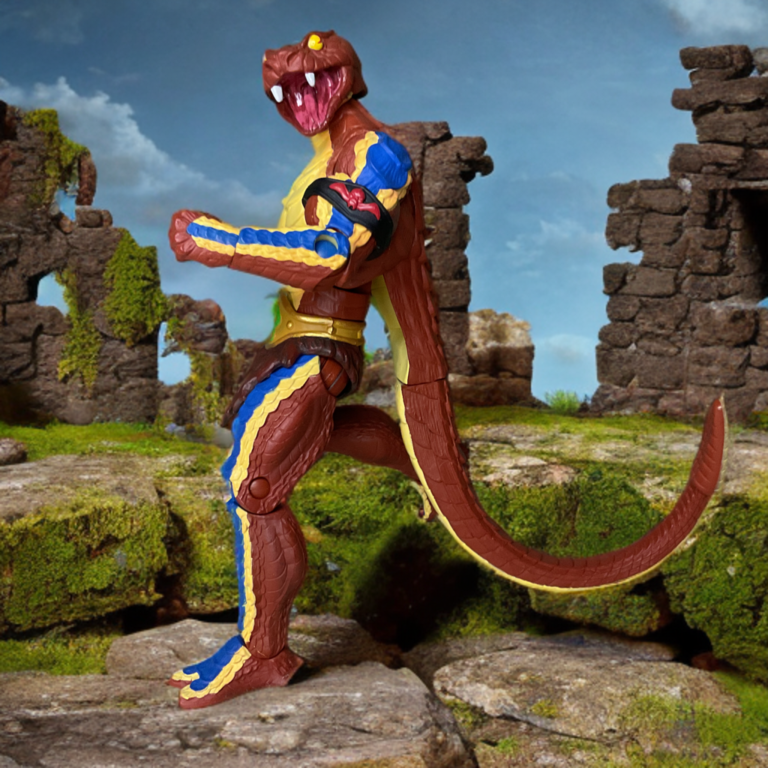
Personality-wise, Rattlor embodies loyalty laced with pragmatism. He’s quick to align with power, as seen in his Horde stint, but his true allegiance lies with the Snake Men cause. Fury boils beneath his calm exterior, especially toward those who imprison or betray his kind. He’s no mindless brute; strategic escapes and alliances show a calculating mind, always one slither ahead.
His abilities extend beyond the physical. In group dynamics, Rattlor acts as an enforcer, quelling dissent with a glare or a rattle. This makes him indispensable to leaders like King Hiss, who rely on his steadfastness amid the Snake Men’s scheming ranks.
Clashes and Vendettas: Eternal Enemies
No warrior’s tale is complete without rivals, and Rattlor’s list is as long as his neck. Foremost is He-Man, the champion of Eternia, whose interventions thwarted countless Snake Men plots. In epic showdowns, Rattlor’s strikes met He-Man’s sword, sparks flying as hero and villain tested each other’s resolve. These encounters often ended with Rattlor retreating, tail between his legs, but always vowing revenge.
Zodak, the cosmic enforcer, holds a special grudge. As part of the Council that sealed the Snake Men, Zodak personally battled Rattlor in ancient times. Their rematches in the modern era were brutal, with Rattlor seeking payback for millennia of exile.
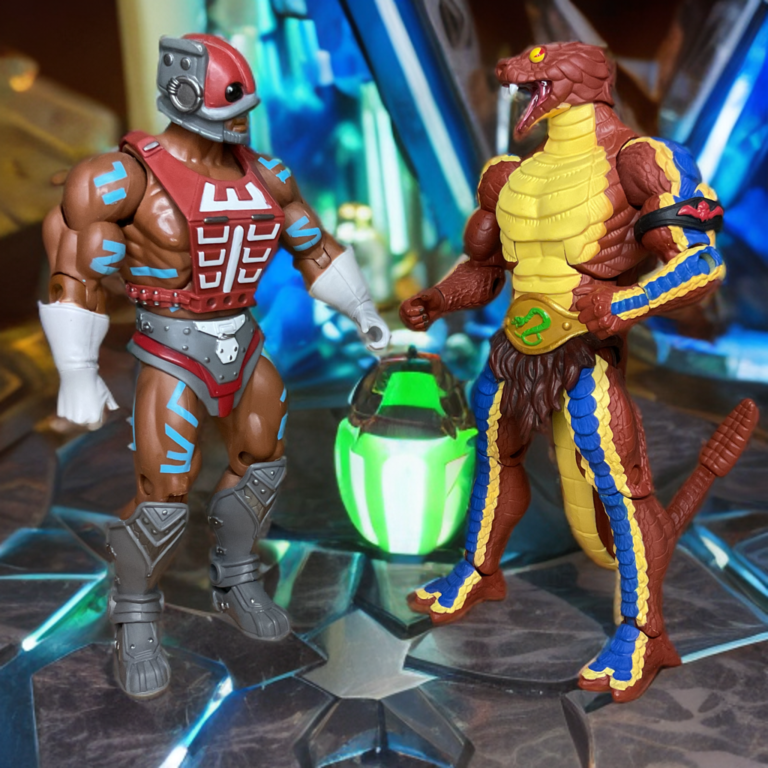
Skeletor, the self-proclaimed Lord of Destruction, represents another thorn. When the Snake Men reclaimed Snake Mountain, Rattlor led the charge against Skeletor’s minions. A brief alliance turned sour, leading to betrayals that left lasting scars. Evil-Lyn’s involvement in these schemes added layers of intrigue, with Rattlor using her ambitions to his advantage.
Within his own faction, Kobra Khan stands out as a personal antagonist. Rattlor’s disdain for Khan’s “impure” heritage fueled petty squabbles, from ignored rescue attempts to contested positions at King Hiss’s side. This internal rivalry weakened the Snake Men at times, proving that even serpents can bite their own tails.
Broader conflicts involved the Evil Horde and the Masters. Rattlor’s time with Hordak bred familiarity, but upon return, it became enmity as the Horde vied for Eternian dominance. Against the heroic Masters—Man-At-Arms, Teela, and others—Rattlor’s ambushes tested their vigilance, creating legends of narrow escapes and heroic stands.
Echoes Across Eternia: Portrayals in Stories
Rattlor’s legend has been immortalized in various Eternian chronicles, from illustrated tales to animated epics.
Masters of the Universe Minicomics
Rattlor’s appearances in the Masters of the Universe minicomics are limited but significant, primarily in the late 1980s wave that introduced and expanded the Snake Men faction. As a late-addition character (released in 1986 alongside the Snake Men push), Rattlor was retroactively woven into the lore to bridge his earlier Horde/Skeletor affiliations from the animated series with the new ancient Serpent Empire storyline.
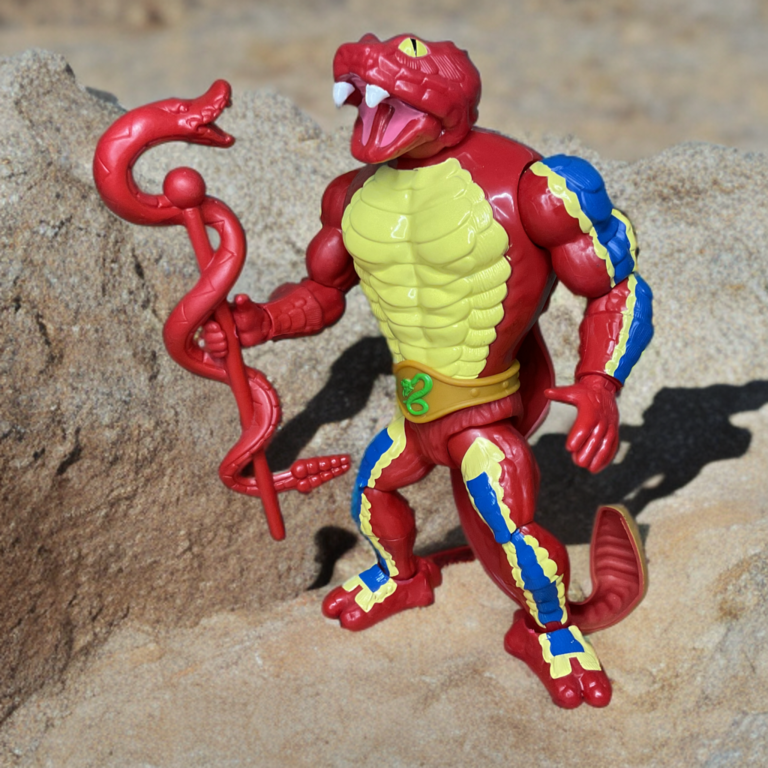
These small-packaged comics—often 16 pages or less—served as the primary narrative vehicle for the toy line’s mythos, especially in the post-cartoon era when Mattel emphasized toy-driven stories over Filmation continuity. Rattlor is portrayed as a loyal, muscle-bound enforcer: silent or minimal in dialogue, relying on brute force, his quick-strike neck extension, and rattling tail for intimidation and combat. He rarely schemes; instead, he executes orders with mechanical efficiency, often serving as the “brawn” to complement more cunning allies like Tung Lashor or Kobra Khan.
Key Minicomic Appearances and Roles
King of the Snake Men (1986, Series 5 – Packaged with King Hiss, Tung Lashor, and Rattlor; art by Bruce Timm)
This is Rattlor’s debut and one of his most prominent roles. The story introduces the Snake Men as an ancient conquering force, with King Hiss emerging from disguise to ally temporarily with Skeletor. After Kobra Khan and Skeletor breach the energy pool beneath Snake Mountain, they summon reinforcements from the timeless Void dimension. Only two Snake Men appear initially: Tung Lashor and Rattlor.
Rattlor plays a straightforward combat role—he lunges with his extendable neck to attack He-Man directly, demonstrating his signature quick-strike ability in action. He helps capture the Power Sword briefly during the chaos, underscoring his value as frontline muscle. The comic ends with He-Man thwarting the full army’s release, but Rattlor and Tung Lashor stand as the first visible lieutenants of the revived King Hiss. His design here shows an intermediate prototype look (dragon-like spines on the back, not fully matching the final toy), emphasizing his monstrous, serpentine menace.
Revenge of the Snake Men! (1986/1987, late Series 5/early Series 6 – Packaged with figures like Blast-Attak; art varies, often Bruce Timm influence)
Rattlor returns as part of the growing Snake Men force. King Hiss, now more established, summons additional warriors (including Snake Face and Sssqueeze) from the Void to escalate the threat. Rattlor appears in battle sequences, using his rattling tail and neck strike to harass heroes like He-Man, Extendar, and the Sorceress (disguised as Queen Marlena). His role reinforces the faction’s resurgence: he’s the reliable heavy hitter in group assaults, often positioned to clash physically while others employ trickery or powers.
The story highlights internal Snake Men dynamics indirectly—Rattlor’s loyalty to King Hiss is unquestioned, contrasting with later lore where he resents Kobra Khan’s favoritism.
Snake Attack! (1986/1987, late wave – Often bundled or referenced in Snake Men packs)
Rattlor teams up closely with Tung Lashor here. Tung Lashor takes a more tactical/brains-oriented approach (using his tongue whip for ranged attacks and taunts), while Rattlor provides the brawn—charging in with neck extensions and tail rattles to overwhelm opponents. This duo dynamic portrays Rattlor as the straightforward enforcer, rarely speaking but always striking fast when ordered.
The Ultimate Battleground! (1987, late Series 6 – Tied to final waves)
Rattlor appears in large-scale confrontations involving multiple factions (Snake Men, Evil Warriors, Heroic Warriors). He contributes to chaotic battles around Snake Mountain, using his abilities to disrupt He-Man’s allies and support King Hiss’s bid for dominance.
Other Minor or Background Appearances
• Energy Zoids and The Powers of Grayskull: The Legend Begins! (unproduced line concepts, but referenced in surviving minicomics/art): Rattlor is included in Preternian-era Snake Men battles, hinting at his ancient origins as a veteran warrior before imprisonment.
• He also pops up in transitional stories bridging alliances (e.g., brief nods to his Horde service before full Snake Men loyalty).
Overall Portrayal and Legacy in Minicomics
In the minicomics, Rattlor is the archetype of the loyal general: disciplined, ferocious in combat, but not a leader or schemer. He speaks little (often just hisses or battle cries), letting his physicality do the talking. This contrasts with more verbose villains like Skeletor, Beast Man, or Kobra Khan. His quick-strike feature gets showcased repeatedly—neck lunges to disarm or bite foes—making him a visual highlight for kids flipping through the pages.
These stories retcon Rattlor from his She-Ra/Filmation Horde roots (where he served Hordak as “The General”) into an ancient Snake Man who rejoins King Hiss upon revival. The minicomics avoid deep explanation for this shift, focusing instead on action and faction rivalry.
Later media (2002 cartoon, Classics bios) expanded on this—making him “The General” who defects temporarily to the Horde out of resentment toward Kobra Khan—but the vintage minicomics keep it simple: Rattlor is King Hiss’s steadfast striker, always ready to rattle and strike in service of serpentine conquest.
For collectors and fans revisiting these on sites like He-Man.org or in Dark Horse reprints, Rattlor’s panels capture the raw, gimmick-driven excitement of the era—proving even silent henchmen can slither into memorable villainy. If you’re building a Snake Men display, these comics provide the perfect narrative backdrop for posing him mid-strike!
Rattlor in the 2002 He-Man and the Masters of the Universe Cartoon
The 2002 animated series He-Man and the Masters of the Universe (produced by Mike Young Productions for Cartoon Network) gave Rattlor a much more prominent and fleshed-out role than his brief, late-wave appearances in the vintage minicomics or his minor cameos in the original 1980s continuity. Voiced by Richard Newman, Rattlor is reimagined as “The General”—King Hssss’s loyal, strategic second-in-command and the tactical leader of the Snake Men army. This version elevates him from a gimmick-driven henchman to a competent, no-nonsense military mind with genuine menace, fitting the reboot’s darker, more serialized tone.
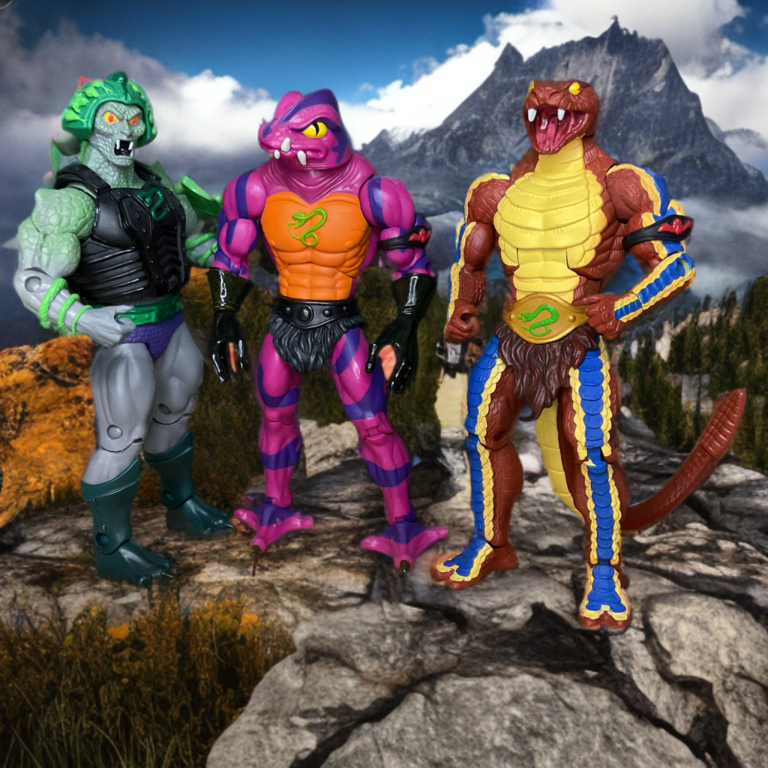
The series ran for two seasons (39 episodes total, 2002–2004), with the Snake Men storyline dominating Season 2 (retitled Masters of the Universe vs. The Snake Men in some marketing). Rattlor debuts in the arc where Kobra Khan awakens the ancient Snake Men from their imprisonment in the Void. Unlike the vintage toy era’s quick resurrections, the cartoon builds tension around their return.
Key Episodes and Role Highlights
• “The Rise of the Snake Men” (Season 2 premiere, episodes around “The Price of Victory” through the multi-part arc): Rattlor is among the first fully freed Snake Men (alongside Tung Lashor and others). He emerges as King Hssss’s right-hand enforcer, coordinating assaults on Eternia and Skeletor’s forces. His quick-strike neck extension is used in combat to devastating effect, often catching heroes off-guard with rapid lunges. Voice actor Richard Newman delivers a deep, gravelly tone that conveys authority and simmering resentment.
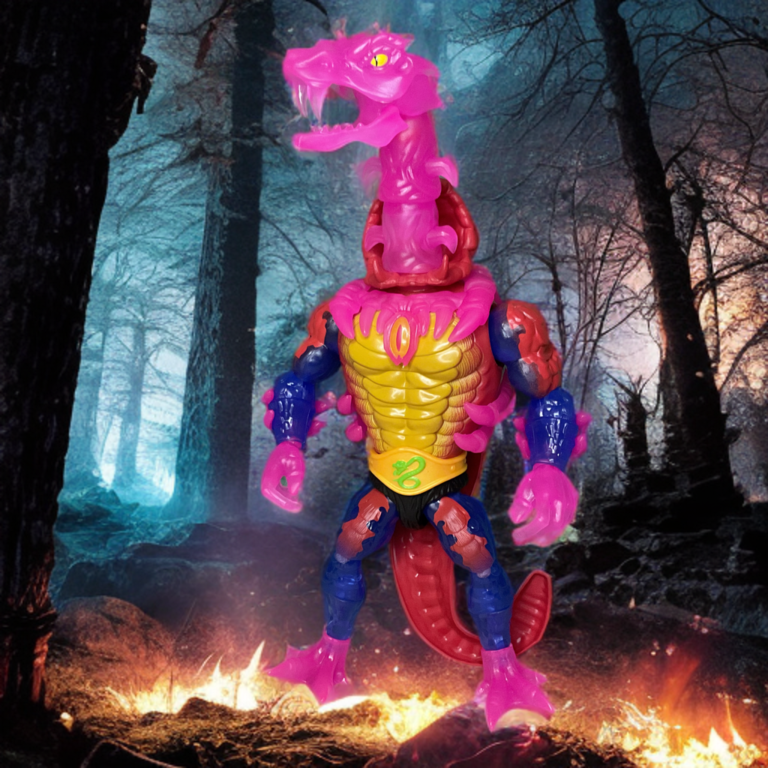
• “Rattle of the Snake” (Episode 37, aired December 27, 2003): This is Rattlor’s spotlight episode and one of the strongest showcases for his character. The plot centers on his long-held grudge against Kobra Khan for not rescuing him sooner from the Void during the millennia of imprisonment. Rattlor views Kobra Khan as an upstart descendant unworthy of his position as King Hssss’s favorite. The episode explores internal Snake Men tension: Rattlor’s fury boils over into a confrontation, forcing King Hssss to mediate. It highlights Rattlor’s disciplined personality—he’s not chaotic like Skeletor’s minions but a professional soldier who prioritizes strategy and loyalty. The moral (delivered by He-Man) emphasizes resolving grudges through communication, but Rattlor’s arc shows his stubborn pride.
• Other appearances: Rattlor frequently leads ground assaults, directs Snake Men troops in battles against He-Man, Man-At-Arms, and the Masters, and participates in schemes to unleash Serpos (the giant serpent god) or seize Snake Mountain. He’s involved in turning some heroes (like a temporary corruption of Man-At-Arms into a Snake Man via the Serpent Crown) and clashing with both heroic and evil factions in the three-way war dynamic.
Character Traits and Design in the 2002 Series
• Personality: Stoic, tactical, and fiercely loyal to King Hssss. He resents being sidelined or outranked by “lesser” Snake Men like Kobra Khan. Unlike the bumbling Horde version from She-Ra (where he served Hordak as a generic warrior), here he’s competent and intimidating—rarely humorous, often the voice of cold reason in villain meetings.
• Abilities: His extendable neck for surprise strikes and rattling tail for intimidation are faithfully adapted, often animated with dramatic slow-motion or sound effects to emphasize the threat.
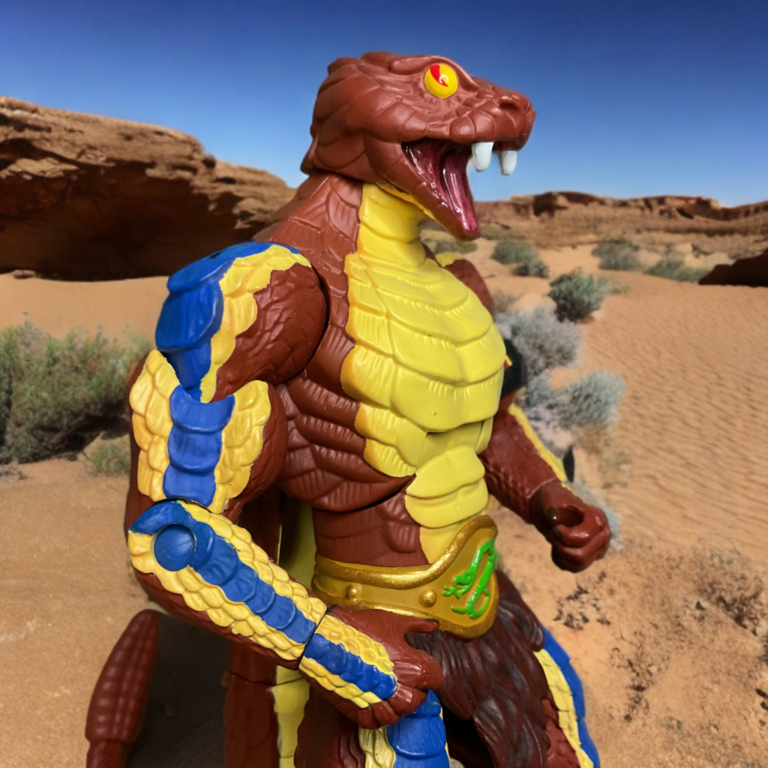
• Design: Bulkier and more lizard-like than the vintage toy (with added muscle mass and sharper features), aligning with the Four Horsemen’s sculpt style that influenced the concurrent 200X toy line. His red scales, blue accents, and armored look make him stand out in group shots.
Legacy and Impact
Rattlor’s portrayal in the 2002 series helped solidify the Snake Men as credible major antagonists, shifting focus from Skeletor in Season 2. His role as “The General” added depth to the faction—showing hierarchy, rivalries, and military discipline—elements later echoed in the Classics toy bios and Origins packaging. Fans often praise this version for making Rattlor feel like a real threat rather than comic relief.
If you’re collecting or displaying 200X/Origins Rattlor figures, this cartoon provides the richest narrative context: pose him mid-neck strike leading a charge, or in tense standoffs with Kobra Khan. Episodes are available on YouTube playlists, DVD sets (like Mill Creek’s complete series release), or streaming in some regions—perfect for rewatching his key moments.
Episode Guide: Rattlor in He-Man and the Masters of the Universe (2002 Series)
In the 2002 He-Man and the Masters of the Universe reboot (produced by Mike Young Productions for Cartoon Network), Rattlor—voiced by Richard Newman—is reimagined as General Rattlor (or simply “The General”), King Hssss’s disciplined, no-nonsense second-in-command. He serves as the tactical leader of the Snake Men army, emphasizing strategy, loyalty to King Hssss, and resentment toward “lesser” descendants like Kobra Khan. His extendable neck strike and rattling tail are animated with dramatic flair, making him a formidable battlefield presence.
Rattlor appears almost exclusively in Season 2 (often marketed as Masters of the Universe vs. The Snake Men), which shifts the focus from Skeletor to the ancient Snake Men threat. He debuts in the multi-part arc introducing the faction and features prominently through the season’s climax. Below is a detailed guide to his key episodes and appearances, including plot summaries focused on his role, air dates (original Cartoon Network run), and notable moments. Episodes are numbered per the standard production/airs order (total series: 39 episodes).
Major Appearances and Key Episodes
1. Episode 30: “Rise of the Snake Men, Part 1”
• Original Air Date: November 8, 2003
• Rattlor’s Role: Debut appearance. Rattlor is the first major Snake Man freed from the Void (alongside Tung Lashor) after Kobra Khan and Evil-Lyn steal Zodak’s staff to open the portal. He emerges as King Hssss’s loyal general, coordinating the initial assault on Snake Mountain. He helps secure the fortress while mocking Kobra Khan as a “puny descendant.”
• Key Moments: Rattlor’s quick-strike neck is used in combat; he declares Zodak “another meal for our king” upon seeing the ancient warrior. This episode marks He-Man’s new Snake Armor debut as a direct counter to the Snake Men. Rattlor establishes himself as the faction’s military mind.
2. Episode 31: “Rise of the Snake Men, Part 2”
• Original Air Date: November 15, 2003 (approximate; part of the arc)
• Rattlor’s Role: Continues as field commander. He leads Snake Men troops in battles against the Masters and Skeletor’s forces during the chaos of the resurgence. His strategic oversight helps the Snake Men gain ground temporarily.
• Key Moments: More neck strikes and tail rattles in action sequences; he laughs off Kobra Khan’s ambitions, reinforcing internal tensions.
3. Episode 37: “Rattle of the Snake”
• Original Air Date: December 27, 2003
• Rattlor’s Role: Spotlight episode and his most character-driven appearance. The plot revolves around Rattlor’s deep grudge against Kobra Khan for not freeing him sooner from the Void during their long imprisonment. Rattlor views Khan as an unworthy upstart and confronts him, forcing King Hssss to intervene.
• Key Moments: Rattlor’s fury highlights his pride and sense of hierarchy among the ancient Snake Men. He demonstrates combat prowess (including overpowering foes like Roboto in related scenes). The episode ends with He-Man’s moral: “Holding a grudge never solves anything.” This is one of the best showcases of Rattlor’s personality—stoic soldier with simmering resentment.
4. Episode 38: “Second Skin” (or similar late-season episodes involving Snake Men assaults)
• Rattlor’s Role: Supporting in group battles. He participates in schemes to corrupt heroes (e.g., attempts to turn Man-At-Arms into a Snake Man via artifacts) and leads ground forces.
• Key Moments: A notable fear-of-mongooses gag (Orko exploits his natural predator weakness with a spell), adding rare humor to his otherwise serious demeanor.
5. Episode 39: “History” / Late-Season Arc (including Serpos Awakening)
• Rattlor’s Role: Key in the final push. He assists King Hssss in using the Medallion of Serpos to revive the giant serpent god Serpos for world conquest. Rattlor prioritizes stopping threats like Hordak’s potential return (interrupting Evil-Lyn’s plans). He commands troops in climactic battles around Snake Mountain.
• Key Moments: Strategic dialogue emphasizing “It is vital that Hordak never return!” Shows his pragmatic side—focused on Snake Men dominance over personal vendettas.
Minor/Background Appearances
• Rattlor appears in several other Season 2 episodes during the ongoing Snake Men arc (roughly Episodes 30–39), often in group shots leading assaults, directing lesser Snake Men (like Sssqueeze, Snake Face, or Tung Lashor), or clashing in three-way fights (Heroes vs. Skeletor vs. Snake Men). He rarely has solo lines outside major episodes but is consistently voiced with a deep, authoritative growl.
• No significant pre-Season 2 appearances (Season 1 focuses on Skeletor; Snake Men are only hinted at via Kobra Khan and Zodak’s backstory in “Snake Pit”).
• Total credited/voiced episodes: Around 10–15 (per voice actor credits and fan wikis), mostly clustered in the back half of Season 2.
Overall Portrayal Notes
Rattlor’s 2002 version is far more competent and layered than vintage depictions— a professional general rather than mute muscle. His rivalry with Kobra Khan adds depth to Snake Men dynamics, and his fear of mongooses provides comic relief. This portrayal directly influenced later toys (200X, Classics, Origins), where bios often reference him as “The General” who defects temporarily or resents subordinates.
Episodes are available on YouTube playlists, Mill Creek DVD sets (complete series), or streaming platforms in some regions. For collectors displaying Rattlor figures, these episodes offer the richest animation references—pose him mid-lunge or in command poses from “Rise of the Snake Men” or “Rattle of the Snake.”
The Collectible Legacy: Figures Through the Ages
Rattlor’s physical incarnations have evolved alongside his stories, captivating collectors with innovative designs and features. From his debut in the 1980s to modern revivals, each release captures his essence while adding new twists.
Below is a comprehensive chart of his official action figure releases, including key details and estimated current aftermarket prices (as of early 2026, based on recent sales data from platforms like eBay for complete or near-mint conditions). Prices can fluctuate due to condition, packaging, and rarity.
| Release Year | Line/Variant | Key Features | Accessories | Estimated Aftermarket Price (USD) |
|---|---|---|---|---|
| 1986 | Vintage MOTU (Wave 5) – Standard (Yellow Neck) | Extendable neck (pale yellow variant), rattling tail, scaly armor | Snake staff (flexible red), mini-comic | $25–$50 (loose/complete); $80–$150 (MOC/unpunched) |
| 1986 | Vintage MOTU (Wave 5) – Red-Neck Variant (Taiwan factory) | Extendable neck in matching red/maroon (rarer production run), otherwise identical: rattling tail, scaly armor | Snake staff (flexible red), mini-comic | $60–$180 (loose/complete with staff); $200–$500+ (MOC/unpunched or excellent examples; premiums for tight bubbles and working mechanism) |
| 2003 | 200X (The General Rattlor) | Updated sculpt with detailed scales, poseable neck extension, more articulated body | Snake staff, removable armor | $80–$120 (complete/near mint) |
| 2010 | MOTU Classics | Highly detailed collector figure, bio card with real name (Slltyo), extendable neck | Snake staff, cross-sell art packaging | $120–$180 (complete; sealed/mailers higher) |
| 2022/2023 | Origins (Rise of Snake Men) | Retro-style with modern articulation, quick-strike head, Snake Men branding | Snake staff, mini-comic | $15–$35 (complete; often near or below original retail for loose figures) |
| 2024 | Turtles of Grayskull (Crossover) | Hybrid design blending MOTU and TMNT elements, reptilian wars theme, poseable (includes interchangeable neck pieces) | Staff accessory, crossover packaging | $15–$30 (new/near mint; emerging secondary market) |
Notes on prices (as of January 2026): Estimates reflect recent eBay sold data, collector forums, and sites like motuvintagevariants.com. The 1986 red-neck variant (Taiwan-marked, © MATTEL INC. 1985 TAIWAN) is rarer due to a factory production batch using maroon plastic for the extendable neck to match the body—far more uniform and desirable than the common pale yellow neck. Condition matters hugely: working neck mechanism, included staff, minimal paint wear, and packaging quality drive premiums (especially MOC red-neck examples). Origins and Turtles of Grayskull figures tend to hover near retail. Markets shift—check current auctions for the latest.
Highly Sought After Red-Neck Variant
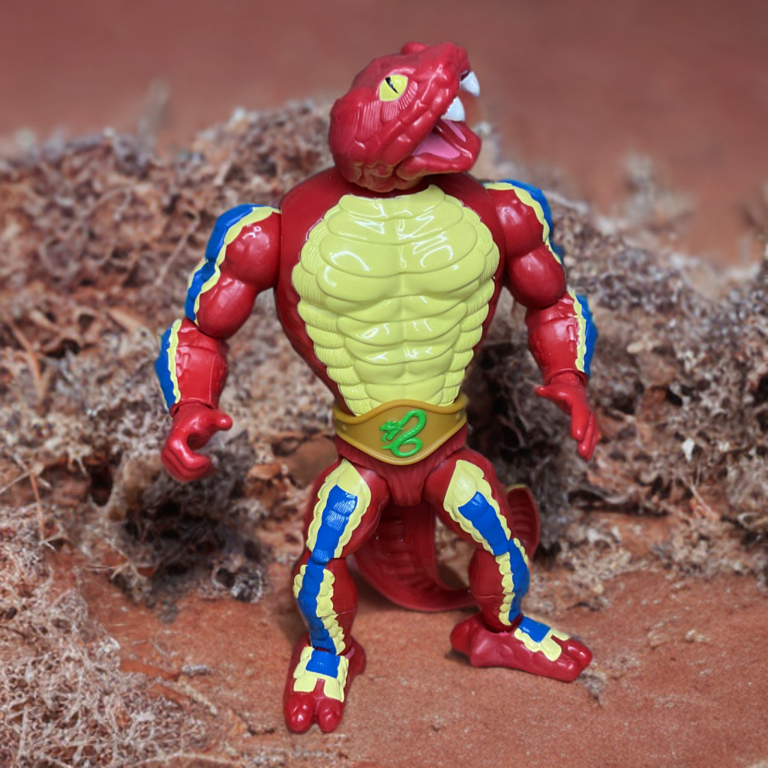
The red-neck variant of the 1986 vintage Masters of the Universe Rattlor (Wave 5) is one of the most sought-after production differences from the original line, produced at the Taiwan factory (marked © MATTEL INC. 1985 TAIWAN on the figure and accessories).
Key Differences from the Standard Version
• Neck Color: The standard Rattlor has a pale or light yellow neck (the extendable/spring-loaded part that shoots out when you press the button on his back). The red-neck variant matches the rest of his body with a red/maroon/burgundy neck color, creating a more uniform, seamless look across the torso, head, shoulders, and extended neck.
• Otherwise Identical: No other changes exist in sculpt, paint apps (e.g., light yellow chest, tan belt with neon green serpent), accessories (flexible red snake staff), action features (quick-strike neck pop-out, rattling beads inside when shaken), or markings. The variant is purely a factory color variation from a specific production run, not a deliberate “chase” or mail-away exclusive.
• Why It Happened: Like many vintage MOTU figures, Taiwan factory runs had occasional paint/plastic batch differences. The red neck is considered a “running change” or error-turned-rarity—most production used yellow plastic for the neck piece, but a batch used red/maroon to match the body.
Collectors often describe the red-neck version as looking “cleaner” or more intentional, especially when the neck is extended. The standard yellow-neck version is far more common and what most people remember from childhood.
Rarity and Collectibility
This variant is notably harder to find than standard Rattlors, especially in complete condition (with staff) or with original packaging. It’s not ultra-rare like some international variants (e.g., certain Spanish or Mexican releases), but it’s a staple “grail” for serious vintage MOTU completists focusing on U.S./Taiwan figures.
• Loose/Complete Figures: Typically sell in the $50–$150 range depending on condition (paint wear, working action feature, staff included). Nicer examples with minimal wear push toward the higher end.
• Mint on Card (MOC) or Carded/Bubbled: These command significant premiums—recent sales have ranged from $150–$400+, with exceptional examples (tight bubble, no yellowing, unpunched card) occasionally hitting $500 or more in hot markets.
• Factors Influencing Price:
• Condition of the neck extension mechanism (does it still pop out smoothly?).
• Presence of the staff (often missing on loose figures).
• Card condition if packaged (minor bubble separation is common and doesn’t tank value much).
• Overall demand—Rattlor’s popularity among Snake Men fans keeps this variant desirable.
Prices fluctuate based on eBay sold listings, collector forums, and sites like Heritage Auctions or specialty shops. As of early 2026, the red-neck variant consistently outpaces standard yellow-neck Rattlors by 2–4x in comparable condition.
If you’re hunting one for your collection focus on Taiwan-marked figures and check photos closely for the neck color. Many sellers explicitly label “Red Neck Variant” in listings to highlight it.
These figures showcase Rattlor’s evolution: the vintage toy’s simple mechanics gave way to the 200X’s gritty realism, while Classics offered premium details for adults. Origins revived the nostalgic feel with updated playability, and the recent crossover adds a fun twist. Collectors prize variants like the rare red-neck 1986 edition, which can fetch premiums.
Enduring Menace: Rattlor’s Place in Legend
As Eternia’s sagas continue, Rattlor remains a symbol of persistent evil—always ready to strike when least expected. His journey from ancient general to dimensional wanderer to vengeful liberator encapsulates the timeless appeal of these tales. Whether rattling his tail in warning or extending his neck in assault, Rattlor reminds us that some threats never truly fade; they simply wait for the right moment to uncoil.
For those diving into the archives, Rattlor’s story offers layers of intrigue, from strategic genius to petty vendettas. He’s more than a villain; he’s a thread in Eternia’s rich tapestry, connecting prehistoric wars to modern heroism. As new generations discover these legends, Rattlor’s hiss echoes on, a reminder that in the world of Masters of the Universe, danger lurks in every shadow.

 English
  Deutsch
  Français
  Português do Brasil
  日本語
日本語  Español
  English (Australia)