

Why Spider-Man Can’t Just Punch the Kingpin: The Brutal Truth
Wilson Fisk, better known as the Kingpin, stands out as one of Spider-Man’s most persistent and influential adversaries. Unlike flamboyant costumed villains like the Green Goblin or Doctor Octopus, Kingpin operates primarily as a crime lord—a massive, physically imposing figure who blends raw strength, ruthless intellect, and vast resources. He rarely relies on superpowers or gadgets for his schemes, instead using money, henchmen, and political leverage to maintain control over New York’s underworld (and beyond). This makes him a grounded, enduring threat who often forces Spider-Man to confront the limits of his own heroism.
Origins and Early Role in Comics
Kingpin debuted in The Amazing Spider-Man #50 (1967), during the iconic “Spider-Man No More!” storyline. In his first appearances, Fisk is introduced as a powerful mob boss who seizes control of the city’s crime families by defeating the “Big Man” (Frederick Foswell). Stan Lee and John Romita Sr. portrayed him as a hands-on criminal mastermind who could physically overpower ordinary foes while outsmarting authorities.
Early on, Kingpin serves as a symbol of organized crime’s corruption. He exploits Spider-Man’s public image problems, abducts J. Jonah Jameson, and pressures Peter Parker into quitting as Spider-Man. Unlike many of Spidey’s foes driven by personal grudges or science gone wrong, Fisk represents systemic evil: he profits from chaos while presenting himself as a legitimate businessman. In these initial arcs, he employs superpowered underlings (like Electro) and demonstrates that Spider-Man can’t simply punch away entrenched power structures—Fisk always seems to slither back into influence after defeats.
Over time, Kingpin’s role evolved. Frank Miller’s landmark Daredevil run (starting 1981) redefined him as Daredevil’s arch-nemesis, emphasizing his cold-blooded scheming and personal vendettas. Yet he never fully left Spider-Man’s orbit. He remains a recurring thorn, often allying with or manipulating other Spider-villains, funding projects like the Spider-Slayers, or clashing directly in brutal hand-to-hand fights where his immense size and martial prowess let him trade blows with the wall-crawler.


Kingpin as a Spider-Man Villain: Key Traits and Dynamics
The Master Manipulator and Strategic Organizer
Wilson Fisk is rarely a villain who stands alone on a battlefield; he is the architect of a sprawling criminal infrastructure. As a master manipulator, Kingpin pulls the strings of both the underworld and the city’s legitimate institutions to isolate and destroy Spider-Man. Rather than engaging in every skirmish, he blackmails powerful figures like Norman Osborn and hires elite assassins to do his bidding. By funding tech-based villains or recruiting enhanced threats, Fisk forces the wall-crawler into a war of attrition, ensuring that even if one threat is neutralized, the “Kingpin of Crime” remains safely insulated behind layers of deniability.
A Physical Powerhouse Without Superpowers
While his intellect is his greatest weapon, Kingpin possesses a “Charles Atlas” physique that makes him a terrifying physical match for Peter Parker. Despite having no traditional superpowers, his massive frame is composed of near-solid muscle, allowing him to withstand Spider-Man’s superhuman strength and deliver devastating, bone-crushing blows.
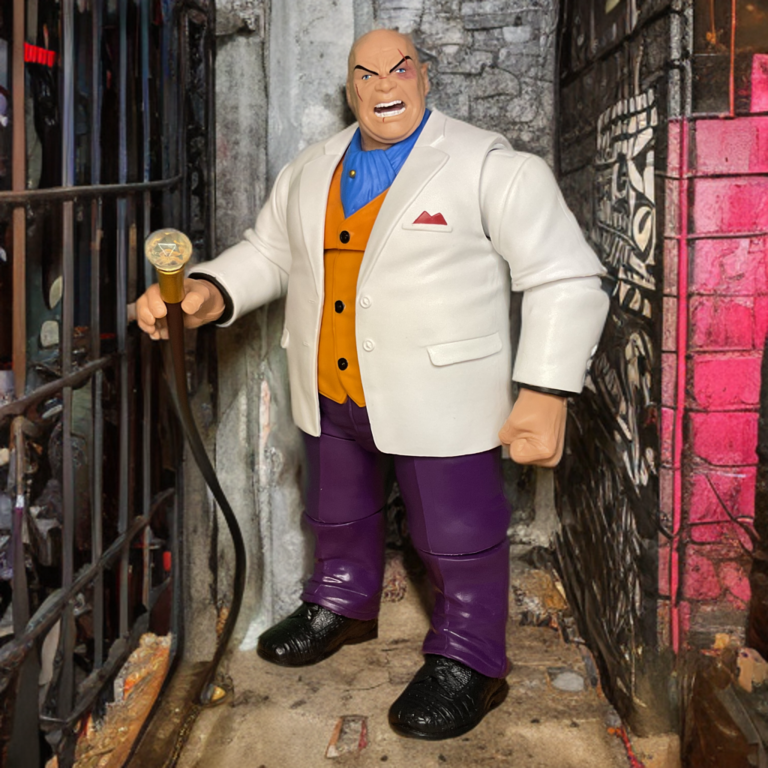
This physical dynamic often leads to the most visceral moments in Marvel history. In the iconic “Back in Black” arc, the stakes shifted from a standard rivalry to a brutal bloodbath. Driven by grief over the shooting of Aunt May, Peter Parker abandoned his quips to unleash raw, unchecked fury, systematically dismantling Fisk in a display of power that proved just how dangerous both men become when the gloves finally come off.
Kingpin
The Central Architect • Pulls strings from safety
• Relentless Spider-Slayers
• Advanced Military Gear
• Specialized Mercenaries
• Enhanced Enforcers
• Political Insulation
• Blackmailed Authority
The Target: Spider-Man
Forced to fight an entire systemic empire rather than a punchable enemy.
Personal Stakes and the Systemic Empire
Fisk’s true lethality lies in his ability to invade Peter Parker’s civilian life. He doesn’t just attack the mask; he weaponizes media pressure, targets Peter’s loved ones, and uses his vast resources to frame the hero for crimes he didn’t commit. These schemes often force Spider-Man to confront the heavy themes of his own mantra: responsibility. Fisk poses a philosophical challenge that a simple web-shooter cannot solve—how does a single hero topple a criminal empire when the legal and political systems are built to protect its leader? This creates a persistent tension where Spider-Man is often forced to expose an entire web of corruption rather than relying on a single knockout punch.
Resilience and the Burden of Stability
Kingpin embodies the “better the devil you know” archetype of villainy. His resilience makes him a permanent fixture of the New York landscape; whenever Fisk falls, the resulting power vacuum leads to chaotic, bloody gang wars that spill into the streets. This cyclical nature of his power creates a moral dilemma for heroes: at times, they are forced to tolerate his return to the throne simply to maintain a fragile sense of urban stability. Whether he is fueling tech-villain upgrades or clashing with rivals like Hammerhead, Fisk remains an “untouchable” boss whose presence is woven into the very fabric of the city.
Essential Comic Arcs and Historical Clashes
The evolution of the Fisk-Parker rivalry is documented through several landmark comic runs that showcase Kingpin’s transition from a mob boss to a global threat:
- Early Foundations: Their initial clashes in Amazing Spider-Man #50–52 and #83–85 established Fisk as a titan who could test Peter’s resolve and physical limits.
Defining Growth: Stories such as the “Learning Arc” or “Breakin’!” pushed the boundaries of their relationship, featuring moments where Fisk unmasked or nearly killed Spider-Man, forcing the hero to evolve his tactics.
The Broader Marvel Landscape: While Fisk frequently crosses paths with the Punisher or the Avengers, his relationship with Spider-Man remains uniquely personal. In these crossovers, his role as a financier of villainy and an instigator of gang wars highlights his status as the ultimate apex predator of the Marvel underworld.
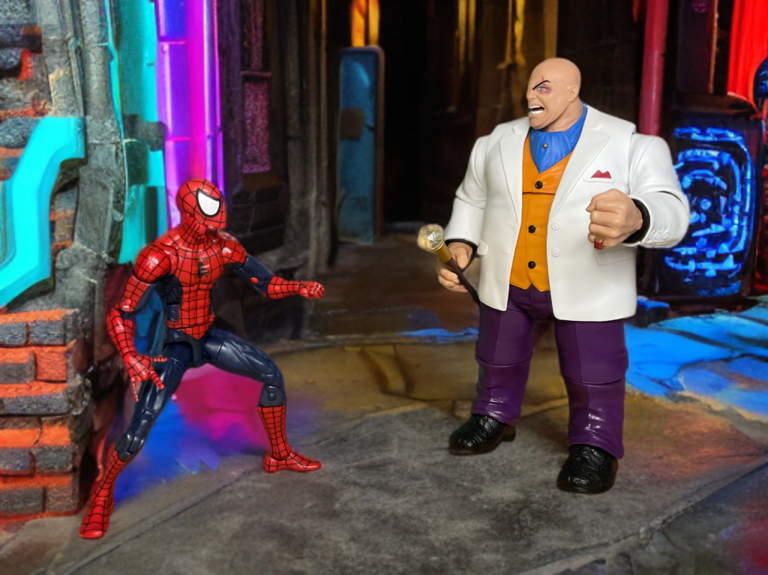
Kingpin’s Prominent Role in Spider-Man: The Animated Series (1994)
The Definitive Animated Big Bad
In the 1994 Spider-Man: The Animated Series, Wilson Fisk (voiced with sophisticated gravitas by Roscoe Lee Browne) is elevated from a mere mob boss to the show’s central antagonist. Appearing in over 30 episodes, he is the most recurring villain in the series, serving as the primary “Big Bad” who drives the show’s heavy serialization. Operating from his high-tech “Crime Central” base hidden within the Chrysler Building, this version of Kingpin is the architect behind nearly every major crisis Peter Parker faces, blending legitimate business fronts with high-stakes supervillain recruitment to maintain a global criminal empire.

Architect of the Insidious Six and Global Conspiracies
One of Fisk’s most significant contributions to the series’ lore is his role as the engineer behind the Insidious Six. During the “Neogenic Nightmare” storyline, Kingpin orchestrates a massive prison breakout to form a hand-picked team consisting of Doctor Octopus, Chameleon, Mysterio, Rhino, Scorpion, and Shocker. He provides the funding and tactical commands via intercom, specifically timing their attacks to exploit Spider-Man’s fluctuating powers. Even when the team collapses due to internal infighting, Fisk’s reach remains undisputed; he later reforms a new iteration with Vulture for the “Six Forgotten Warriors” arc. This storyline famously expanded the stakes by tying Fisk’s ambitions to global conspiracies involving the Red Skull and the mysterious past of Peter’s parents.
A Puppet Master of Technological Terror
Beyond team-building, Kingpin functions as the financier of Spider-Man’s most persistent nightmares. He is the man who commissions Alistair Smythe’s relentless Spider-Slayers, blackmails Norman Osborn into compliance, and employs specialized mercenaries like the Hobgoblin and the Spot. His obsession with eliminating Spider-Man is rooted in pure pragmatism: the wall-crawler is the primary obstacle to his total control over the Crime Cartel, his rival organization to Silvermane’s syndicate. These broader schemes showcase a Kingpin who is a strategic genius, making individual villains significantly more dangerous through his coordination and vast resources.
Personal Confrontations and Unique Adaptation
Unlike the modern comics where he is often viewed as a Daredevil-centric nemesis, the 1990s show firmly establishes him as Spider-Man’s overarching foe. The series added significant depth to his character by exploring his backstory—detailing his rise from poverty as Wilson Moriarty—which fueled his relentless drive for power. Direct physical clashes often highlight his sheer mass, featuring iconic bear hugs that nearly crush the life out of Spider-Man. His ability to survive defeat and return to his skyscraper to scheme again underscores a resilience that makes him feel like an immovable force of nature within the city.
Comparison: Comics vs. Animation
Divergent Paths in the Marvel Landscape
The portrayal of Kingpin varies significantly between mediums, though both maintain his status as a titan of crime. In the Comics, Kingpin began as a Spider-Man adversary but eventually shifted to become the definitive arch-enemy of Daredevil. He is one of many top-tier threats in a sprawling rogues’ gallery, and while his influence is massive, he isn’t always the direct catalyst for every villain’s appearance. Comic narratives often emphasize the long-term sociopolitical consequences of his actions, such as the violent power vacuums that occur whenever he is temporarily dethroned.
Conversely, the Animation makes him the dominant, ever-present force in Peter’s life. He functions as the ultimate strategist and financier; the Insidious Six exists almost entirely as a weapon of his design, a significant departure from the comic book origins of the Sinister Six. This central role makes him feel more integral to Spider-Man’s world in the show than he did in the core comics of that era.
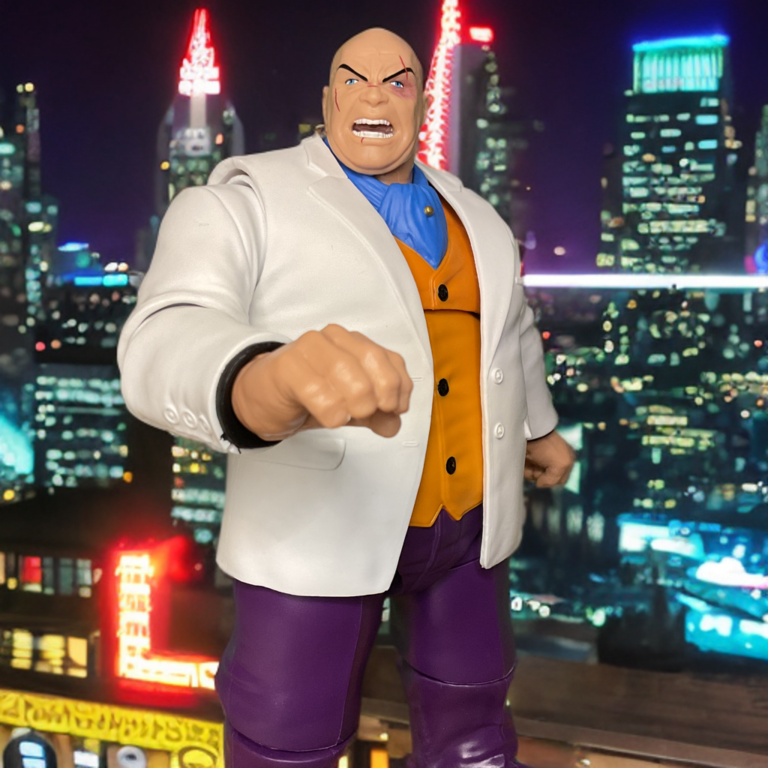
| Character Attribute | Core Comics | 1994 Animated Series (TAS) |
|---|---|---|
| Physical Power | 85% (Peak Muscle/Martial Artist) |
75% (Heavyweight/Bear hugs) |
| Strategic Intellect | 90% (Cold-blooded Planner) |
95% (Mastermind Masterclass) |
| Systemic Leverage | 80% (Corrupt Business Fronts) |
95% (Global/Tech Conspiracies) |
| Focus on Spider-Man | 65% (Shared with Daredevil/Punisher) |
95% (Ultimate Series Big Bad) |
The Core Theme: The Hero vs. The Empire
Despite these differences in frequency and focus, both versions of Kingpin highlight the unique nature of Spider-Man’s street-level struggles. While Peter Parker’s webs and quips are effective against costumed bank robbers, they are insufficient against a man like Wilson Fisk. Dismantling a criminal empire requires more than just a well-placed punch; it demands strategy, unlikely allies, and a willingness to navigate moral gray areas. Kingpin remains the ultimate reminder that while a hero can stop a crime, it is much harder to stop a system built on corruption.
Legacy and Impact
Kingpin remains one of Spider-Man’s greatest villains precisely because he lacks flashy powers—he wins through corruption, patience, and sheer will. His presence elevates other rogues by providing resources and direction, while forcing Peter to question if punching harder is enough. In adaptations (comics, TAS, films like Into the Spider-Verse, games, and MCU), he consistently embodies the idea that true power often hides in boardrooms and back alleys.
Whether funding the Insidious Six, clashing in brutal fisticuffs, or rebuilding after every fall, Kingpin proves that the Kingpin of Crime is never truly dethroned. He endures as a reminder that Spider-Man’s greatest battles aren’t always against monsters—but against the men who create them. His role enriches the mythos by grounding fantastical threats in realistic criminal enterprise, making victories feel hard-won and temporary.
Forge Your Path with Us!
???? Choose Your Next Battle
 The Complete History of the Insidious Six in Spider-Man: The Animated Series (1994)
 The Evolution of the Ultimate Slayer: Analyzing Alistair Smythe from the 1994 Series to the Comics
 Marvel Legends Grizzly: Bringing a Forgotten Spider-Man Villain to Life
 Marvel Legends Retro Owl Review: 2026 Spider-Man Wave Guide
 English
  Deutsch
  Français
  Português do Brasil
  日本語
日本語  Español
  English (Australia)