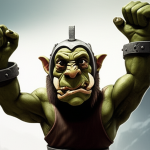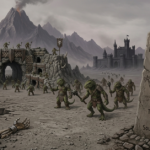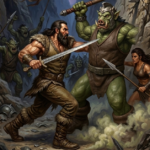

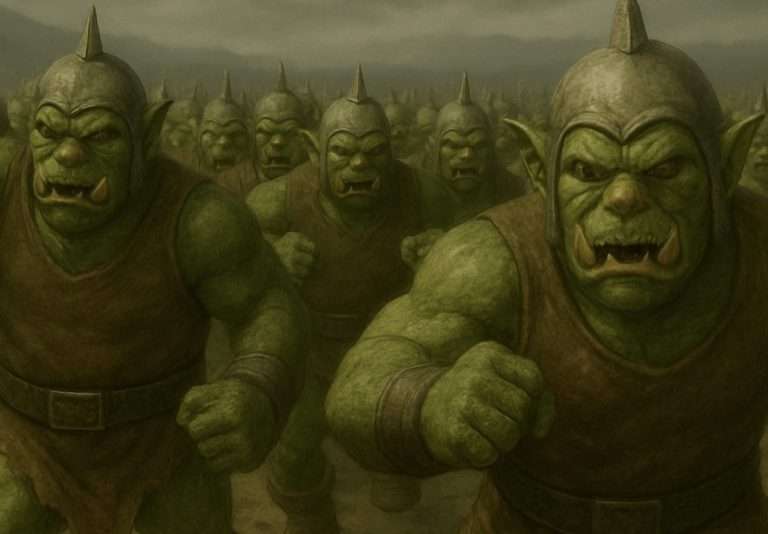
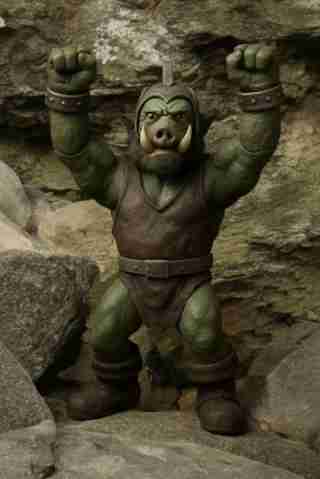
In the shadowed annals of Kimel Drago’s history, few tales resonate with the raw ferocity of the Troglodytarum’s conquest over the Gorblagonn. This was no mere skirmish but a cataclysm that reshaped the Hills of Serifornum, leaving the once-mighty giants a dwindling shadow of their former glory. At the heart of this brutal saga stood Gulik Horridus, a name now synonymous with unrelenting ambition and savage cunning, whose leadership forged the Troglodytarum into a force that would scar the land forever.
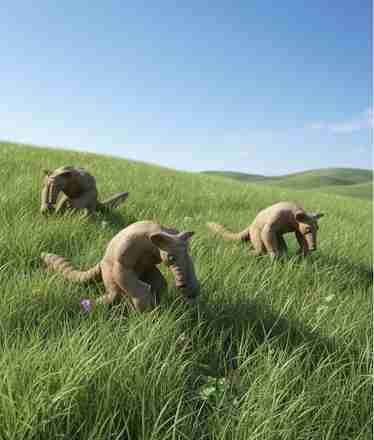
Long before the Black Wizard Witalis Atrox bent the remnants of the Gorblagonn to his will, the Hills of Serifornum were a sanctuary for these ancient giants. Towering at eight to ten feet, with hides like armadillo plating and trunks reminiscent of elephants, the Gorblagonn were a formidable yet reclusive people. They lumbered through their misty hills, content to hurl boulders at intruders or swing their spiked tails in rare displays of territorial wrath. Their minds, though not sharp, held a quiet wisdom, and their hearts harbored no malice—only a desire for solitude.
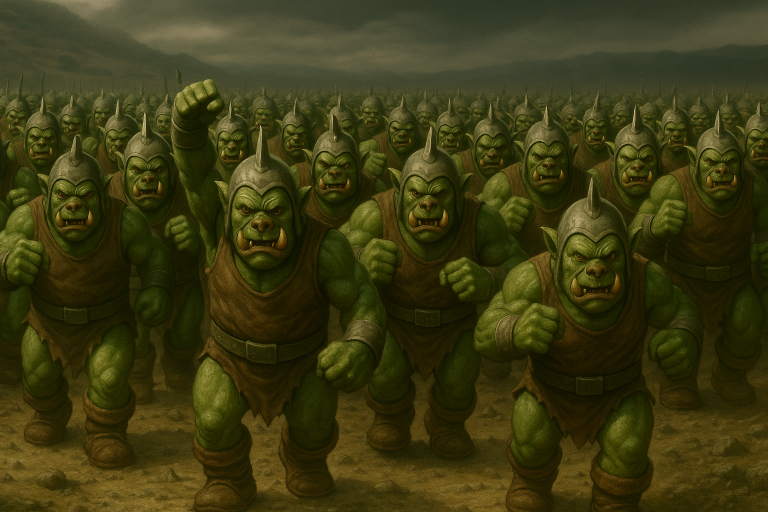
But solitude was a luxury the Troglodytarum would not permit. From the craggy Odsted Mountains, Gulik Horridus emerged as a warlord unlike any the Trogs had known. His eyes burned with a hunger for dominion, fueled by whispers of power from a then-unknown benefactor, the Black Wizard. The Troglodytarum, a race of wiry, battle-hardened warriors, thrived on chaos and bloodshed. Their raids at dusk and dawn had already terrorized the wilds of Naheld, but Gulik sought a grander prize: the subjugation of the Hills of Serifornum, home to the Gorblagonn, whose lands promised resources and strategic dominance.
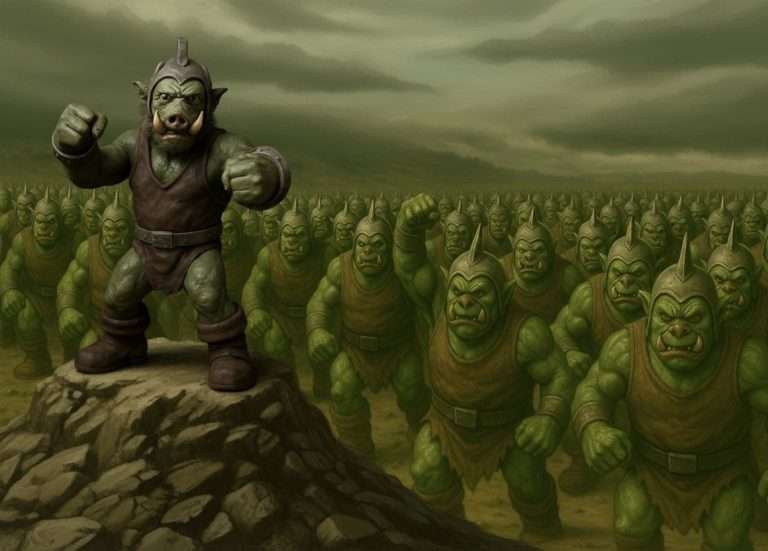
The campaign began under a bruised twilight sky, as Gulik rallied his horde in the Gravelands. Thousands of Trogs, their eyes glinting with feral glee, gathered beneath crude banners of bone and hide. Gulik, clad in jagged armor forged from the bones of fallen beasts, stood atop a jagged outcrop. His voice, a guttural roar, carried over the restless throng: “The giants hoard what is ours by right! Their hills will be our stronghold, their bones our trophies!” The Trogs howled, their weapons—crude blades, spiked clubs, and barbed spears—clashing in a cacophony of war lust.
The march to Serifornum was swift and merciless. The Troglodytarum moved like a plague, stripping the land bare as they advanced. Villages in their path were razed, their inhabitants fleeing or falling to the horde’s relentless blades. Gulik’s strategy was as brutal as it was effective: overwhelm with numbers, strike at dusk when the Gorblagonn’s sluggish senses were dulled, and exploit their lack of cunning. He sent scouts to map the hills, identifying narrow passes and open clearings where the giants’ size would be a disadvantage.
The first clash came at the edge of Serifornum, in a valley flanked by jagged cliffs. The Gorblagonn, roused by the distant clamor of the approaching horde, formed a loose line of defense. Their leader, a towering giant named Thragorblagonn, bellowed a challenge, hefting a boulder the size of a cart. The Gorblagonn, though few—numbering perhaps a thousand—stood resolute, their massive forms casting long shadows in the fading light.
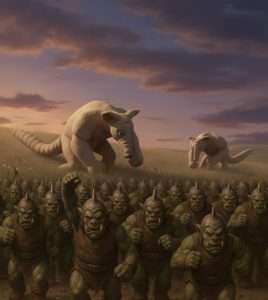
Gulik, ever the tactician, did not meet them head-on. Instead, he divided his forces, sending smaller bands to harry the giants’ flanks. The Trogs, agile and relentless, darted through the underbrush, slashing at the Gorblagonn’s thick legs with poisoned blades. The giants roared, swinging their tails and hurling stones, each blow crushing dozens of Trogs. But the horde’s numbers were overwhelming, and their ferocity unmatched. For every Trog felled, ten more surged forward, their blades biting deeper.
Thragorblagonn’s stand was valiant but doomed. Gulik himself led the central assault, wielding a massive, serrated axe that gleamed with dark enchantments—gifts, perhaps, from his shadowy patron. He targeted the giants’ knees and ankles, knowing their size was their weakness. One by one, the Gorblagonn fell, their blood soaking the earth. Thragorblagonn, pierced by a dozen spears, toppled with a thunderous crash, his final roar echoing through the hills.
The battle stretched into the night, the Trogs’ favored hour. Under the cover of darkness, they pressed their advantage, setting fire to the giants’ sacred groves to sow panic. The Gorblagonn, unaccustomed to such relentless aggression, faltered. Their lack of strategic cohesion left them vulnerable to Gulik’s coordinated strikes. By dawn, the valley was a graveyard of giant corpses, the air thick with smoke and the stench of blood.
The campaign did not end there. Over weeks, Gulik’s horde swept through the Hills of Serifornum, hunting down scattered Gorblagonn clans. Some giants fled to distant lands, but most were cornered and slaughtered. The Troglodytarum took no prisoners; their goal was annihilation, not conquest. By the time the dust settled, the Gorblagonn’s numbers had plummeted from thousands to mere hundreds, their once-proud hills scarred and silent.
Gulik Horridus stood victorious, his horde chanting his name as they piled the giants’ bones into grotesque cairns. The Hills of Serifornum were claimed, a new stronghold for the Troglodytarum. Yet, even in triumph, Gulik’s ambition burned brighter. He believed this victory was a step toward the kingdom promised by Witalis Atrox, unaware of the Black Wizard’s deceit. The Gorblagonn, broken and scattered, would later bend the knee to Atrox, their hatred for the Trogs buried under the weight of their defeat.
Thus was born the enmity between the Troglodytarum and the Gorblagonn, a wound that would fester in the lore of Kimel Drago. The March of the Troglodytarum was not just a battle but a harbinger of the chaos to come, a testament to Gulik Horridus’s ruthless vision and the unrelenting tide of his horde. The Hills of Serifornum, once a haven, became a monument to the Trogs’ savage ascendancy, their shadow looming over Kimel Drago’s future.
Don’t miss the Rise of Gulik Horridus!
 English English
  Deutsch
  Français
  Português do Brasil
  日本語
日本語  Español
  English (Australia) English English Deutsch
Français
Português do Brasil
日本語
Español
English (Australia)
English (Australia) English English Deutsch
Français
Português do Brasil
日本語
Español
English (Australia)
We use cookies to improve your experience on our site. By using our site, you consent to cookies.
Manage your cookie preferences below:
Essential cookies enable basic functions and are necessary for the proper function of the website.
Statistics cookies collect information anonymously. This information helps us understand how visitors use our website.
Google Analytics is a powerful tool that tracks and analyzes website traffic for informed marketing decisions.
Service URL: policies.google.com (opens in a new window)