
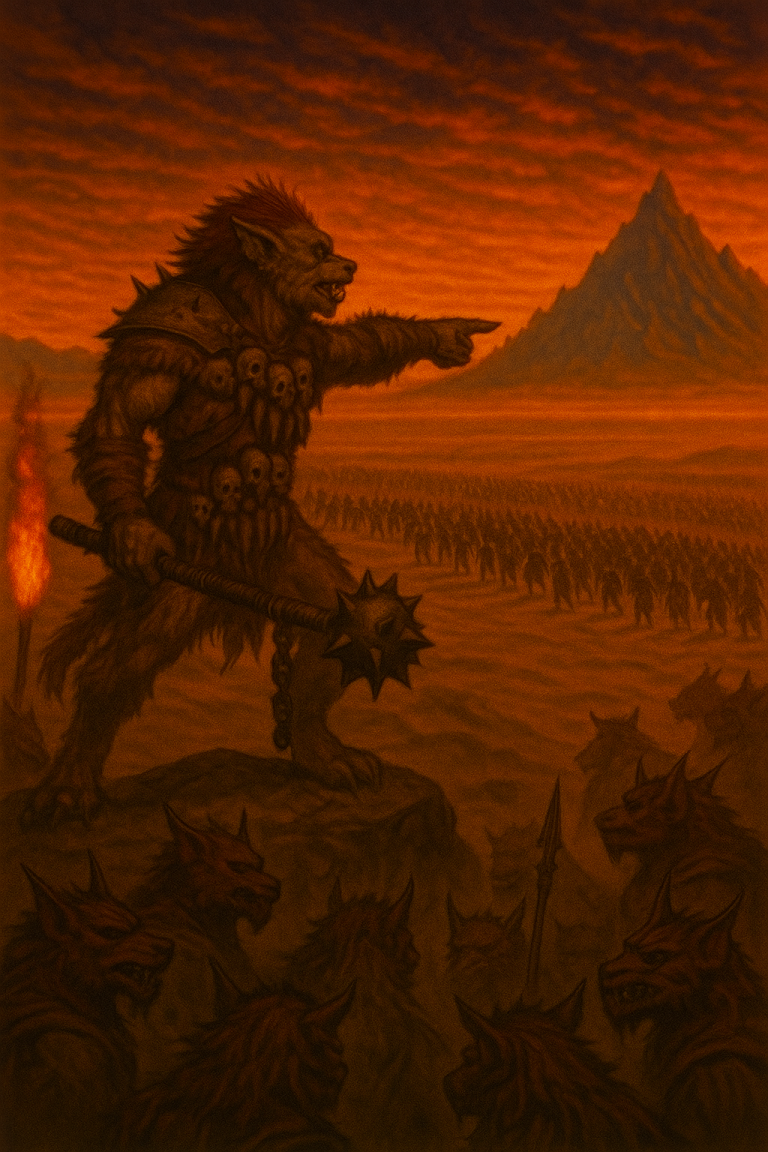
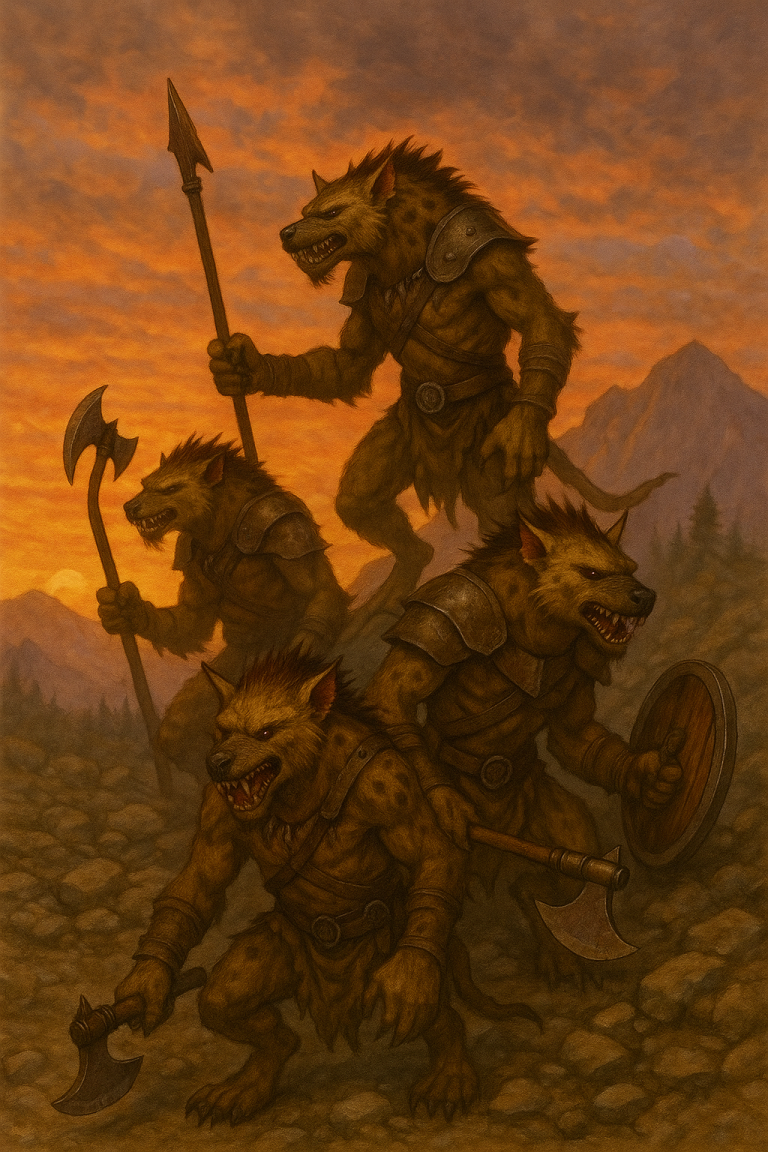
Gnolls in Dungeons & Dragons (D&D) are a race of hyena-like humanoids known for their savagery, chaotic nature, and connection to the demon lord Yeenoghu. Their lore has evolved across D&D’s editions, reflecting their origins, culture, and role in the game. Below is a comprehensive biography of gnolls, drawing from their depiction in various D&D sourcebooks, including Monster Manual (1e, 2e, 3e, 3.5e, 4e, 5e), Volo’s Guide to Monsters (5e), and other supplemental materials, while staying mindful of their fictional context within the D&D multiverse.
Gnolls were first introduced in D&D’s earliest iterations, appearing in the Dungeons & Dragons white box set (1974) and later detailed in the Monster Manual (1977, 1e). Their creation is often tied to the demon lord Yeenoghu, the “Beast of Butchery,” in the game’s lore, particularly in later editions. According to Volo’s Guide to Monsters (5e), gnolls are not a naturally occurring race but were created through Yeenoghu’s influence. The demon lord, a chaotic evil entity ruling over savagery and destruction in the Abyss, is said to have infused hyenas that fed on his kills with demonic essence, transforming them into the first gnolls. These creatures became his mortal instruments, embodying his insatiable hunger for slaughter.
In earlier editions (1e and 2e), gnolls were described as a naturally occurring humanoid species with hyena-like traits, possibly evolving from hyenas or bred by some forgotten creator. The 3rd and 4th editions solidified their demonic origin, emphasizing Yeenoghu’s role. By 5th edition, their lore became more explicit: gnolls are not just influenced by Yeenoghu but are extensions of his will, driven by a supernatural compulsion to kill and destroy in his name.
Some D&D settings, like Eberron, deviate slightly. In Eberron, gnolls are a native race of the continent of Xen’drik, with a more complex society and less overt demonic influence, though they retain their predatory instincts. In other settings, such as the Forgotten Realms, gnolls are almost universally tied to Yeenoghu’s cult, reinforcing their role as agents of chaos.
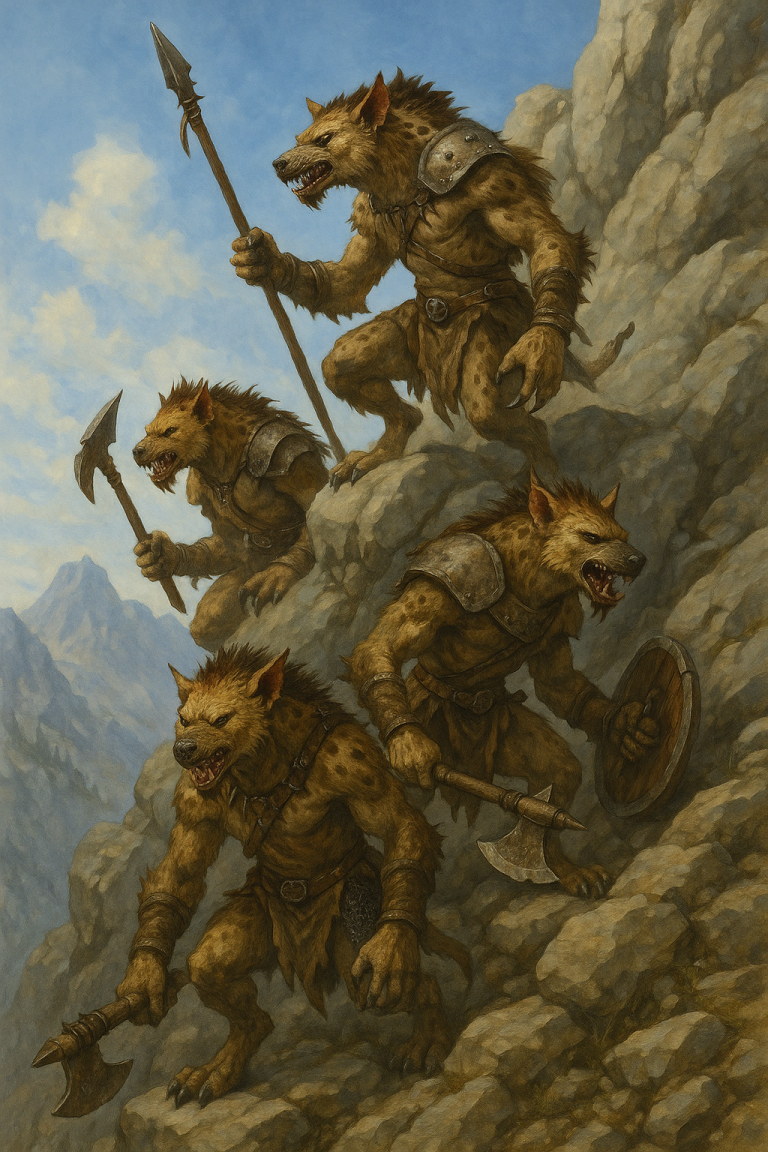
Gnolls are large, humanoid creatures standing between 7 and 8 feet tall, with a muscular, hunched posture. Their appearance draws heavily from spotted hyenas, featuring:
• Fur and Coloration: Coarse, spotted fur ranging from brown to yellowish-gray, often matted with blood or dirt due to their violent lifestyle.
• Facial Features: Muzzle-like faces with powerful jaws, sharp teeth, and glowing eyes (often yellow or red). Their hyena-like cackle is a signature trait, used to intimidate foes or communicate.
• Build: Lean but strong, with long arms and clawed hands suited for combat. Their digitigrade legs give them a loping gait, enhancing their predatory aura.
• Sexual Dimorphism: In early editions (1e, 2e), female gnolls were noted to be slightly larger and more dominant, mirroring spotted hyena biology. Later editions downplayed this, focusing on their uniform savagery.
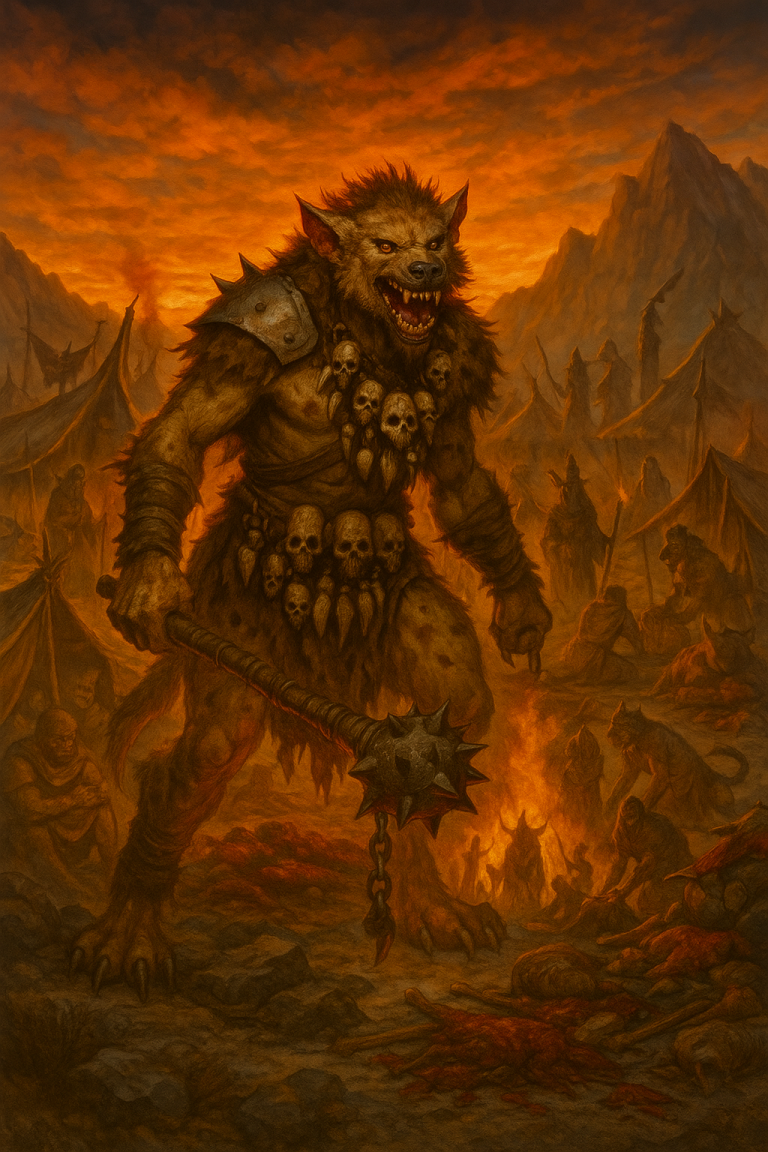
Gnolls often adorn themselves with crude armor, scavenged weapons, and trophies from their kills, such as bones or skulls. Their hygiene is poor, and their camps reek of decay, reflecting their disregard for anything beyond survival and slaughter.
Gnolls have a rudimentary, chaotic society driven by instinct and violence. They organize into nomadic warbands or packs, led by the strongest or most cunning members, often called pack lords or fang of Yeenoghu (a title for gnolls blessed with demonic power).
Their culture revolves around:
• Worship of Yeenoghu: Gnolls revere Yeenoghu as their creator and god. Rituals involve blood sacrifices, feasting on enemies, and desecrating civilized lands. In 5e, Volo’s Guide to Monsters describes gnolls as performing horrific rites to summon demons or create new gnolls by feeding hyenas on cursed flesh.
• Pack Dynamics: Gnoll society is hierarchical but unstable, with constant power struggles. Loyalty is fleeting, and leaders maintain control through fear or displays of strength. Weaker gnolls, called runts or cacklers, are bullied into submission.
• Nomadic Lifestyle: Gnolls rarely build permanent settlements, preferring to roam and raid. Their camps are temporary, littered with bones and refuse. In some settings, like the Forgotten Realms, gnoll tribes may claim ruined fortresses or caves as temporary strongholds.
• Craftsmanship: Gnolls are not known for creating art or advanced technology. Their weapons and armor are crude, often stolen or scavenged. However, they are skilled at using terrain and pack tactics to overwhelm enemies.
In Eberron, gnolls form more structured societies, with some tribes acting as mercenaries or guardians of ancient ruins. These gnolls have a code of honor and may resist demonic influence, making them a rare exception to the typical portrayal.
Gnolls are defined by their relentless bloodlust, which 5e attributes to Yeenoghu’s influence. They live to hunt, kill, and destroy, viewing all other creatures as prey or obstacles.
Key traits include:
• Savagery: Gnolls revel in violence, often killing for pleasure rather than necessity. They rarely take prisoners, preferring to devour or sacrifice captives.
• Hunger: Their demonic nature gives them an insatiable appetite, both literal and metaphorical. They consume flesh voraciously, sometimes eating while still fighting.
• Chaos: Gnolls disdain order and civilization, targeting settlements to raze them. They are drawn to war-torn regions, where they can feed on the chaos.
• Pack Mentality: Gnolls are fiercely loyal to their pack but distrustful of outsiders, including other gnoll bands. Betrayal within the pack is common if a leader shows weakness.
In 4e, gnolls were given a slightly more nuanced portrayal, with some capable of pragmatic alliances, though still driven by greed and violence. In 5e, this nuance is reduced, emphasizing their role as mindless agents of destruction unless a specific campaign or setting (like Eberron) provides an alternative.
Gnolls are a staple low-to-mid-level threat in D&D, appearing in countless adventures as raiders, bandits, or demonic cultists.
Their stat blocks vary by edition:
• 1e/2e: Gnolls were basic humanoids with 2 Hit Dice, often wielding spears, axes, or bows. They were dangerous in numbers but lacked supernatural traits.
• 3e/3.5e: Gnolls gained more detailed mechanics, with racial traits like darkvision and natural armor. Leaders might have class levels (e.g., barbarian or cleric).
• 4e: Gnolls were tied to the primal and demonic, with roles like “gnoll huntmaster” or “demonic scourge.” Their mechanics emphasized pack tactics and ferocity.
• 5e: Gnolls are streamlined, with abilities like Rampage (bonus action to move and attack after reducing an enemy to 0 HP). Variants like the fang of Yeenoghu or pack lord add demonic powers, such as summoning hyenas or casting spells.
Gnolls often serve as antagonists in wilderness or frontier settings, attacking villages or trade routes. In larger campaigns, they may act as minions of a greater demonic threat, such as a cult of Yeenoghu or a summoned demon. In rare cases, particularly in Eberron, gnolls might be allies or morally complex NPCs, challenging players’ assumptions.
• 1e (1974-1989): Gnolls were simple monsters, described as “hyena-men” with little backstory beyond their tribal nature and hatred of civilization.
• 2e (1989-2000): Expanded lore in Monstrous Compendium gave gnolls more cultural details, like their matriarchal tendencies and use of slaves. They were still generic humanoids.
• 3e/3.5e (2000-2008): Gnolls gained a stronger demonic connection, with Yeenoghu’s influence clarified. They were playable as a race in some sourcebooks, with racial traits like +4 Strength and natural weapons.
• 4e (2008-2014): Gnolls were reimagined as primal and demonic, with detailed roles in the Monster Manual. Their lore emphasized Yeenoghu’s creation myth and their role in the Abyss.
• 5e (2014-present): Gnolls are fully demonic, with Volo’s Guide to Monsters providing extensive lore on their psychology, rituals, and variants. They are less playable as PCs due to their chaotic evil nature but remain a versatile threat.
• Flind: Elite gnolls, often leaders, wielding magical flindbars (a type of flail). In 5e, flinds are blessed by Yeenoghu with enhanced strength and charisma, capable of inspiring or controlling other gnolls.
• Fang of Yeenoghu: Gnolls infused with demonic power, acting as priests or shamans. They can summon hyenas or spread Yeenoghu’s influence by creating new gnolls.
• Witherling: Undead gnolls, introduced in 5e, created when gnolls die but are reanimated by Yeenoghu’s will. They are skeletal and relentless.
• Shoosuva: Demonic hyena-like creatures summoned by powerful gnoll shamans, serving as Yeenoghu’s emissaries.
• Forgotten Realms: Gnolls are widespread, particularly in regions like the Sword Coast or Thar. They are tied to Yeenoghu’s cults and often raid human lands. Notable tribes include the Redclaws and the Blackmane pack.
• Eberron: Gnolls of Xen’drik are less demonic, forming tribes like the Znir Pact, which reject Yeenoghu’s influence. They act as mercenaries or protectors of ancient ruins, offering a more nuanced portrayal.
• Greyhawk: Gnolls are common in wild regions, often clashing with human kingdoms like Furyondy or the Yeomanry. They are typically portrayed as barbaric raiders.
Gnolls have become iconic D&D monsters due to their distinctive appearance and relentless aggression. They appeal to players and Dungeon Masters for their versatility as enemies, fitting roles from random encounters to major campaign villains. Their hyena-like traits and demonic connection make them memorable, while their pack-based tactics challenge players to think strategically.
However, some players and critics have noted that gnolls’ portrayal as inherently evil can limit storytelling potential. In response, settings like Eberron and homebrew campaigns often explore gnolls with more depth, presenting them as misunderstood or capable of redemption. Fan-made content on platforms like DMsGuild has also introduced gnoll player races and nuanced tribes.
Gnolls are one of D&D’s most enduring monster races, evolving from simple hyena-men to complex agents of demonic chaos. Their lore, rooted in Yeenoghu’s influence, paints them as embodiments of savagery, yet their adaptability across settings allows for diverse interpretations. Whether as bloodthirsty raiders, demonic cultists, or rare honorable warriors, gnolls remain a dynamic part of the D&D multiverse, challenging adventurers with their ferocity and unpredictability.
Learn all about fauns and satyrs!
 English English
  Deutsch
  Français
  Português do Brasil
  日本語
日本語  Español
  English (Australia) English English Deutsch
Français
Português do Brasil
日本語
Español
English (Australia)
English (Australia) English English Deutsch
Français
Português do Brasil
日本語
Español
English (Australia)
We use cookies to improve your experience on our site. By using our site, you consent to cookies.
Manage your cookie preferences below:
Essential cookies enable basic functions and are necessary for the proper function of the website.
Statistics cookies collect information anonymously. This information helps us understand how visitors use our website.
Google Analytics is a powerful tool that tracks and analyzes website traffic for informed marketing decisions.
Service URL: policies.google.com (opens in a new window)