

Slithering Shadows: Ultimate Guide to the Snake Men of MOTU
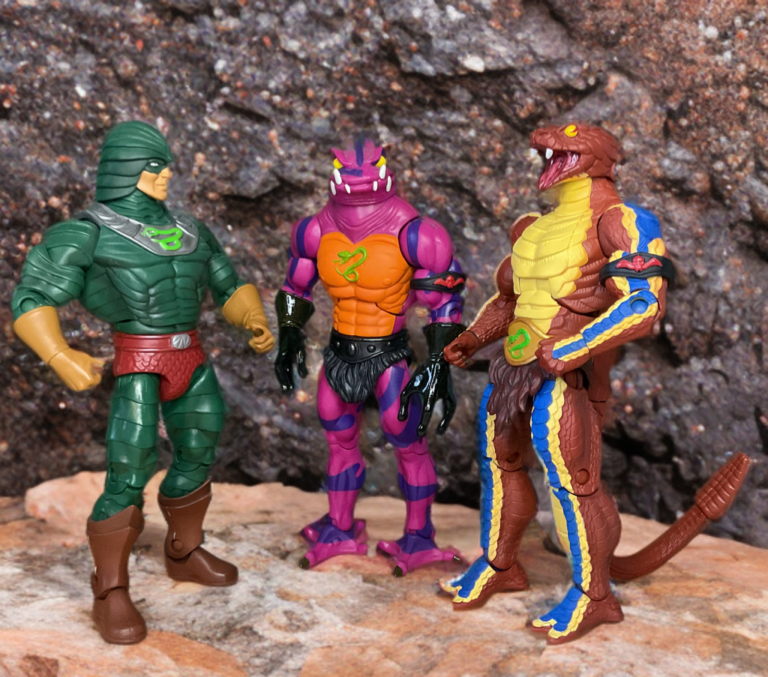
In the world of MOTU and the vast tapestry of Eternia’s turbulent past, few factions evoke as much dread as the Snake Men. These serpentine warriors, with their cold-blooded cunning and unyielding ambition, have slithered through the annals of history, leaving trails of conquest and chaos. Led by the formidable King Hiss, they represent an ancient evil that predates many of the conflicts known to modern heroes like He-Man. Their story is one of interstellar domination, imprisonment, and resurgence, forever entwined with the fate of the planet they sought to claim as their own. As collectors and enthusiasts revisit these legendary antagonists through plastic embodiments, the Snake Men’s legacy continues to captivate, reminding us of the eternal struggle between light and shadow on Eternia.
The Snake Men aren’t just another band of villains; they embody a primal fear, drawing from myths of reptiles as symbols of deception and power. Their designs, with scaly hides, venomous strikes, and hypnotic gazes, make them stand out among Skeletor’s bumbling henchmen or the Horde’s mechanical hordes. Imagine a force that could out-scheme the schemers and out-fight the fighters, all while shedding skins to reveal even more terrifying forms. That’s the essence of these reptilian rogues—a blend of strategy and savagery that keeps Eternia’s defenders on their toes.
🐍 Slithering Shadows: Navigation Menu
Ancient Origins: The Preternian Era
Long before the spires of Castle Grayskull pierced the Eternian skyline, the planet was a wild frontier known as Preternia. This era was marked by colossal beasts, warring tribes, and the first glimmers of magical prowess. It was into this chaotic landscape that the Snake Men arrived, not as natives, but as invaders from distant stars.
The Snake Men’s roots trace back to a nomadic empire spanning multiple worlds. Under King Hiss’s command, they were a relentless army, conquering planets with a combination of brute force and insidious infiltration. Their society was hierarchical, with houses or clans divided by serpentine traits—some venomous, others constricting, all deadly. They worshiped serpentine deities, viewing themselves as extensions of these gods, destined to coil around the universe.
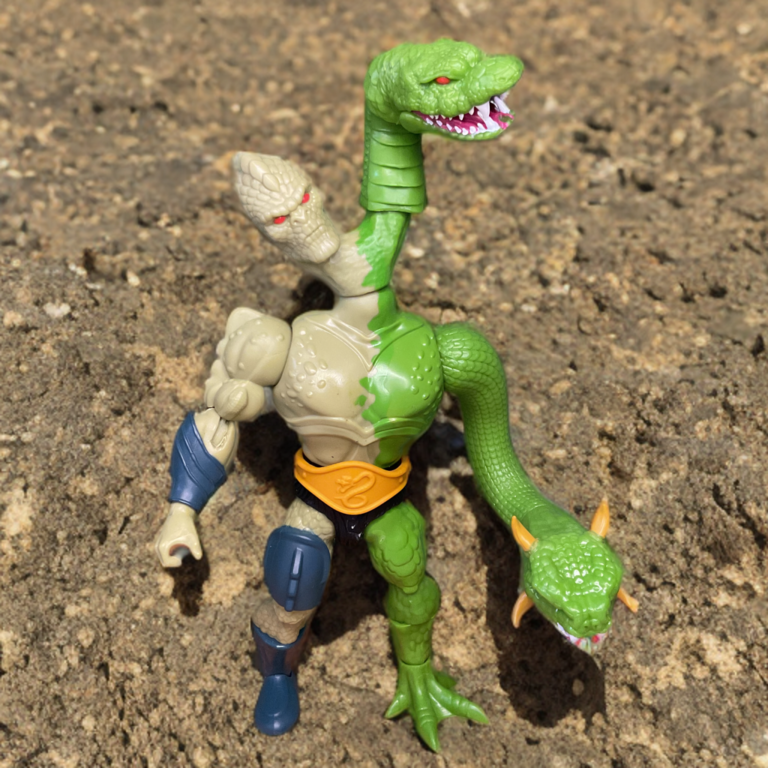
Upon reaching Eternia, the Snake Men found a world ripe for domination. Preternia was home to powerful artifacts and untapped energies, including the mystical forces that would later empower Grayskull. King Hiss, ever the opportunist, saw Eternia as the crown jewel of his conquests. His forces established strongholds, including the foreboding Viper House, and began subjugating local tribes. They clashed with early Eternian kings and wizards, but their true nemesis emerged in the form of King Grayskull, a legendary warrior whose valor united the planet’s defenders.
The battles of Preternia were epic, involving not just swords and sorcery but also the awakening of ancient beasts. One such entity was Serpos, a god-like serpent that the Snake Men sought to control. In some accounts, Serpos was bound to the land itself, its form manifesting as the twisted peaks of Snake Mountain. The Snake Men’s attempts to unleash this power backfired, leading to devastating wars that scarred Eternia. King Grayskull, wielding the Power Sword’s precursor, rallied allies like the cosmic enforcer Zodac and the time-traveling He-Ro to push back the invaders.
After years of conflict, the Snake Men were defeated. King Hiss and his army were sealed in an interdimensional prison called the Void, a limbo realm accessible only through hidden portals—one conveniently located beneath Snake Mountain. This banishment wasn’t eternal, though; whispers of their return lingered in Eternian folklore, warning of a day when the serpents would slither free once more.
The Resurgence: From Void to Vengeance
Centuries passed, and Eternia evolved. The age of Preternia gave way to the rule of King Randor, with threats like Skeletor dominating the landscape. Yet, the Snake Men’s legacy endured through descendants who had evaded imprisonment. These survivors, like Kobra Khan, integrated into society, biding their time and plotting revival.
The turning point came when Skeletor, in his endless quest for power, unwittingly aided the Snake Men’s escape. Kobra Khan, serving as a spy in Skeletor’s ranks, discovered the Void’s entrance in Snake Mountain’s depths. With Evil-Lyn’s magical assistance, he freed King Hiss and key lieutenants. The Snake Men emerged into a changed Eternia, their ancient grudges burning brighter than ever.
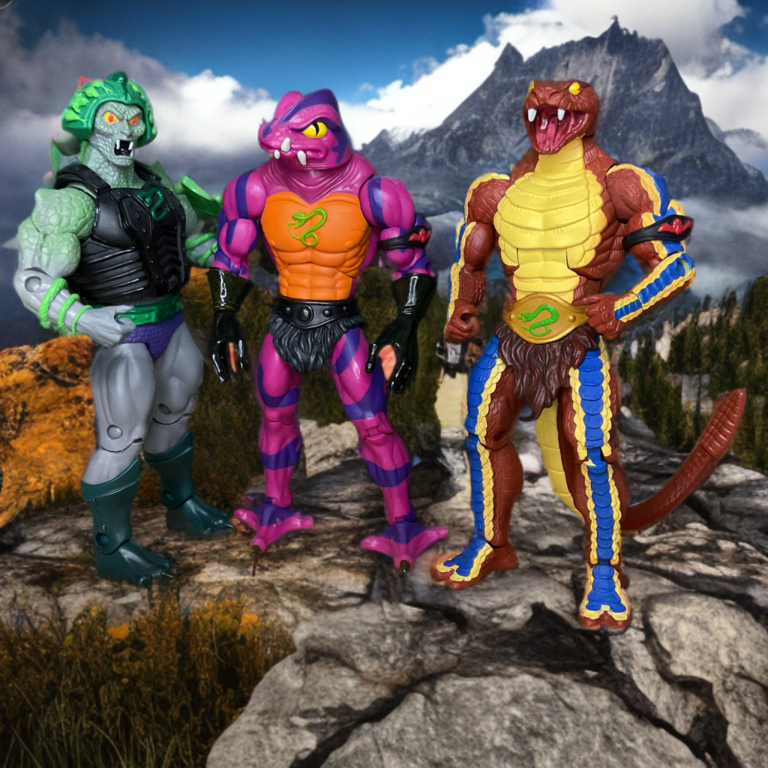
This resurgence wasn’t seamless. King Hiss initially allied with Skeletor, seeing him as a tool against He-Man. However, rivalries flared; the Snake Men’s independence clashed with Skeletor’s ego. In various confrontations, they turned on each other, with King Hiss plotting to usurp Snake Mountain and reclaim Eternia. The Heroic Warriors, led by He-Man, faced a two-front war, battling both skeletal sorcerers and slithering serpents.
The Snake Men’s tactics evolved in this new era. They employed infiltration, turning allies into puppets through venom or hypnosis. Their goal remained conquest, but now infused with revenge against Grayskull’s descendants. Battles raged from the Evergreen Forest to the Sands of Time, with the Snake Men summoning forgotten beasts and wielding artifacts like the Medallion of Serpos.
Despite their might, the Snake Men were thwarted again. He-Man’s strength, combined with strategic alliances, drove them back. Yet, their essence persists—scattered survivors, hidden lairs, and the ever-present threat of another awakening. In Eternia’s lore, the Snake Men symbolize resilience, a reminder that old evils never truly die; they merely coil in wait.
Key Members of the Snake Men
The Snake Men’s strength lies not just in their leader but in a cadre of specialized warriors, each with unique abilities honed over eons. These characters bring diversity to the faction, from brute enforcers to sly saboteurs. Let’s explore the prominent figures, their backgrounds, traits, and roles in the eternal conflict.
King Hiss: The Dreadful Disguised Ruler
At the helm slithers King Hiss, the undisputed sovereign of the Snake Men. His appearance is a masterclass in deception—a handsome, armored humanoid facade that peels away to reveal a writhing mass of serpents. This dual form reflects his personality: outwardly charismatic and strategic, inwardly a tangle of ruthless ambition.
Born as leader of the Viper House, King Hiss built his empire through conquests across galaxies. His arrival on Eternia marked the peak of his power, where he ruled with an iron coil, demanding tribute and loyalty. Defeat at King Grayskull’s hands fueled a millennia-long hatred for Eternia’s guardians. Upon release, he quickly reasserted dominance, manipulating allies like Skeletor while plotting global domination.
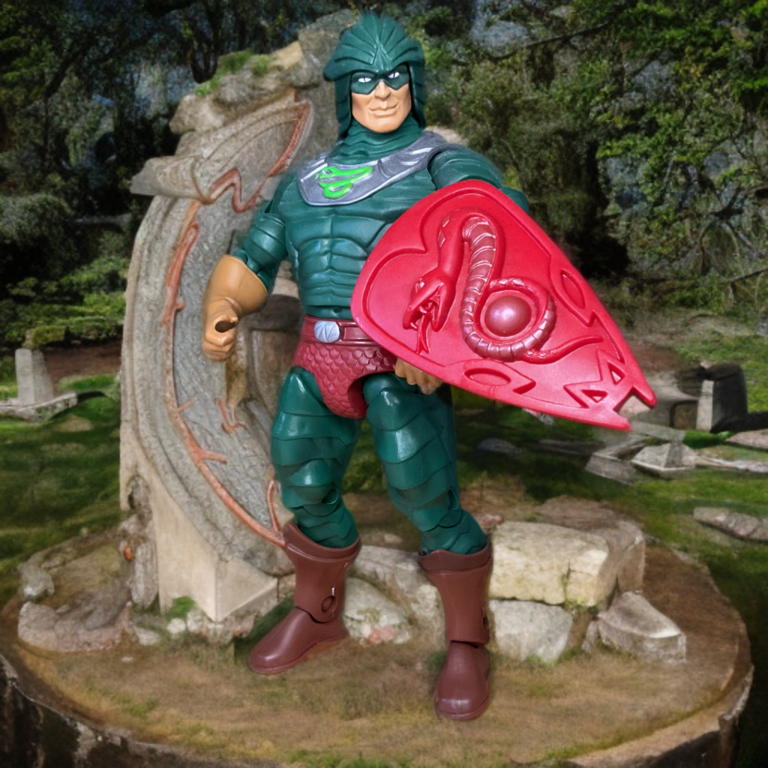
King Hiss’s abilities include regeneration, venomous bites from his snake heads, and command over lesser reptiles. His rivalries are legion: He-Man as Grayskull’s heir, Skeletor as a treacherous partner, and even internal challengers like potential usurpers. His wit shines in schemes, such as awakening Serpos to devour Eternia. Though often outmatched in raw power, his cunning makes him a perennial threat, always one shed skin away from revival.
The Genesis of a Serpentine Sovereign: King Hiss’s Conceptual Origins
In the mid-1980s, as the Masters of the Universe toy line entered its later waves, Mattel sought fresh antagonists to invigorate the franchise. The Snake Men faction emerged from this push, spearheaded by marketing manager Tim Kilpin. This group was conceived as a third evil force, distinct from Skeletor’s Evil Warriors and the Evil Horde. King Hiss, the faction’s leader, was designed to embody deception and ancient menace, drawing from reptilian myths and infiltration tropes.
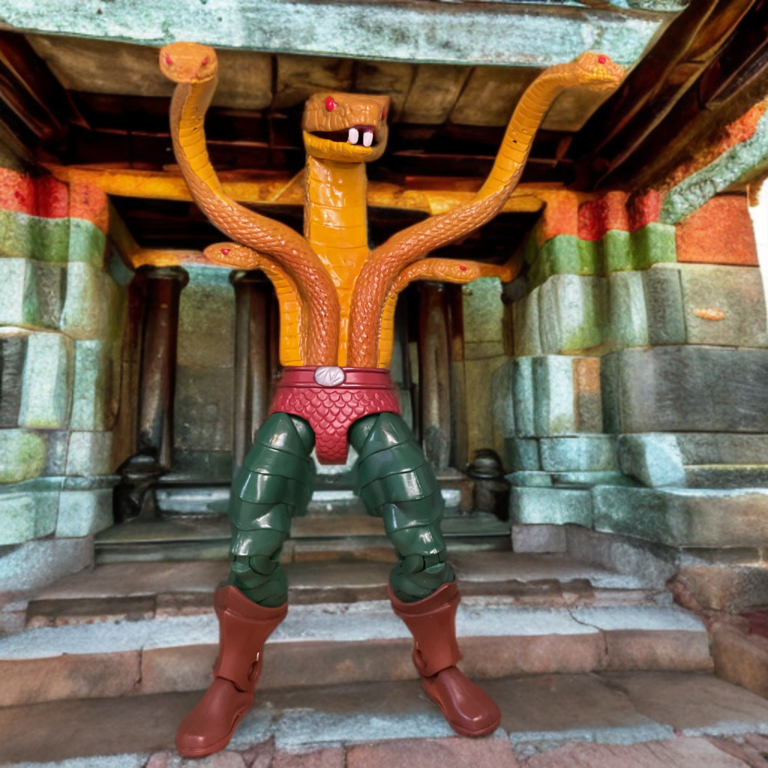
Ted Mayer, a key designer at Mattel, crafted King Hiss’s visual and mechanical identity. The core idea revolved around duality: a regal, humanoid exterior masking a horrific interior of writhing serpents. This gimmick aimed to surprise young players, allowing the figure to “shed” its skin like a snake. Early sketches emphasized this transformation, with the outer shell resembling a noble warrior to facilitate storylines of betrayal and surprise attacks. Kilpin’s vision ensured all Snake Men figures—Rattlor, Tung Lashor, and others—were developed simultaneously, creating a cohesive army under King Hiss’s command.
The character’s backstory positioned him as an interstellar conqueror from Preternia, Eternia’s ancient era. Banished to the Void by King Grayskull, he awaited revival. This narrative tied into existing lore, allowing alliances and rivalries with figures like Skeletor. Mattel filed a patent for the figure on September 27, 1985, securing its unique action feature. Production challenges included balancing the reveal mechanism with playability, resulting in limited articulation for the snake form to prioritize durability.
Vintage Era Debut: The 1986 Release
King Hiss slithered onto shelves in 1986 as part of Wave 5 of the original Masters of the Universe line. Priced around $5.99, he came packaged on a standard blister card with Snake Men branding, featuring artwork by William George that depicted his dual forms in dramatic confrontation. The card back bio described him as the “Dreadful disguised leader of the SNAKE MEN,” highlighting his ability to pose as a hero before unleashing his true nature.
The figure stood about 5.5 inches tall, with a muscular humanoid torso in green armor accented by gold and red details. His head sported a stern expression under a hooded helmet, evoking a pharaoh-like authority. The standout feature was the removable outer shell: lifting the torso revealed a mass of five interconnected snakes—four arms and a central head—molded in flexible plastic for a grotesque, wriggling appearance. Accessories included a red shield with snake motifs and a golden staff, doubling as a weapon and scepter.
Articulation was standard for the era: swivel joints at the shoulders, hips, and neck. However, the snake form’s arms had reduced mobility due to their interconnected design, limiting poses but enhancing the horror element. The legs were shared molds from earlier figures, painted in scaly green to fit the theme. Early production runs featured brighter colors, while later variants showed subtle shifts in plastic hues due to manufacturing variations.
Marketing positioned King Hiss as a major threat, with minicomics like “King of the Snake Men” and “The Ultimate Battleground” showcasing his resurrection by Skeletor and subsequent betrayal. In these stories, he summoned allies from the Void, clashing with He-Man in epic battles. Despite the late introduction, the figure sold well, appealing to kids for its transformation gimmick. International releases included variants from lines like Estrela in Brazil, with softer plastics and alternate paint apps.
Post-Vintage Hiatus and Resurgence in Media
After the original line ended in 1987, King Hiss faded from production but persisted in lore. The unproduced “Powers of Grayskull” subline would have expanded his role with Preternian elements, including ancestors like He-Ro. Concept art showed enhanced snake designs, but cancellation left these unrealized.
The 2002 relaunch by Mike Young Productions revived King Hiss (spelled “Hssss” here) in the animated series “He-Man and the Masters of the Universe.” Voiced by Brian Dobson, he debuted in season two as a cunning overlord, awakening from millennia of imprisonment. Episodes like “The Beginning” and “Rise of the Snake Men” fleshed out his conquests, including control over Serpos, a god-like serpent. This version emphasized his regenerative abilities and command over venomous minions, influencing toy designs.
The 200X Revival: 2003-2004 Releases
Mattel’s 200X line, launched in 2002, brought King Hiss back with modern sculpts. Released in 2004 as part of the Snake Men wave, this version retailed for about $8.99. Sculpted by the Four Horsemen studio, it amplified the original’s features: a more detailed humanoid form with intricate armor scales, and an inner snake body with articulated heads for dynamic poses.
The transformation remained central, but improved engineering allowed better articulation—ball-jointed shoulders, swivel hips, and bendable snake necks. Accessories included a staff, shield, and removable cape. Variants emerged, such as a Toys “R” Us exclusive with metallic paint. The bio expanded his history, portraying him as servant to the Unnamed One, adding layers of cosmic intrigue.
This figure tied into the cartoon, where King Hssss’s design influenced the toy’s menacing aesthetic. Collectors praised the enhanced detail, though some noted fragility in the snake joints. Production numbers were moderate, leading to steady aftermarket values today—loose figures around $35-50, mint-in-box up to $150-250.
Masters of the Universe Classics: 2010-2011 Iteration
The collector-focused Classics line, starting in 2008, delivered a premium King Hssss in 2010 (initial release) and 2011 (reissue). Priced at $20, it blended vintage charm with adult-oriented articulation. Again sculpted by the Four Horsemen, the figure measured 6 inches, featuring over 20 points of articulation, including double-jointed knees and swivel wrists.
The humanoid shell boasted ornate gold armor and a removable helmet revealing a fanged face. The snake reveal was refined: five independent heads with posable necks, each with unique expressions. Accessories expanded to include two staffs (vintage and 200X styles), a shield, and swappable parts for customization. A notable issue was the “backwards shoulder syndrome,” where early batches had misassembled arms, prompting fan fixes and later corrections.
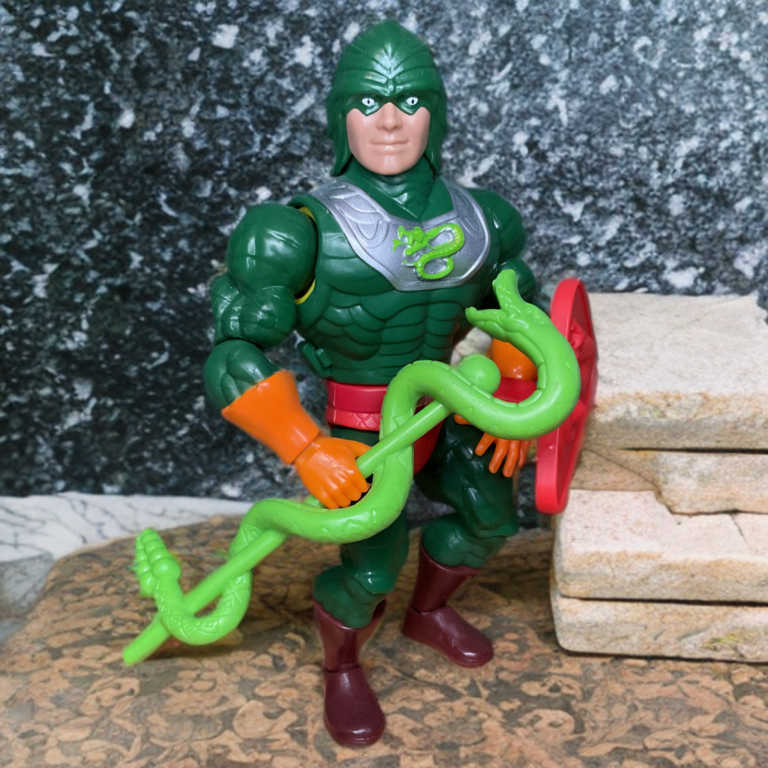
Bios on the packaging delved deeper: King Hssss as ruler of the Viper House, banished after failing to unleash Serpos. This version integrated elements from minicomics, cartoons, and new lore. Exclusives included a “vs. Snake Armor He-Man” two-pack. High demand drove aftermarket prices: loose $50-80, carded $150-300.
Evolutions in customs highlighted community passion, with fixes for shoulders and enhanced paints.
Modern Reinventions: Origins and Beyond (2020s)
Mattel’s Origins line, debuting in 2020, homaged the vintage era with updated engineering. King Hiss arrived in 2023 as a deluxe figure (initial tease), fully releasing in 2024. Retailing at $19.99, it captured the 1986 essence but added modern flair: improved articulation (ankle rockers, waist swivel), and a seamless snake transformation.
The sculpt featured vibrant colors—emerald green armor, crimson accents—and detailed scales. The inner snakes were more flexible, with glow-in-the-dark variants in some packs. Accessories mirrored the original, plus bonus heads for display. A multipack, “Diabolical Snake Invasion,” included him with Necro-Conda and others.
Reviews praised its playability, noting sturdier construction than vintage. In 2023 videos, collectors dissected its mechanics, comparing to Classics. By 2026, aftermarket holds steady: loose $32-48, carded $75-150.
Variants and Collectibility Across Decades
King Hiss’s variants span eras:
• Vintage (1986): Standard; international like Top Toys with softer plastics.
• 200X (2004): Base; metallic exclusive.
• Classics (2010-2011): Standard; two-pack; shoulder variants (early misassembled).
• Origins (2023-2024): Deluxe; multipack; potential con exclusives with alternate decos.
Rarities include prototypes from Mattel’s archives, showing unpainted shells or alternate colors. Collectibility factors: Condition (paint wear on snakes), completeness (accessories often lost), and packaging (bubble yellowing).
Current aftermarket (2026 estimates): Vintage loose $45-70, MIB $250-500. Demand surges with media revivals, like rumored Netflix series nods.
Behind-the-Scenes: Development Insights and Challenges
Development stories reveal hurdles: Lou Scheimer, Filmation producer, reportedly resisted Snake Men integration due to production timelines, explaining their absence from the original cartoon. Kilpin’s mass creation ensured faction unity, but late timing limited media exposure.
Sculptors faced balancing gimmick with poseability—snake arms prioritized shock over movement. Modern lines addressed this via better materials.
King Hiss’s enduring appeal lies in his transformative surprise, symbolizing hidden threats. From 1986 shelves to 2026 collections, he remains a cornerstone of MOTU villainy, coiling through generations.
Rattlor: The Quick-Strike General
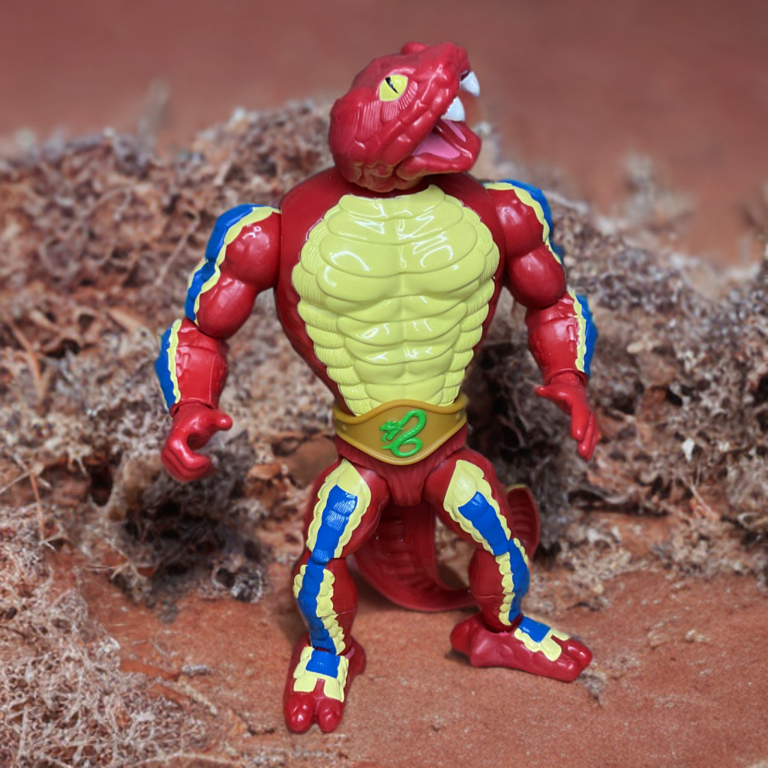
Rattlor, known as the General of the Snake Men, embodies tactical brilliance wrapped in a rattling tail. His red-scaled body, armored chest, and extendable neck make him a striking figure on the battlefield. Personality-wise, he’s disciplined and loyal, serving as King Hiss’s right-hand enforcer with a no-nonsense demeanor.
Hailing from the Rattlor House, he earned his rank through victories in the Preternian wars. Imprisoned with his king, Rattlor was among the first freed, using his seismic strikes—vibrations from his tail—to shatter obstacles. His quick-strike head allows lightning-fast attacks, disorienting foes before delivering fatal blows.
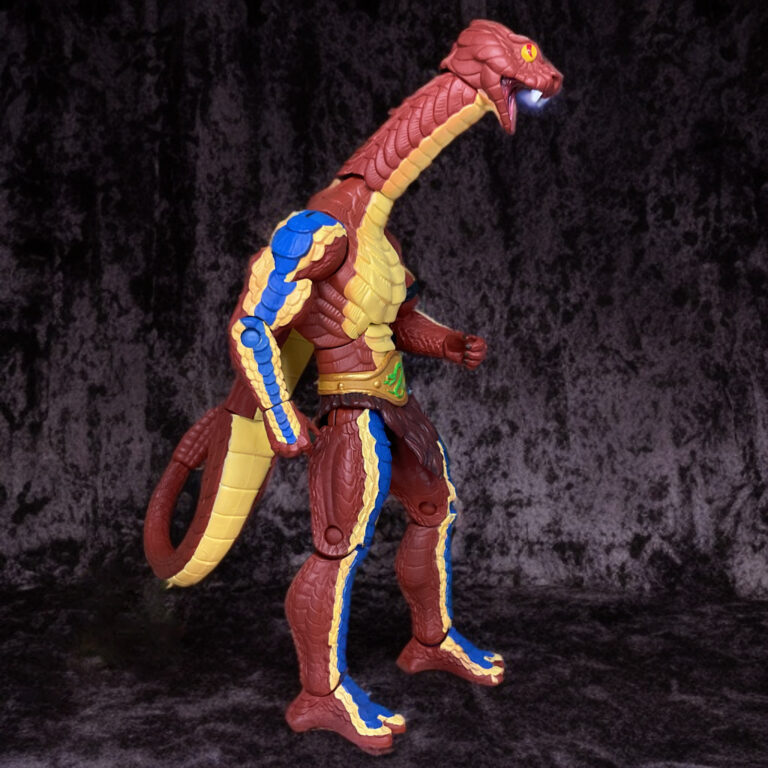
Rattlor’s rivalries include Man-At-Arms, whose gadgets counter his brute force, and Fisto, matching him in hand-to-hand combat. He’s clashed with the Horde, viewing them as mechanical interlopers. In alliances, he’s pragmatic, temporarily aiding Skeletor against common enemies but always prioritizing Snake Men supremacy. His steadfastness makes him a pillar of the faction, though his predictability sometimes leads to defeat.
The Rattling Menace: Conceptual Origins of Rattlor
Rattlor emerged as one of the key enforcers in the Snake Men faction, a late addition to the Masters of the Universe line designed to inject fresh villainy into the waning years of the original toy series. Conceived in 1985 by Mattel’s Masters Brand Group under Tim Kilpin, the Snake Men were positioned as an ancient, more primal evil force summoned from the depths of Snake Mountain to bolster Skeletor’s faltering army. Rattlor, dubbed the “Evil Snake Men creature with the quick-strike head,” was crafted as a tactical striker—disciplined, loyal, and built for rapid assaults.
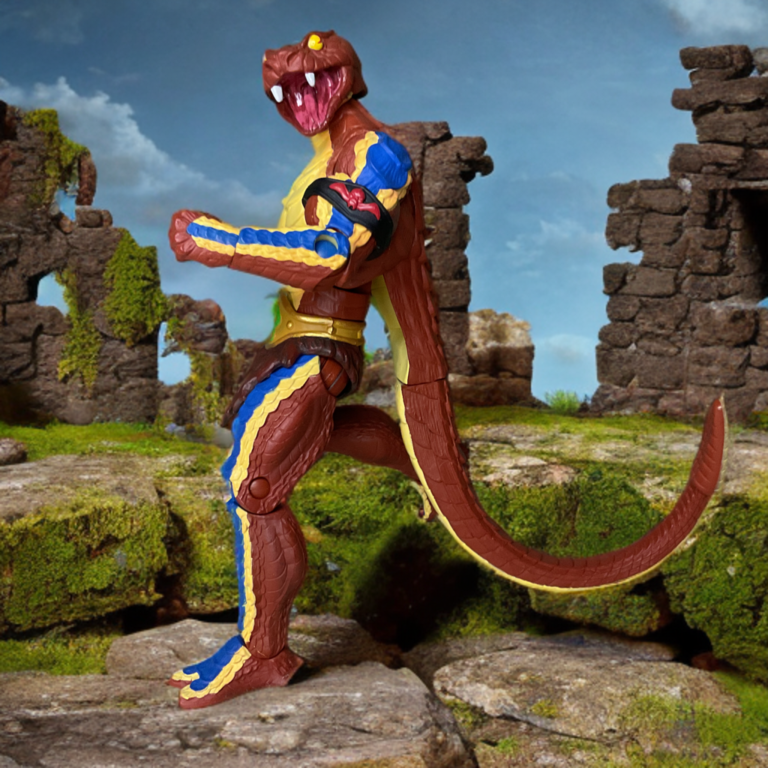
Early concept art by Roger Sweet showed a more monstrous, dragon-spined prototype with yellowish-orange tones and exaggerated features. These designs evolved through iterations, incorporating scaly textures, a Southwestern-inspired color palette of rust-red, cream, blue, and yellow, and a functional action feature. The spring-loaded neck extension became central, allowing the figure to simulate a serpentine lunge. Development memos from May 1985 outlined Rattlor alongside King Hiss, Tung Lashor, and the retconned Kobra Khan as core members, emphasizing their role in a three-way conflict against the Heroic Warriors and Skeletor.
The character’s Preternian roots tied him to Eternia’s ancient history, portraying him as a veteran of interstellar conquests before imprisonment in the Void. His personality—stoic, strategic, and hiss-preferring over speech—drew from rattlesnake lore, making him the no-nonsense general of King Hiss’s forces.
Vintage Debut: The 1986 Release
Rattlor hit shelves in 1986 as part of Wave 5 (often called the “1986 1/2” wave internally at Mattel), retailing for about $4.99. Packaged on a blister card with striking red artwork featuring the Snake Men emblem—two green serpents flanking a fanged maw—he was marketed as the “Evil Snake Men creature with the quick-strike head.” The card-back bio highlighted his loyalty to King Hiss and his ability to extend his neck for surprise attacks.
Standing roughly 5.5 inches, Rattlor featured a completely new sculpt: a muscular red torso with detailed scaly skin, blue legs, a yellow rattle tail, and a cream underbelly. His head had glaring yellow eyes, an open fanged mouth, and a button-activated spring mechanism on the back that propelled the neck forward with a satisfying “pop.” Shaking the figure produced a rattling sound from internal beads, adding auditory menace. Accessories included a coiled red snake staff, evoking his reptilian heritage.
Articulation followed vintage standards: swivel neck (enhanced by the extension), shoulders, hips, and waist. The quick-strike feature limited some poses but delivered play value—kids lined up figures for Rattlor to “knock down” in sequence. Production occurred in Taiwan, Malaysia, Hong Kong, Argentina (Top Toys), and Spain, leading to variants. A notable one: early Taiwan runs had a yellow neck that later shifted to red/maroon for consistency. International versions varied in plastic softness and paint apps.
Minicomics like “King of the Snake Men” and “Revenge of the Snake Men” integrated Rattlor into the Snake Men’s resurgence, showing him escaping the Void with Kobra Khan’s help and clashing in battles against He-Man. Though the original animated series ended before his release, he appeared in “She-Ra: Princess of Power” as a Horde member (voiced by Lou Scheimer as “Erik Gunden”), later shifting to Skeletor’s side—elements retconned into his toy lore.
Hiatus and Media Persistence
Post-1987, as the vintage line wound down, Rattlor vanished from production but lingered in lore. The unproduced “Powers of Grayskull” line would have explored Preternian battles involving Snake Men ancestors. In the 2002 Mike Young Productions animated series, Rattlor (as “The General”) became King Hssss’s second-in-command, emphasizing strategy and leading assaults in episodes like “Rise of the Snake Men.” This version influenced later toys, portraying him as a defecting tactician who briefly joined the Horde.
200X Era: 2003 Revival
The 200X line (2002-2004) reintroduced Rattlor in 2003, sculpted with updated detail. Retailing around $7-9, it featured enhanced scaly textures, brighter colors, and the signature quick-strike neck with improved spring action. The figure included the red staff and tied into the cartoon’s narrative of Snake Men supremacy. Variants included minor paint differences. Collectors appreciated the modern engineering while retaining vintage charm; aftermarket values stabilized around $30-45 loose, $120-220 carded.
Masters of the Universe Classics: 2011-2012 Premium Release
The collector-driven Classics line delivered Rattlor in 2011 (with reissues into 2012), priced at $20. Sculpted by the Four Horsemen, this 6-inch version boasted over 20 points of articulation, including ball-jointed shoulders and swivel wrists for dynamic poses. The quick-strike neck remained, now with finer control, and the rattle function persisted. Accessories expanded: the red staff plus swappable parts.
The bio deepened his story—Slltyo of the Rattlor House, first escapee from the Void, demoted by Kobra Khan’s schemes, defecting to the Horde as “The General.” Early batches had minor issues like paint variations, but demand pushed values to $45-70 loose, $140-280 carded. This iteration blended nostalgia with adult detailing, making it a favorite for display.
Origins Line: 2023 Modern Homage
Mattel’s Origins series revived Rattlor in 2023 as part of the “Rise of the Snake Men” wave, retailing at $14.99-$19.99. At 5.5 inches with 16+ points of articulation (including swivel/hinge ankles, elbows, and wrists), it captured the vintage look with brighter, updated colors—no true pop-out neck, but an interchangeable extended piece for the feature. The rattle sound returned via internal beads, and it included the red staff plus a themed mini-comic exploring new storylines.
Packaging evoked retro blister cards, appealing to longtime fans. Reviews highlighted fidelity to the 1986 design with improved posability and sturdier construction. Aftermarket holds at $25-40 loose, $60-120 carded/MIB, reflecting strong collector interest in the Snake Men resurgence.
Variants, Collectibility, and Legacy
Rattlor’s variants include:
• Vintage (1986): Standard (yellow vs. red neck); international (Top Toys softer plastics, Malaysian high-quality apps).
• 200X (2003): Base sculpt with cartoon-accurate details.
• Classics (2011-2012): Premium articulation; minor paint runs.
• Origins (2023): Modular neck extension; potential exclusives with alternate decos.
Collectibility thrives on condition—complete accessories, intact spring mechanism, vibrant paint. Rarity spikes for unpunched cards or foreign variants. His enduring appeal stems from the satisfying action feature, unique sculpt, and role as the Snake Men’s tactical backbone—rattling warnings before striking swiftly.
From 1986’s late-wave surprise to 2026’s Origins displays, Rattlor embodies MOTU’s knack for blending gimmick-driven fun with layered villainy. In Eternia’s endless battles, his quick-strike head remains ever-ready, a coiled threat in plastic form.
Kobra Khan: The Master of Snakes
Kobra Khan stands as a bridge between ancient and modern Snake Men, a descendant who survived the banishment. His hooded head, scaly green skin, and water-spraying ability (often laced with venom) mark him as a versatile operative. He’s sly and opportunistic, with a personality that’s equal parts schemer and survivor.
Unlike his imprisoned kin, Kobra Khan roamed Eternia, joining Skeletor’s Evil Warriors as a cover. His true goal: locate and free King Hiss. Succeeding with Evil-Lyn’s help, he rejoined the fold, bringing insider knowledge of current threats. His abilities include hypnotic gazes, acidic sprays, and summoning snake swarms.
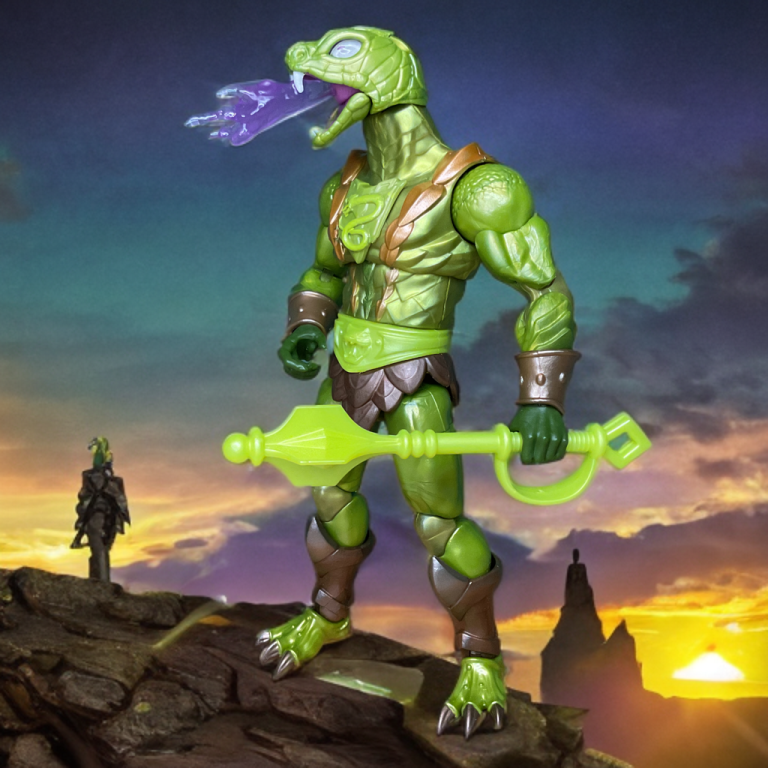
Rivalries flare with Teela, whose agility dodges his strikes, and Buzz-Off, clashing in aerial skirmishes. He’s also faced King Randor. He’s betrayed Skeletor multiple times, fostering enmity. Kobra Khan’s wit often saves him, like escaping traps with clever diversions. His role as infiltrator adds layers to the Snake Men’s strategies, making him indispensable yet distrusted.
Tung Lashor: The Tongue-Lashing Terror
Tung Lashor, with his purple scales, frog-like features, and extendable tongue, is the Snake Men’s resident trickster. His personality is impulsive and mocking, using taunts to unsettle opponents. The tongue isn’t just for show—it’s a whip-like weapon that lashes with precision, often coated in paralytic slime.
From the Lashor House, Tung Lashor specialized in hit-and-run tactics during Preternian invasions. Freed alongside others, he reveled in chaos, targeting Eternia’s weaker points. His speed and agility make him a guerrilla fighter, evading direct confrontations.
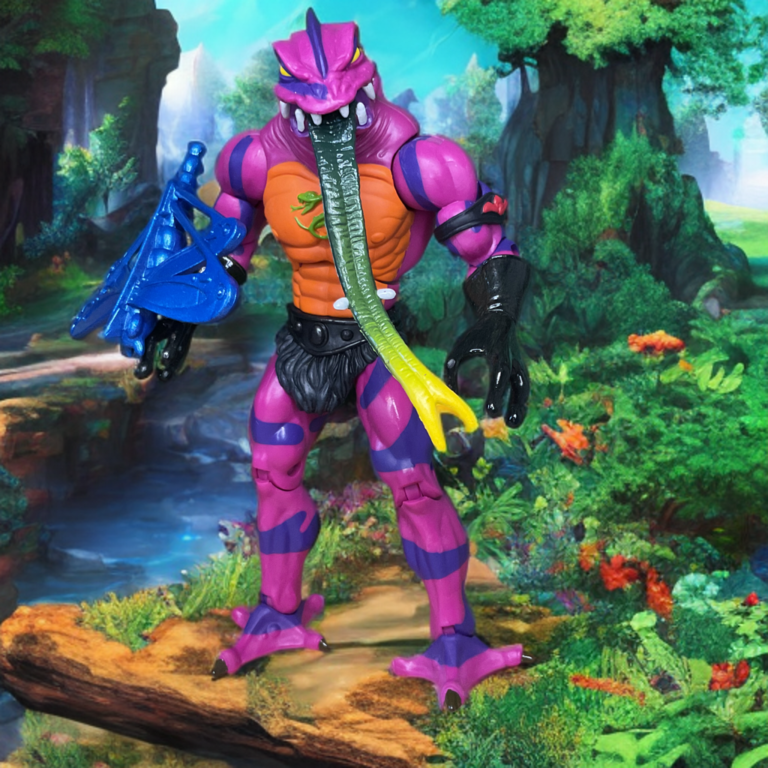
Rivalries include Ram Man, whose charges counter his whips, and Stratos, in sky battles. He’s feuded with Horde members like Mantenna over territory. Tung Lashor’s humor shines in battles, quipping as he strikes, but his overconfidence leads to slip-ups. He’s a wildcard, adding unpredictability to the Snake Men’s assaults.
Sssqueeze: The Constricting Crusher
Sssqueeze lives up to his name with elongated arms that coil like pythons, crushing foes in unbreakable grips. His green-scaled body and fanged maw exude menace, matched by a patient, calculating personality. He’s the strong silent type, preferring actions over words.
As a veteran of interstellar campaigns, Sssqueeze’s strength turned tides in Preternia. Post-release, he serves as muscle, grappling heroes while others scheme. His arms extend far, allowing surprise attacks from distance.
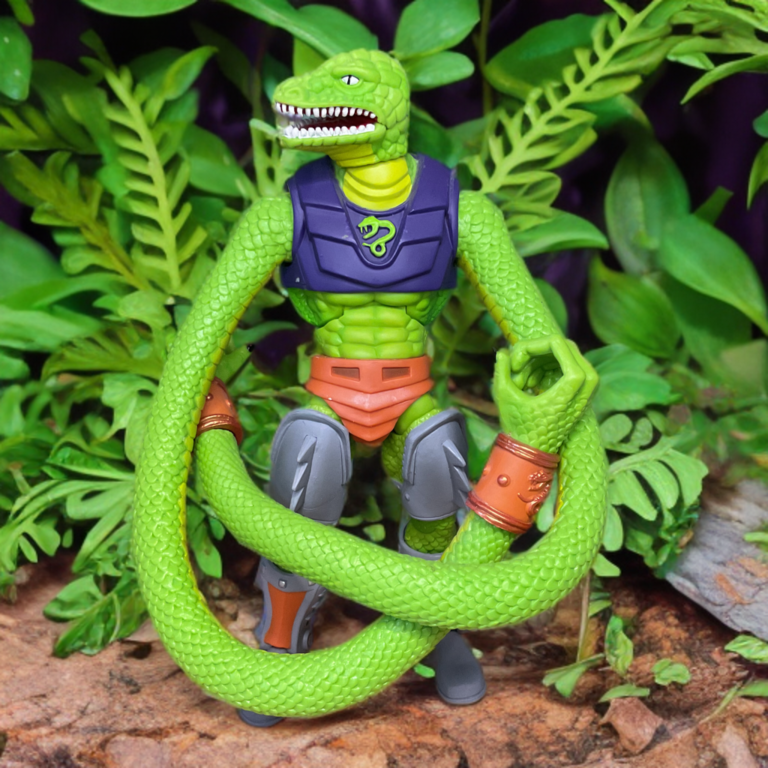
Rivalries pit him against Clamp Champ, master of captures, and Roboto, whose machinery resists constriction. He’s clashed with Beast Man over beast control. Sssqueeze’s endurance makes him a tank in fights, though speedsters like He-Man exploit his slowness. His loyalty is unwavering, making him a backbone of the army.
Snake Face: The Petrifying Gaze
Snake Face terrifies with snakes emerging from his face, turning victims to stone with their stares. His green armor and hooded eyes hide this horror until unleashed. Personality-wise, he’s arrogant and sadistic, delighting in foes’ frozen fear.
From ancient lineages, Snake Face honed his petrifying power in conquests. Freed, he targets key heroes, aiming to statue Eternia’s defenders. His ability requires eye contact, adding tension to encounters.
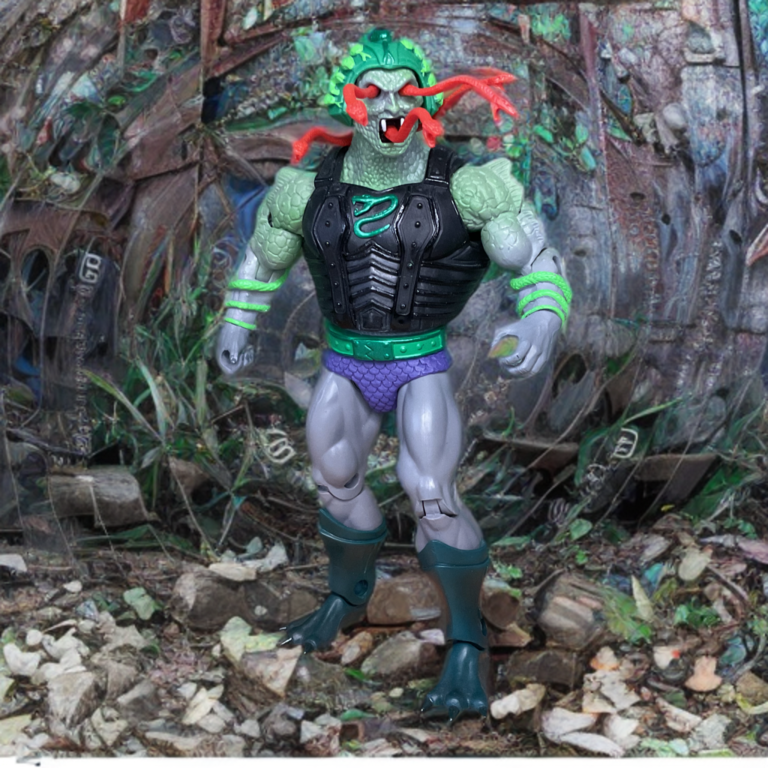
Rivalries include Mekaneck, whose extendable neck dodges gazes, and Man-E-Faces, matching transformations. He’s vied with Evil-Lyn for magical supremacy. Snake Face’s flair for drama—revealing snakes with flair—adds spectacle, but overreliance on his trick leaves him vulnerable when countered.
Camo Khan: The Veiled Infiltrator
Camo Khan is a cunning variant of the classic Kobra Khan lineage, enhanced through dark enchantment to embody deception and adaptability. His chameleon-like scaled body shifts colors seamlessly for perfect camouflage, paired with a hooded cobra head, hypnotic eyes, and upgraded venomous mist capabilities. Personality-wise, he’s sly, opportunistic, and treacherous—always scheming to advance his own position while serving the greater Snake Men cause. Originally a survivor or descendant of the ancient Snake Men like his predecessor Kobra Khan, Camo Khan received Skeletor’s dark blessing, granting him enhanced powers including superior camouflage, a more potent hypnotic mist, and the mystical Golden Claws of Crushing.
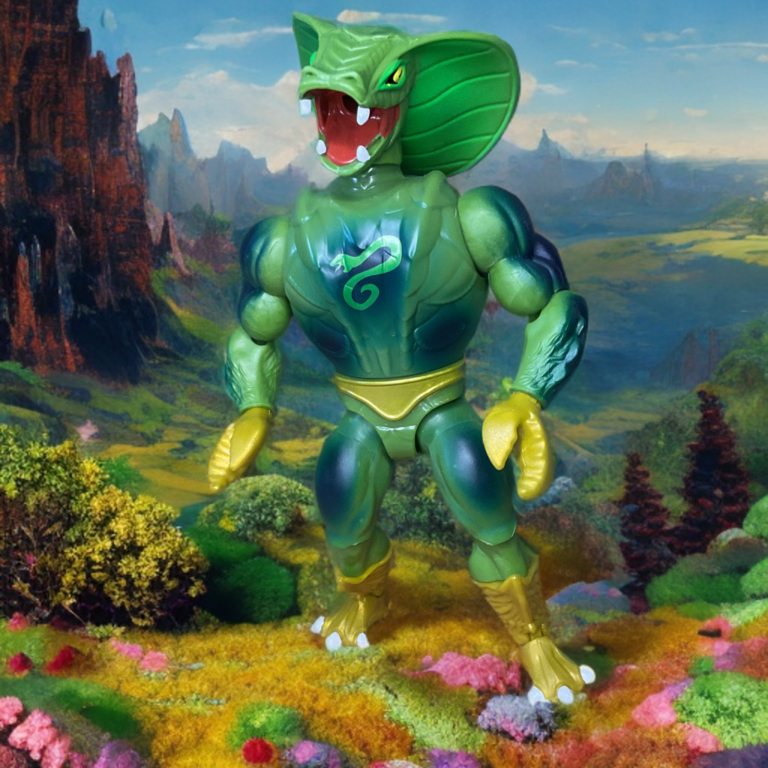
This upgrade made him a deadly infiltrator, allowing him to blend into any environment or battle. He operates as a master of disguise and sabotage, often working undercover to undermine enemies before striking. His abilities let him vanish in plain sight, disorient foes with blinding sprays, and deliver crushing blows with his enchanted claws. Camo Khan’s rivalries include heroic warriors like He-Man, whose raw power counters his subtlety, and figures like Man-At-Arms, whose tech detects his tricks. He maintains a tense alliance with Skeletor (who empowered him) but remains loyal to King Hiss’s vision, making him a wildcard who betrays when it suits the Snake Men’s supremacy. His elusive nature makes him a frustrating and dangerous foe.
Lord Gr’asp: The Venomous Strategist
Lord Gr’asp stands as the Snake Men’s master of strategy, a calculating commander whose intellect is as deadly as his appearance. His serpentine body is accented by a massive, crab-like crushing claw replacing one hand, a flowing cape, serpent-entwined staff, and ornate Snake Men shield—making him a striking, aristocratic figure among the reptilian horde. He is vilely cunning, manipulative, and ambitious, always plotting multi-layered schemes while maintaining an air of superiority. A high-ranking member of King Hiss’s elite, Lord Gr’asp rose through ruthless cunning during the ancient conquests, brokering temporary alliances (even with the Evil Horde) to further Snake Men dominance.
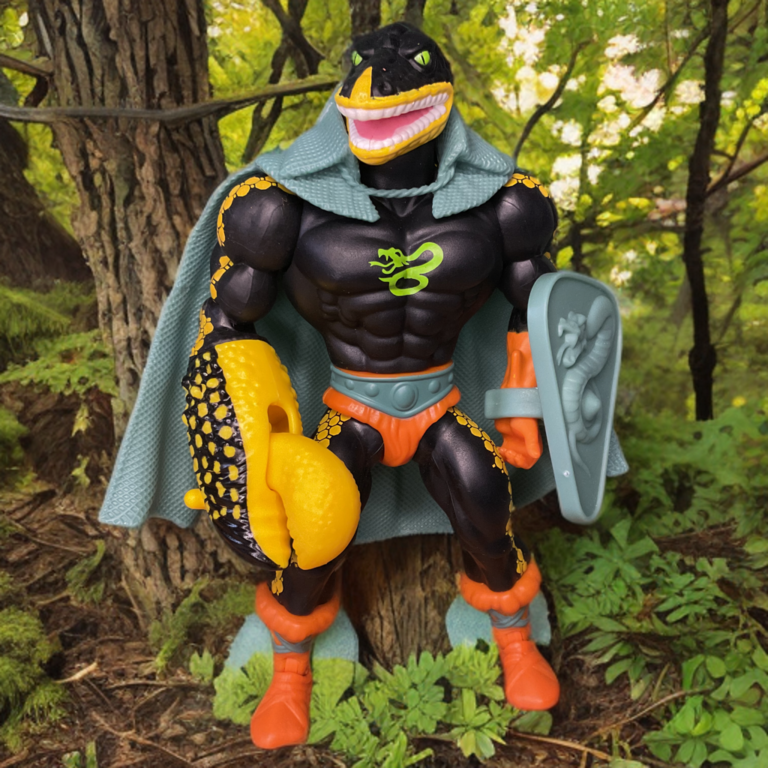
Known for his deadly captor claw that seizes and crushes foes, he excels at battlefield tactics, ambushes, and psychological warfare. His claw allows him to trap enemies in iron grips, while his strategic mind turns the tide in battles. Rivalries burn hottest with heroic tacticians like Man-At-Arms and Teela, whose disciplined defenses foil his plans, and opportunistic allies like Skeletor, whom he views as crude. Lord Gr’asp’s alliances are pragmatic—he will aid or betray anyone for advantage—but his ultimate loyalty lies with King Hiss and the restoration of Snake Men rule. His intellect makes him indispensable, yet his overconfidence in schemes often invites downfall.
Terroar: The Shapeshifting Shriek
Terroar is a terrifying, formless exile turned Snake Man asset, a chaotic being of adaptive horror. His patchwork appearance blends traits from multiple evil factions—serpentine scales, armored plates, jagged features, and multiple swappable arm weapons—reflecting his ability to assimilate characteristics from those around him. Personality-wise, he’s menacing, unpredictable, and sadistic, reveling in the fear his presence inspires. Banished from his homeworld of Melodian, Terroar arrived on Eternia as a shapeshifting entity without fixed form. Upon encountering the Snake Men, Evil Warriors, and Evil Horde, he absorbed their traits, becoming a hybrid monstrosity loyal to King Hiss.
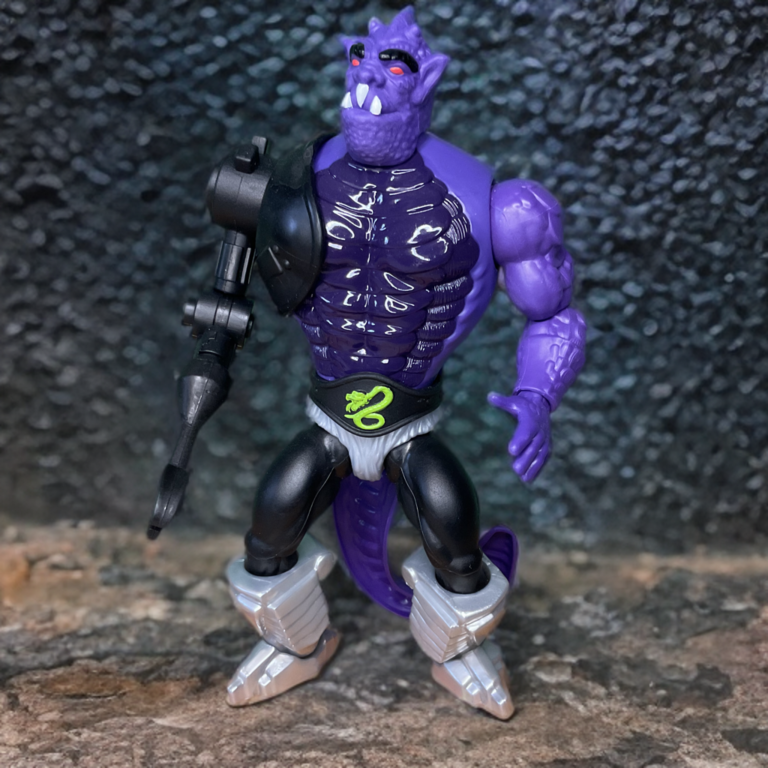
His signature ability is a deafening sonic roar (the “Sinister Shriek”) that disorients and paralyzes enemies, leaving them helpless for follow-up attacks. His shapeshifting allows him to morph limbs into weapons or adapt mid-battle. Terroar’s rivalries include sound-resistant heroes like He-Man, who can withstand his shrieks, and tech-savvy fighters like Man-At-Arms, who counter his chaos with gadgets. He clashes with structured villains like Hordak, viewing them as too rigid. As a living weapon of terror, Terroar serves as shock troop and psychological warfare specialist for the Snake Men, his ever-changing form making him nearly impossible to predict or defeat permanently.
Fang-Or: The Fearsome Fanged
Engineer Fang-Or is the Snake Men’s mechanical expert and fearsome warrior, a savage reptilian scientist whose design screams ancient Preternian menace. His snake-skinned body, beady green eyes, open-mouthed snarl displaying massive bone-white fangs, and mechanical enhancements mark him as both brute and inventor. He’s aggressive, inventive, and fanatically loyal, with a personality driven by destructive ingenuity. Hailing from the savage age of Preternia, Fang-Or serves as a loyal servant to King Hiss, specializing in engineering deadly devices and weapons for the Snake Men. His primary ability involves launching or extending his deadly fangs as projectiles or melee weapons, combined with mechanical expertise to create traps, enhancements, and serpentine machinery. He leads charges with cunning tactics and venomous strikes.
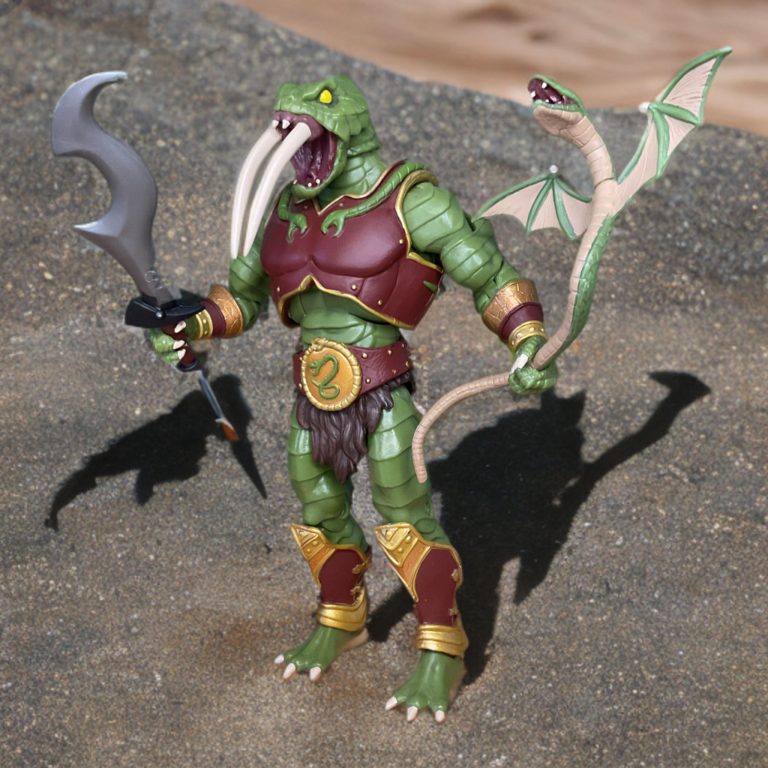
Rivalries include heroic engineers like Man-At-Arms, whose inventions counter his gadgets, and brute-force warriors like Fisto, who match his ferocity. Fang-Or aids in battles against Skeletor or the Horde when needed but always prioritizes Snake Men goals. His role as the faction’s tinkerer and fanged enforcer makes him a key asset in sieges and technological warfare, though his reliance on gadgets can leave him vulnerable when outmaneuvered. His savage design and fang-launching action make him a standout terror on the battlefield.
Fang-Or was originally designed for the MOTU Classics line as a lead engineer for the Snake Men.
Action Feature: Includes swappable fangs (short and long) to simulate his “rearing” attack.
Lore Detail: Known as the mechanic and weapon-smith for King Hiss; he is often seen with a wrench and specialized survival gear.
Collector Note: Look for the detailed “snake skin” texture on his harness, which distinguishes him from standard palace guards.
Vypor: The Sinister Embodiment of Viper Tower
Vypor is the dark, serpentine incarnation of pure evil, a fanatical Snake Man warrior who channels the malevolent power of the ancient Viper Tower itself. His appearance is striking and ominous: a towering cobra-like head with articulated jaw, intricate scale patterns, chains and tower-inspired motifs evoking the Viper Tower from Eternia’s mythic past, combined with a muscular serpentine body armored in classic Snake Men style. He exudes an aura of zealous menace, his design drawing directly from unproduced vintage concepts and Axel Giménez’s illustrations, brought to life in modern lines with enhanced detail and articulation. Personality-wise, he’s a fervent zealot—fanatically devoted to King Hiss and the Snake Men’s supremacy, matching his king’s extremism in his belief that the reptilian race are the chosen ones of the old gods.
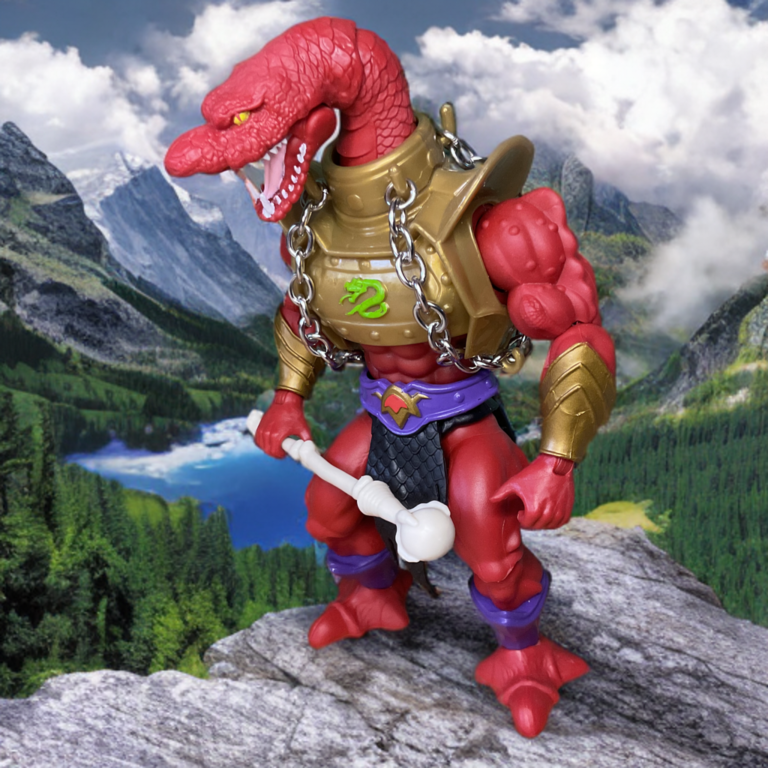
Emerging from the deep lore of Preternia, Vypor was conceptualized as a young apprentice to the evil wizard Ka who corrupted ancient sorcery to infuse himself with the sinister essence of Viper Tower (the evil-aligned counterpart to Grayskull Tower in Eternia’s legendary triad of towers). This transformation made him a living vessel of dark power, embodying the tower’s corrupting influence. In some expanded tales, he even served as a predecessor ruler to King Hiss, though viewed as a fool for once seeking peace with enemies—now fully embracing ruthless conquest. Released as a deep-cut character in the Masters of the Universe Origins line (based on planned but unreleased Classics designs), Vypor acts as a high-ranking enforcer and symbol of the Snake Men’s ancient, unyielding evil.
His abilities tie into his tower-embodied nature: potentially channeling dark energy blasts, hypnotic stares from his cobra hood, crushing constrictions, and venomous strikes, with his design suggesting mystical surveillance (like a living spy tower) and overwhelming presence on the battlefield. He serves as a psychological terror, reminding foes of the Snake Men’s primordial dominion.
Rivalries include heroic guardians like He-Man, whose pure strength shatters his dark enchantments, and figures such as Zodak or the Sorceress, who oppose the corrupting forces he represents. Vypor scorns alliances with “lesser” villains like Skeletor, seeing them as temporary tools at best. His unwavering fanaticism makes him a core pillar of King Hiss’s forces—dangerous, devout, and nearly impossible to sway—ensuring the Snake Men’s legacy of terror endures across Eternia.
Vypor is a fascinating character whose design is directly inspired by the vintage 1980s Snake Mountain and Viper Tower concepts.
Design Origin: His head sculpt is a literal 1:1 recreation of the stone snake head found on the unproduced Viper Tower playset.
Weaponry: Usually carries a snake-themed scythe or staff, mirroring the ancient architecture of the Snake Lair.
Lore Detail: He acts as a “living temple,” a mystical guardian of the Snake Men’s ancient secrets.
Lady Slither: The Serpent Empress
Lady Slither is the cold, regal matriarch of the Snake Men, commanding respect through both her terrifying physical presence and her sharp, tactical mind. Her most striking feature is her dual form: she possesses a humanoid torso that can transition into a massive, powerful snake tail. Her personality is one of calculating elegance and ruthless ambition; she is not just a warrior, but a conqueror who views the worlds she invades as her rightful nesting grounds.
Hailing from the venomous world of Fang-Or, Lady Slither acted as the high commander of the Snake Men during their campaigns across the stars. While King Hiss was imprisoned on Eternia, she maintained the empire’s strength elsewhere, building a formidable fortress and breeding new generations of serpent soldiers. Her magic is as potent as her venom, allowing her to transform others and manipulate the very environment to favor her cold-blooded kin.
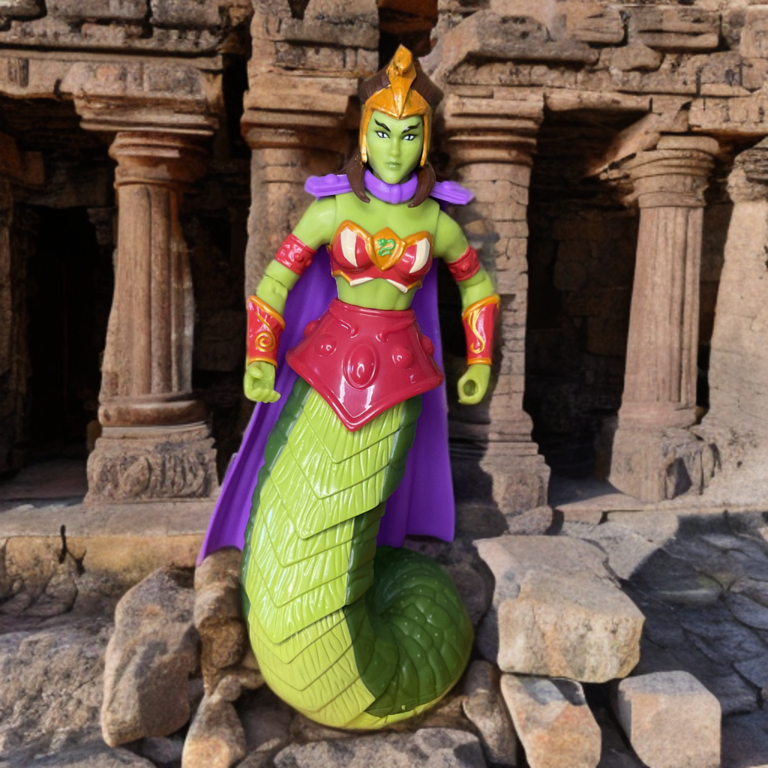
Rivalries flare with Sorceress Teela, whose divine power challenges Slither’s ancient sorcery, and She-Ra, who stands against her expansion into the Etherian frontier. She views King Hiss with a complex mix of loyalty and competitive friction, often believing her methods to be superior. Lady Slither’s patience is her greatest asset, willing to wait centuries to execute a perfect strike. Her arrival on a battlefield signals a shift from mere skirmishes to total planetary subjugation.
Necro-Conda: The Venomous Undead
Necro-Conda is a ghastly fusion of serpent biology and dark necromancy, serving as the literal “ghost” in the machine of the Snake Men army. Clad in tattered, spectral wrappings and eerie translucent armor, he exudes a chilling aura that can sap the warmth from his enemies. He is grim and hollow, speaking in raspy whispers that sound like dry scales sliding over stone. As a sentinel of the grave, he lacks the ego of his living peers, making him a relentless and unswerving soldier.
Created through the forbidden rituals of the Snake Altar, Necro-Conda represents the Snake Men who refused to stay dead. He is often summoned to guard sacred burial grounds or to hunt those who have escaped the reach of the living. His primary ability is his intangibility, allowing him to pass through solid walls and weapons, only to solidify at the moment of a lethal, venomous strike. He can also exhale a “Death-Mist” that induces paralyzing rot in organic matter.
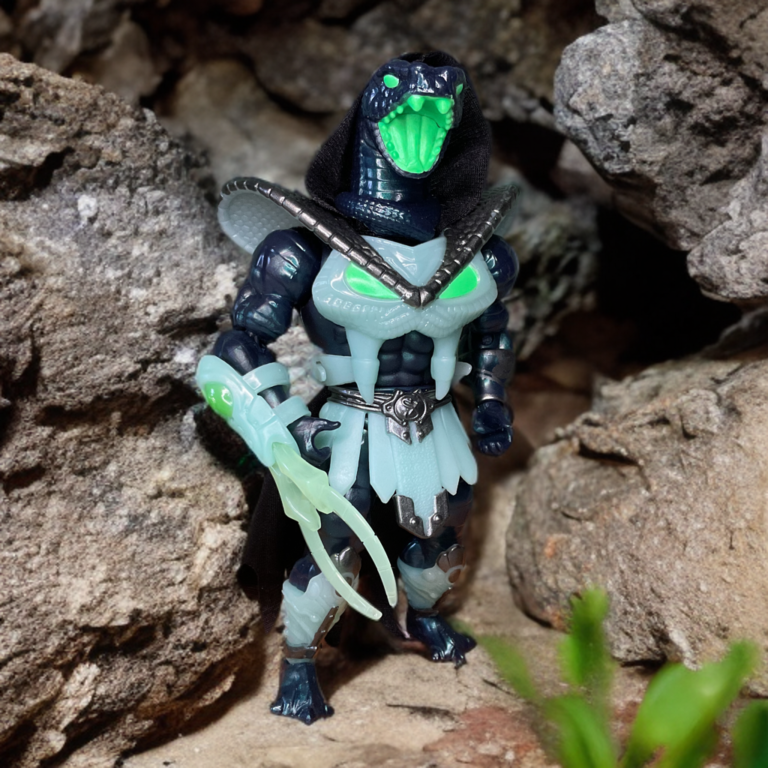
Rivalries include Scareglow, who views Necro-Conda as a competitor for the title of Eternia’s most feared spirit, and Sy-Klone, whose wind powers can disperse his ghostly form. He is frequently utilized by Skeletor when the Overlord of Evil requires a spy that no physical door can keep out. Necro-Conda’s lack of fear makes him terrifyingly effective, though his reliance on magical anchors means he can be banished by those wielding holy or ancient artifacts. He is the silent shadow of the serpent’s past, returned to haunt the present.
Necro-Conda is a standout from the modern Origins line, this character brings a “Glow-in-the-Dark” horror element to the faction.
Key Gimmick: Features Glow-in-the-Dark skin or armor accents, representing his ghostly, undead nature.
The “Snake-Wraith”: He wears a tattered soft-goods or plastic cloak, making him one of the few Snake Men with an “undead soldier” aesthetic.
Interchangeability: Includes a removable tail section that can be swapped with other Origins figures for custom “Naga-style” builds.
Reptilax: Mercenary Brute
Reptilax is officially designated as the “Mercenary Brute of the Snake Men.” While the character was originally a concept sketch by artist Axel Gimenez for the vintage line in the 1980s, he remained unproduced for decades. He finally entered the official canon through the Masters of the Universe Origins line in 2024. Physically, he is distinguished by his spiked, lizard-like head and a long serpent’s tail, which sets him apart from the more humanoid members of the faction.
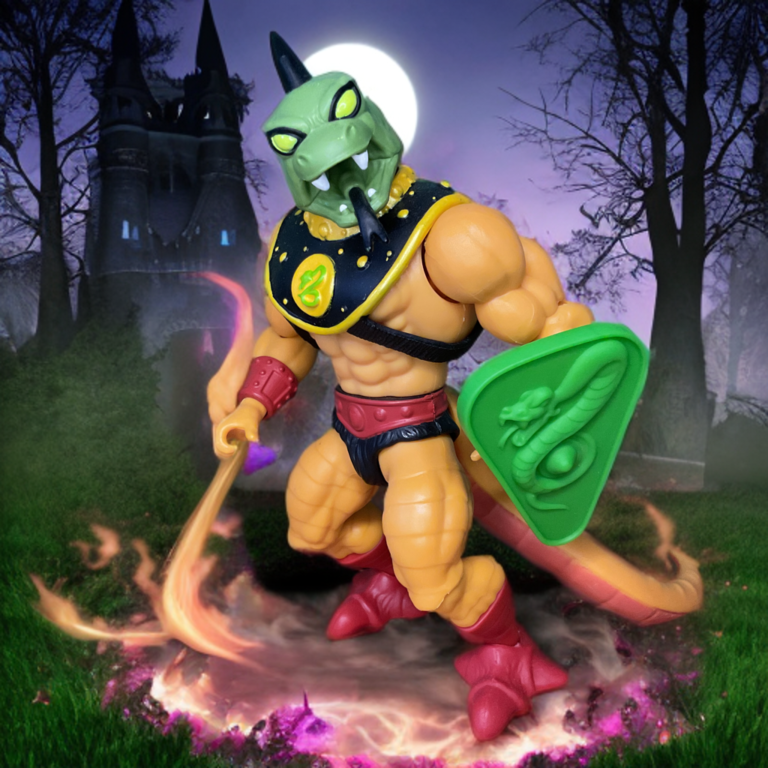
In terms of his rivalries and combat history, Reptilax is established as a power-hungry warrior who serves as a heavy hitter for King Hiss. His primary rivalries are centered around the Heroic Warriors of Eternia, as he is frequently depicted in mini-comics and cross-sell art participating in the invasion of Snake Mountain or clashing with He-Man’s allies to reclaim dominance for the Snake Men. As a “Mercenary Brute,” his role is often to provide overwhelming physical force against anyone standing in the way of the Snake Men’s resurgence.
Reptilax was first seen in the MOTU Classics mini-comics before making his way to the Origins line.
Distinct Sculpt: Unlike the slender snakes, Reptilax uses a beefier, “brute” body mold (similar to Whiplash or Clawful).
Signature Weapon: Carries a spiked mace and a shield emblazoned with the Snake Men sigil.
Lore Detail: Often portrayed as a mercenary-for-hire who joined King Hiss purely for the promise of conquest and “fresh meat.”
Slithor: The Whipping Warden
Slithor is a brutal enforcer known for his immense reach and his mastery of the “Lash of the Pit.” Characterized by his elongated, whip-like arms and deep-set, cruel yellow eyes, he serves as the primary jailer and taskmaster for the Snake Men. His personality is thuggish and domineering; he takes immense pleasure in the cracking of his whip and the subservience of those beneath him. Unlike the schemers of the group, Slithor is a direct agent of physical discipline and pain.
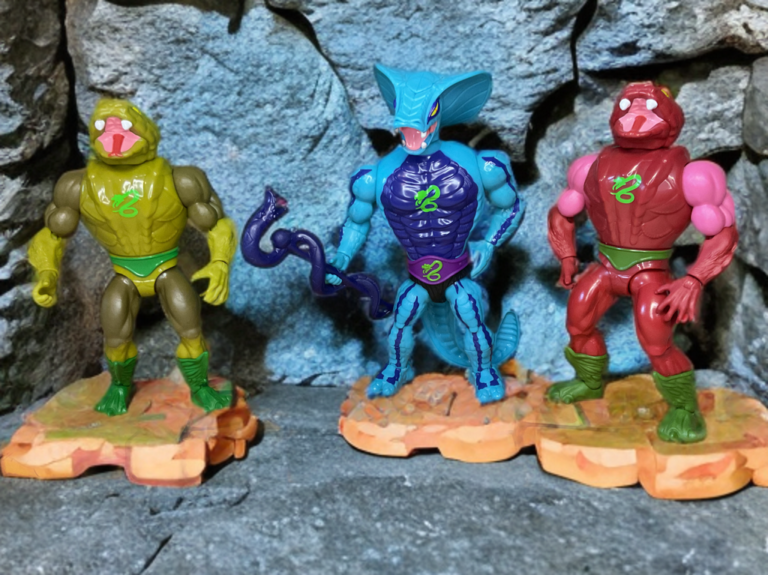
Rising through the ranks by crushing rebellions within the Snake Men’s slave pits, Slithor became King Hiss’s go-to operative for subduing large groups of prisoners. His arms are not just flexible; they are incredibly strong, capable of snapping thick timber or ensnaring a fleeing hero from across a battlefield. He specializes in crowd control, using his sweeping strikes to keep multiple opponents at bay while his venomous barbs deliver localized shocks to the nervous system.
Rivalries pit him against Fisto, whose iron fist can catch and hold his whipping limbs, and Clamp Champ, who seeks to turn Slithor’s own tactics of restraint against him. He has a long-standing grudge against He-Man, who famously shattered one of his primary obsidian lashes during a breakout. Slithor is often paired with Sssqueeze for “capture and contain” missions, though Slithor’s impatience often leads him to injure his prizes. He remains a feared figure on the battlefield, a reminder that for the Snake Men, mercy is a concept as cold as their blood.
Fang Man: Fanged Confusion
Fang Man is not a member of the Snake Men.
While his name and reptilian appearance often cause confusion—especially for casual fans—he is a distinct character with a very different origin.
Why the Confusion Happens
The confusion usually stems from Fang-Or, a much newer character introduced in the Masters of the Universe Classics and Origins lines.
Fang-Or: A high-tech engineer and a definite member of the Snake Men faction.
Fang Man: A classic Evil Warrior who serves Skeletor directly.

Similar to Lord Masque & Shokoti, Fang Man debuted in the 1980s Filmation cartoon. His specific episode is “The Time Corridor.” Here is the breakdown of his character:
Faction: He is one of Skeletor’s Evil Warriors, not a Snake Man.
Species: According to his MOTU Classics biography, he is a member of a species evolved from Dragosaurs (ancient dragon-like creatures), not the serpentine race of the Snake Men.
Abilities: He has the unique power to control and communicate with lower-level reptiles and Dragosaurs.
History: In the lore, Skeletor actually abandoned Fang Man in Eternia’s distant past on Dragosaur Isle, which explains why he didn’t appear in more episodes of the original series.
| Feature | Fang Man | Fang-Or |
| Faction | Evil Warriors (Skeletor) | Snake Men (King Hiss) |
| First Appearance | 1983 Filmation Cartoon | 2017 MOTU Classics |
| Skin Color | Light Blue | Yellow/Greenish |
| Species | Evolved Dragosaur | Snake Man |
| Key Accessory | The Wheel of Infinity | Mechanical tools and sword |
A Note on Ninjor
In the 2026 story-line “The Reptile Wars”, Ninjor is mutated by Mutagen Ooze into a winged, dragon-headed demon. This version of Ninjor is specifically armed with a snake-themed horned harness and features reptile-style claws. Nevertheless, there’s no connection with the Snake Men in this most recent version of the story.
Rivalries and Alliances: Coils of Conflict
The Snake Men have been at odds with both He-Man and Skeletor on different occasions. Their interactions define Eternia’s power dynamics. Primary rivals are the Heroic Warriors, heirs to Grayskull’s legacy. He-Man, with his strength, repeatedly foils their plans, earning King Hiss’s personal vendetta. Teela and Man-At-Arms counter their tactics with strategy and tech.
Skeletor represents a love-hate alliance; initial pacts dissolve into betrayal, as both vie for Snake Mountain. The Evil Horde views them as primitives, leading to skirmishes—Hordak’s hurricanes versus serpentine strikes.
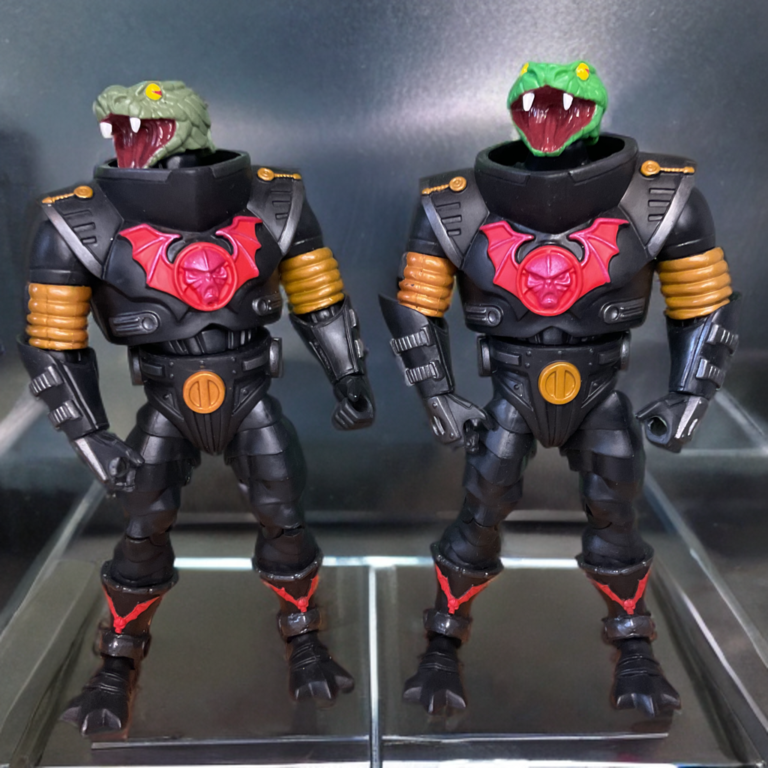
Internally, egos clash; Kobra Khan’s ambitions sometimes challenge King Hiss. Yet, unity prevails against outsiders. Alliances form opportunistically, like with Evil-Lyn for magic boosts, but always with betrayal in mind. These dynamics create rich narratives, where today’s ally is tomorrow’s prey.
Legacy in Plastic: Action Figure Releases
The Snake Men’s journey from lore to toy shelves began in the 1980s, evolving through lines. Collectors prize these figures for gimmicks like extending parts and vibrant colors. Below, a chart details releases with estimated 2026 aftermarket averages, based on eBay trends (prices in USD, approximate; vary by condition).
| Figure Name | Release Year/Line | Variants/Notes | Loose Average Price | Carded/MIB Average Price |
|---|---|---|---|---|
| Kobra Khan | 1984/Vintage | Evil Warrior, later Snake Men; water spray | $40-60 | $200-400 |
| Tung Lashor | 1986/Vintage | Extendable tongue | $30-50 | $150-300 |
| Rattlor | 1986/Vintage | Extendable neck, rattle tail | $35-55 | $180-350 |
| King Hiss | 1986/Vintage | Peel-away skin to snakes | $45-70 | $250-500 |
| Sssqueeze | 1987/Vintage | Extendable arms | $40-60 | $200-400 |
| Snake Face | 1987/Vintage | Pop-out face snakes | $50-75 | $220-450 |
| Kobra Khan | 2003/200X | Updated sculpt, spray feature | $25-40 | $100-200 |
| Rattlor (The General) | 2003/200X | Neck extension | $30-45 | $120-220 |
| King Hssss | 2004/200X | Snake reveal | $35-50 | $150-250 |
| Snake Hunter He-Man | 2004/200X | Hero variant, not core Snake Men | $40-60 | $180-300 |
| King Hssss | 2010/Classics | Detailed, snake form | $50-80 | $150-300 |
| Rattlor | 2011/Classics | Quick-strike | $45-70 | $140-280 |
| Kobra Khan | 2012/Classics | With Camo variant | $40-65 | $130-250 |
| Snake Face | 2013/Classics | Petrifying snakes | $55-85 | $160-320 |
| Sssqueeze | 2014/Classics | Long arms | $50-75 | $150-300 |
| Tung Lashor | 2015/Classics | Tongue whip | $45-70 | $140-280 |
| Lord Gr'asp | 2016/Classics | New character, claws | $60-90 | $180-350 |
| Terroar | 2017/Classics | Sonic scream | $55-80 | $170-320 |
| Kobra Khan | 2023/Origins | Retro style, spray | $20-35 | $50-100 |
| Rattlor | 2023/Origins | Neck extension | $25-40 | $60-120 |
| Tung Lashor | 2023/Origins | Tongue feature | $22-38 | $55-110 |
| Snake Face | 2023/Origins Deluxe | Pop-out snakes | $30-45 | $70-140 |
| Sssqueeze | 2024/Origins | Extendable arms | $28-42 | $65-130 |
| King Hiss | 2024/Origins | Snake reveal | $32-48 | $75-150 |
| Snake Trooper | 2023/Origins | Army builder | $18-30 | $45-90 |
| Snake Men Infiltrator | 2023/Origins | Stealth variant | $20-35 | $50-100 |
| Camo Khan | 2024/Origins Exclusive | Camouflage | $25-40 | $60-120 |
| Diabolical Snake Invasion Pack (King Hiss, Necro-Conda, etc.) | 2024/Origins Multipack | 4 figures | $80-120 (set loose) | $200-400 (boxed) |
NOTE: These prices reflect collector demand, with vintage items commanding premiums for nostalgia. Rarer variants, like exclusives, fetch higher. Always check condition—mint examples soar.
The Snake Men’s enduring appeal lies in their blend of horror and heroism-fodder. As Eternia’s saga unfolds, these serpents remind us: in the game of power, the coil tightens eternally.
The Eternal Coil: Why the Snake Men Endure
From the shadowed peaks of Preternia to the bright plastic shelves of today, the Snake Men have never truly been defeated—they have only waited. King Hiss and his serpentine legion embody something primal in the Masters of the Universe saga: the fear of what hides beneath a friendly face, the patience of ancient evil, and the thrill of an enemy that refuses to stay buried.
Their story is not one of simple conquest or cartoonish villainy. It is a tale of interstellar ambition clashing with Eternian resilience, of betrayals within betrayals, of venom that weakens both body and trust.
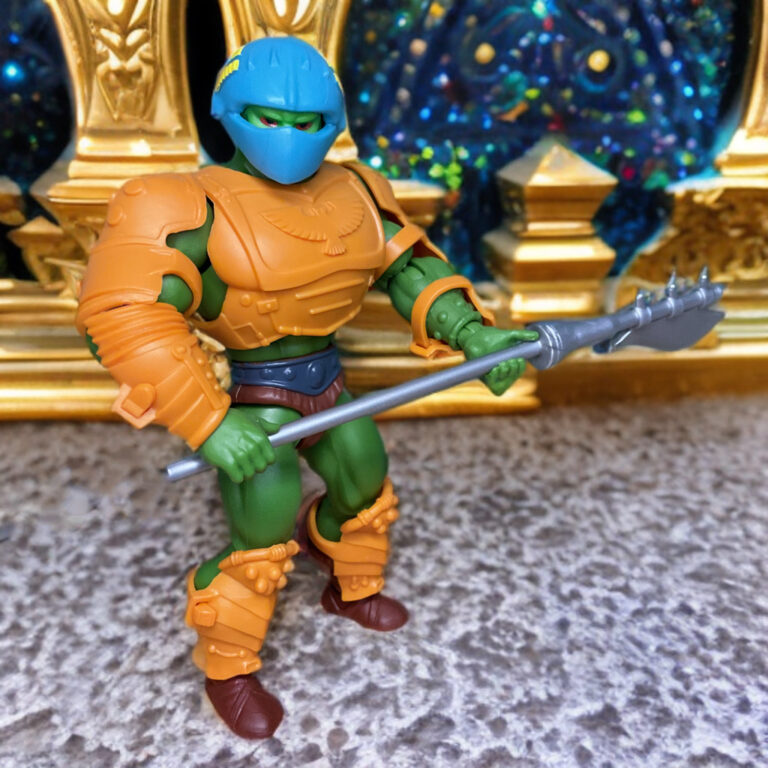
Whether King Hiss was peeling away his heroic disguise to reveal writhing snakes, Rattlor striking with seismic fury, Kobra Khan spraying hypnotic venom, or Sssqueeze crushing foes in unbreakable coils, each warrior brought a distinct flavor of dread to the battlefield. Together they forced He-Man and his allies to fight smarter, not just stronger—proving that even the mightiest hero can be undone by cunning as cold as reptile blood.
Decades later, the Snake Men remain one of the most collectible factions in MOTU history. Vintage figures still command premium prices for their bold gimmicks and nostalgic shock value. The 200X and Classics lines refined their menace with sharper sculpts and deeper articulation. Today’s Origins releases recapture that original magic while adding modern playability, ensuring new generations can experience the same gasp of delight (and horror) that kids felt in 1986 when they first lifted King Hiss’s armor to reveal the nightmare beneath.
In the end, the Snake Men are more than toys or antagonists. They are a reminder that some threats never fade—they shed their skin, adapt, and strike again when the world least expects it. So the next time you open a blister pack, arrange a vintage diorama, or watch an old minicomic unfold, listen closely. You might just hear the faint rattle of a tail… or the soft hiss of scales sliding across stone.
The serpents are always watching.
And they never forget.

 English
  Deutsch
  Français
  Português do Brasil
  日本語
日本語  Español
  English (Australia)